Pirene
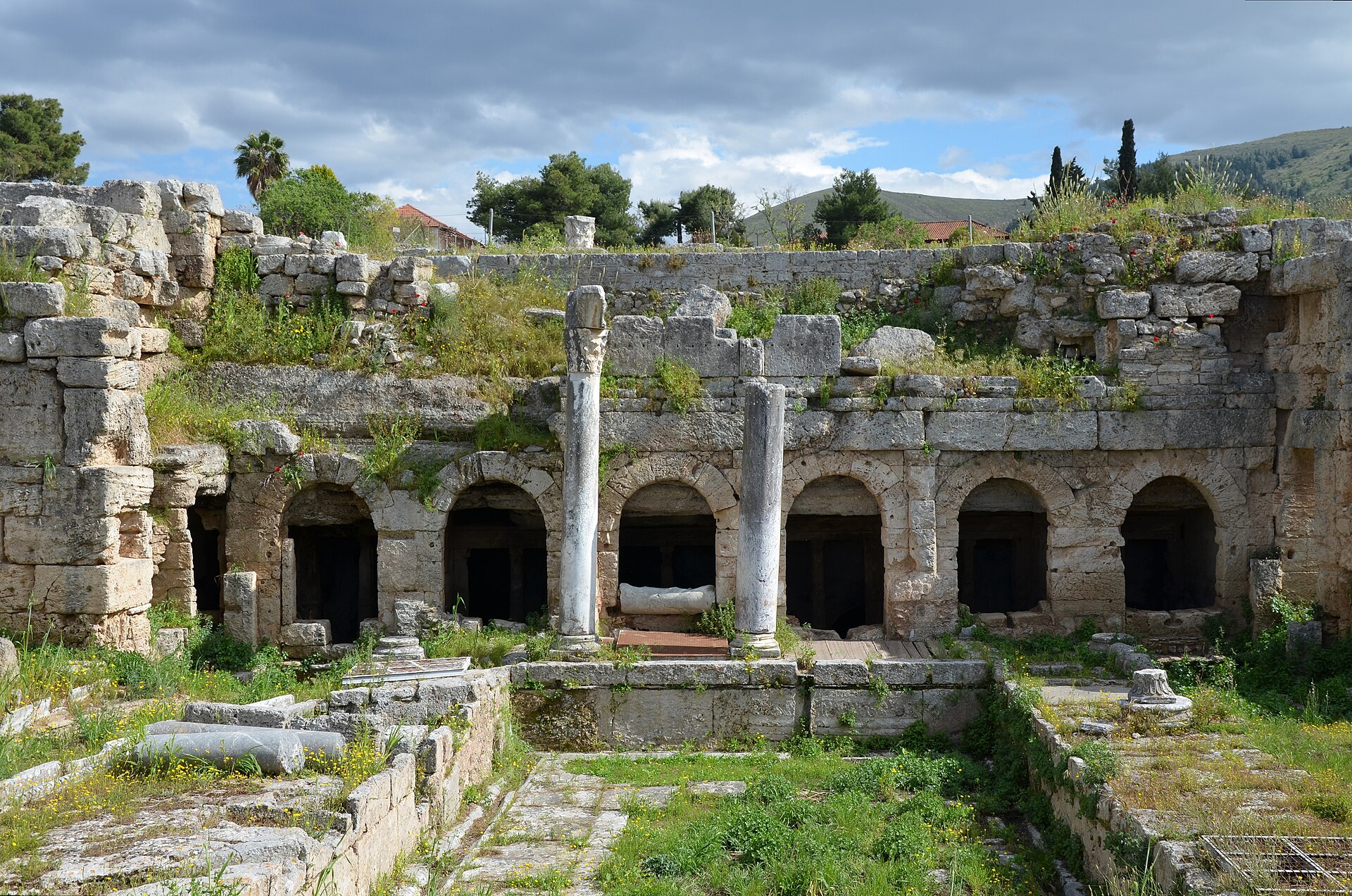
Pirene or Peirene (Greek: Πειρήνη) was a spring in ancient Corinth renowned in Greek mythology as a sacred watering place of Pegasus and the Muses. Poets journeyed there seeking to drink its waters and gain divine inspiration. Writing in the 2nd century AD, the traveler Pausanias recorded his observations of Pirene: The road from the marketplace toward Lechaeum leads to a gateway adorned with two gilded chariots—one bearing Phaethon, son of Helius, the other carrying Helius himself.
A short distance beyond the gateway, on the right side, stands a bronze statue of Heracles. Past this lies the entrance to Peirene's waters. According to local tradition, Peirene was once a woman transformed into a spring through her ceaseless weeping for her son Cenchrias, whom Artemis had accidentally killed.
The spring features elaborate white marble decoration, with cave-like chambers from which water flows into an open cistern. The water is refreshing to drink, and locals claim that Corinthian bronze, when heated red-hot, is tempered using this water—a resource unique to Corinth. Near Peirene stand an image and sacred precinct dedicated to Apollo, the latter containing a painting depicting Odysseus's revenge upon the suitors.
An alternative tradition holds that the fountain sprang forth when Pegasus's hoof struck the earth. However, the account Pausanias provides remained the dominant version of the myth. A second spring known as Upper Pirene, with its own origin story, exists on Acrocorinth, the fortified heights above the city.