Lafayette
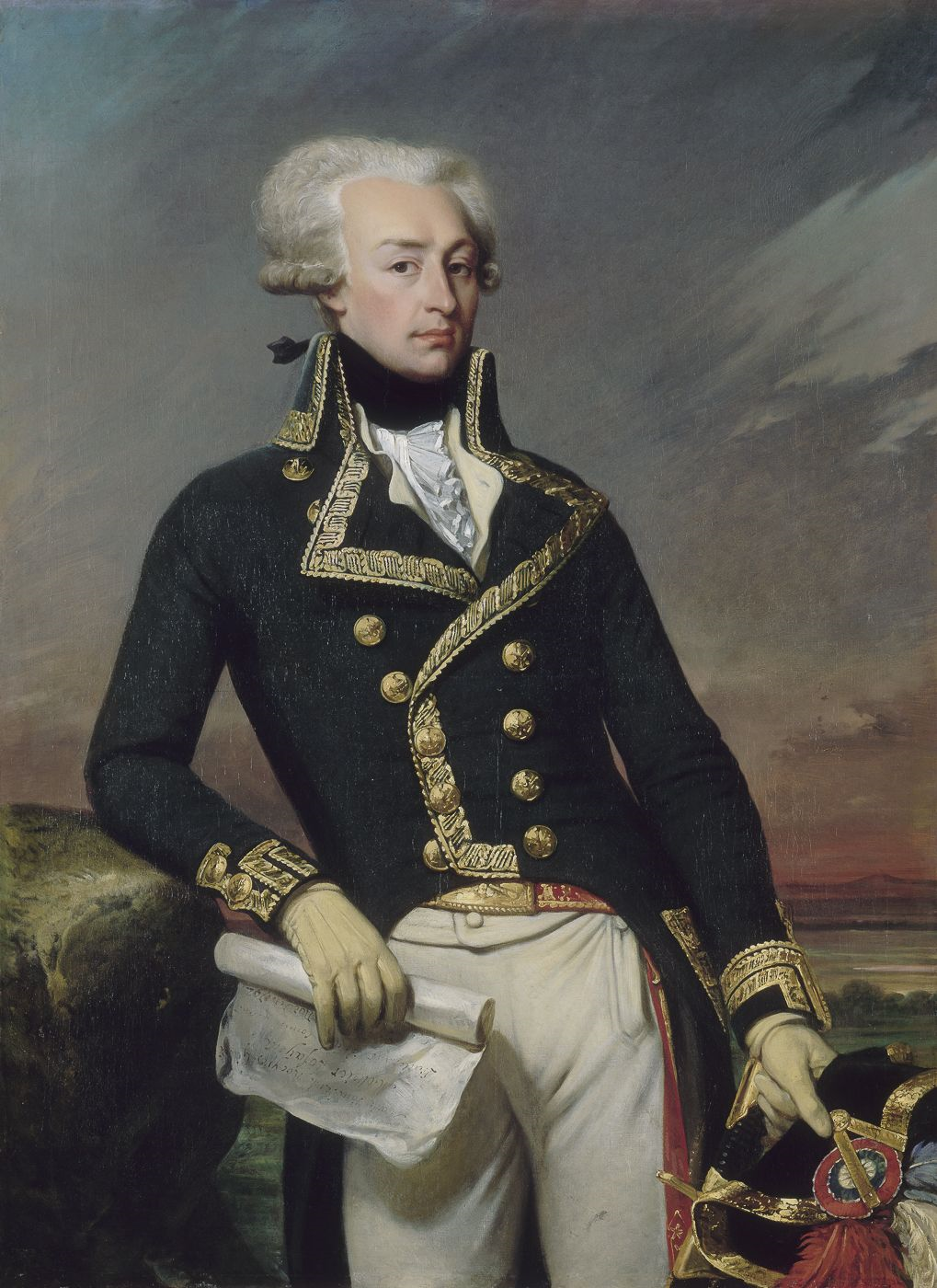
Marie-Joseph Paul Yves Roch Gilbert du Motier de La Fayette, Marquis de La Fayette (French pronunciation: [ʒilbɛʁ dy mɔtje maʁki d(ə) la fajɛt]; September 6, 1757 – May 20, 1834), known in the United States simply as Lafayette, was a French military officer, aristocrat, and politician who became one of the most celebrated figures of both the American and French Revolutions. He volunteered to join the Continental Army led by General George Washington during the American Revolutionary War despite his youth and aristocratic privilege, forming a lifelong bond with Washington that became almost filial in nature. Lafayette commanded Continental Army troops during the decisive siege of Yorktown in 1781, the Revolutionary War's final major battle, which secured American independence from Britain.
After returning to France, he became a prominent and controversial figure in the French Revolution of 1789 and the July Revolution of 1830, attempting to navigate a moderate constitutional path between radical republicanism and monarchical absolutism. He continues to be celebrated as a national hero in both France and the United States, earning the epithet "The Hero of the Two Worlds" for his service to both nations and his dedication to liberal constitutional principles and human rights. Lafayette was born into an extremely wealthy land-owning aristocratic family in the château of Chavaniac in the province of Auvergne in south-central France.
His family possessed ancient noble lineage and substantial estates, providing him with enormous inherited wealth when his father was killed in battle and other relatives died when he was young, leaving him one of the richest orphans in France. He followed his family's distinguished martial tradition and received a military commission as an officer at the remarkably young age of thirteen, typical of aristocratic military careers in ancien régime France. As a young man at the French court, Lafayette became increasingly dissatisfied with the frivolous aristocratic life and yearned for military glory and a meaningful cause.
He became convinced that the American colonists' revolutionary struggle against British rule represented a noble cause worthy of his support, embodying Enlightenment principles of liberty and natural rights that resonated with his idealistic temperament. In 1777, defying orders from the French king and his own family, the nineteen-year-old Lafayette traveled to the New World seeking glory in the American cause, purchasing his own ship to make the voyage and offering his services to the Continental Congress. Despite his youth, inexperience in actual combat, and inability to speak English fluently, he was commissioned a major general at age nineteen—initially an honorary rank granted partly due to his aristocratic status and partly to encourage French support for the Revolution.
However, Lafayette was not immediately given American troops to command, as Congress and Washington were uncertain whether this wealthy young French nobleman possessed genuine military abilities or was merely seeking adventure and status. Lafayette proved his courage and competence at the Battle of Brandywine near Chadds Ford, Pennsylvania, in September 1777, where he fought alongside American troops despite having no official command. He was wounded in the leg during the battle when British forces defeated and pushed back the Americans, but despite his injury, Lafayette helped organize an orderly retreat that prevented the defeat from becoming a complete rout, earning Washington's admiration and respect.
He subsequently served with distinction at the Battle of Rhode Island in 1778, demonstrating both personal bravery and growing tactical skill. These performances convinced Washington and Congress that Lafayette deserved actual command responsibility rather than merely an honorary commission. In the middle of the war, Lafayette returned to France in 1779 to lobby the French government for increased military and financial support for the American Revolution.
His advocacy, combined with French strategic interests in weakening Britain, contributed to France's decision to commit additional troops, naval forces, and financial resources to the American cause—support that would prove decisive in achieving independence. Lafayette returned to America in 1780 with news of this increased French commitment and was given senior command positions in the Continental Army, leading both American and French forces. In 1781, troops under Lafayette's command in Virginia conducted a brilliant campaign of maneuver and harassment against a larger British army led by Lord Cornwallis.
Though initially too weak to directly confront Cornwallis's superior forces, Lafayette skillfully avoided decisive battle while blocking British movements and preventing Cornwallis from achieving his objectives in Virginia. Through his tactical patience and strategic insight, Lafayette effectively trapped Cornwallis's army on the Yorktown peninsula until Washington's Continental Army forces marching from the north and French naval forces under Admiral de Grasse approaching from the sea could converge for the decisive siege of Yorktown in September-October 1781. This siege forced Cornwallis's surrender and effectively ended major military operations in the Revolutionary War, securing American independence.
Lafayette returned to France in 1782 as a celebrated hero of American independence and resumed his position in French aristocratic society, but now with enhanced prestige and a reputation as a champion of liberty. He was appointed to the Assembly of Notables in 1787, a body convened by King Louis XVI in a desperate attempt to address France's severe fiscal crisis and implement necessary reforms to the tax system and financial administration. When this proved insufficient and the crisis deepened, Lafayette was elected as a noble representative to the Estates-General of 1789, where delegates gathered from the three traditional estates or orders of French society: the clergy (First Estate), the nobility (Second Estate), and the commoners (Third Estate).
As the revolutionary crisis unfolded and the Third Estate broke away to form the National Constituent Assembly, declaring itself the legitimate representative body of the French nation, Lafayette played a significant role in drafting the Declaration of the Rights of Man and of the Citizen with assistance from his friend Thomas Jefferson, who was serving as American minister to France. This foundational document of the French Revolution was directly inspired by the United States Declaration of Independence, which Jefferson had primarily authored thirteen years earlier, and invoked natural law and Enlightenment principles to establish the basic rights and freedoms that should belong to all citizens in a democratic nation-state. Lafayette also advocated for the abolition of slavery throughout French territories, demonstrating consistency with the philosophy of natural rights and universal human dignity that animated both the American and French revolutionary movements, though this position put him at odds with powerful commercial interests dependent on colonial slave labor.
After the storming of the Bastille on July 14, 1789—the symbolic beginning of revolutionary violence—Lafayette was appointed commander-in-chief of the newly formed National Guard of France, a citizen militia designed to maintain order and protect the Revolution from both royalist counter-revolution and radical mob violence. Throughout the increasingly turbulent years from 1789 to 1792, Lafayette attempted to steer a difficult middle course between extremes, advocating for a constitutional monarchy modeled partly on British and American examples rather than either absolute royal power or radical republicanism. He sought to preserve the king as a limited constitutional monarch while protecting revolutionary gains and preventing both aristocratic reaction and radical terror.
This moderate position became increasingly untenable as the Revolution radicalized, and Lafayette found himself attacked by both royalists who viewed him as a traitor to his class and radical revolutionaries who saw him as an obstacle to more thoroughgoing social transformation. In August 1792, as radical Jacobin factions gained power and the Revolution entered its most violent phase, Lafayette's moderate constitutional monarchism made him a target. Radical leaders ordered his arrest on charges of counter-revolutionary activity and treason.
Recognizing the mortal danger he faced, Lafayette fled France and crossed into the Austrian Netherlands (modern Belgium), hoping to find refuge or passage to safety. However, instead of finding sanctuary, he was captured by Austrian troops who viewed him as a dangerous revolutionary responsible for destabilizing monarchical authority across Europe. The Austrians imprisoned Lafayette and held him in increasingly harsh conditions for more than five years, despite diplomatic efforts by Washington, Jefferson, and others to secure his release.
He endured solitary confinement, inadequate food and medical care, and was separated from his family, suffering health problems that would affect him for the rest of his life. Lafayette was finally released in 1797 after Napoleon Bonaparte, then rapidly rising to power as France's most successful military commander, negotiated with Austria and secured Lafayette's freedom as part of broader diplomatic arrangements. However, Lafayette refused to participate in Napoleon's increasingly authoritarian government despite Napoleon's offers of positions and honors, as Lafayette's commitment to constitutional republicanism and individual liberty made him deeply suspicious of Napoleon's dictatorial tendencies and imperial ambitions.
He retired to his estate and largely withdrew from public life during the Napoleonic period. After the Bourbon Restoration in 1814-1815, when the French monarchy was restored following Napoleon's defeat, Lafayette re-emerged as a prominent liberal voice in French politics. He was elected to the Chamber of Deputies, the lower house of the French parliament, and held this position for most of the remainder of his life, consistently advocating for constitutional limitations on royal power, expansion of voting rights, freedom of the press, and other liberal reforms.
In 1824, President James Monroe invited Lafayette to visit the United States as "the nation's guest" in recognition of his service to American independence nearly half a century earlier. Lafayette accepted and embarked on a triumphal tour that lasted over a year, during which he visited all twenty-four states then in the Union and received a rapturous reception everywhere he traveled. Enormous crowds gathered to see the aging hero of the Revolution, last surviving major general of the Continental Army, and personal friend of George Washington.
Cities held elaborate celebrations, veterans of the Revolutionary War met with their old commander, and the tour became a moment of national unity and remembrance that reinforced American identity and historical consciousness. Congress voted him a gift of $200,000 and 11,520 acres of land in recognition of his unpaid service and the personal fortune he had spent supporting the American cause. During France's July Revolution of 1830, when the restored Bourbon monarchy of Charles X collapsed in the face of popular uprising, the aging Lafayette once again played a significant role.
Revolutionary crowds and political factions offered him the position of French dictator, recognizing his prestige, military experience, and revolutionary credentials. Lafayette declined this authoritarian role, remaining committed to constitutional government rather than personal rule. Instead, he supported Louis-Philippe, Duke of Orléans, as a constitutional monarch who would respect civil liberties and parliamentary government, and Lafayette's endorsement proved crucial to Louis-Philippe's acceptance as the "Citizen King." However, Lafayette subsequently turned against Louis-Philippe when the new monarch proved increasingly autocratic, restricted political freedoms, and governed in ways that betrayed the liberal principles Lafayette had supported.
Lafayette spent his final years in opposition to the July Monarchy he had helped establish, consistently advocating for broader democratic reforms until his death. Lafayette died on May 20, 1834, at age seventy-six, and was buried in Picpus Cemetery in Paris in a grave literally covered with soil brought from Bunker Hill in Massachusetts—earth from the site of one of the American Revolution's early battles, symbolically reuniting him with the American cause that had defined so much of his life and legacy. His funeral attracted enormous crowds, and tributes poured in from both France and the United States.
He is remembered as "The Hero of the Two Worlds" for his extraordinary accomplishments in service to both French and American liberty, and his legacy as a champion of constitutional government, human rights, and transatlantic cooperation between democratic nations continues to resonate in both countries, where countless cities, streets, squares, and institutions bear his name in grateful remembrance.