Tarand
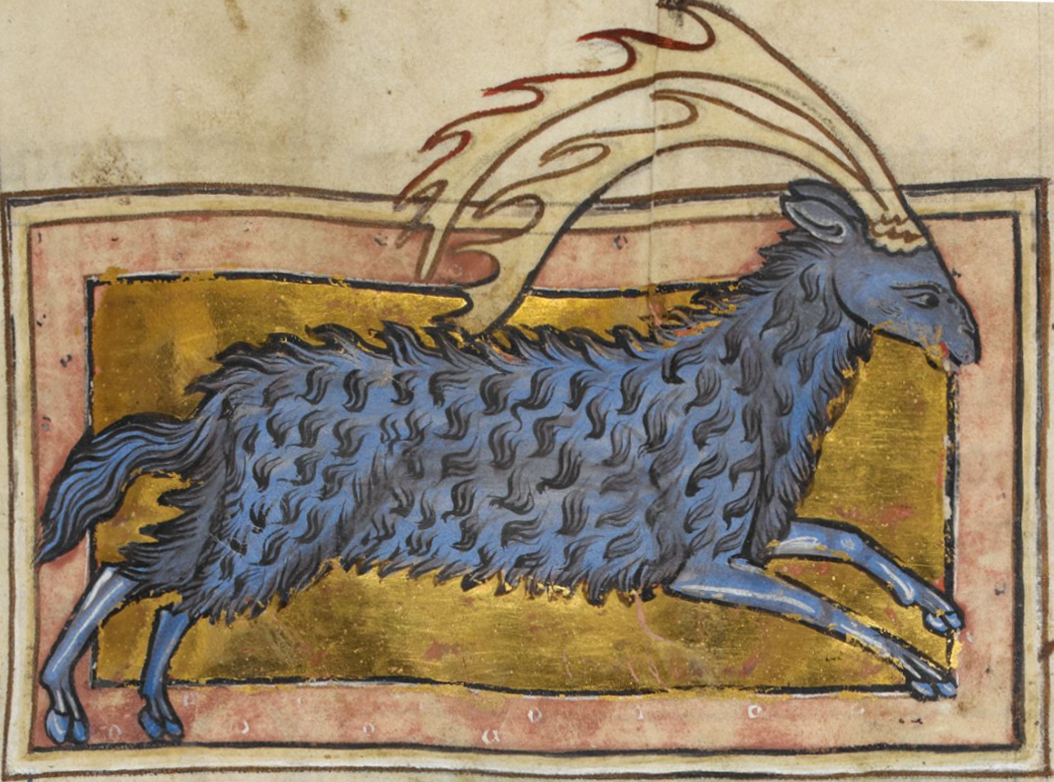
A tarand, also known as tarandos, tarandus, parandrus, or parandros, is a legendary creature resembling a reindeer or moose that possesses remarkable chameleon-like properties, able to change the color of its fur to match its surroundings. This mythical animal was first described in Aristotle's Corpus Aristotelicum as Tarandos (Τάρανδος), establishing it in the classical zoological tradition that blended observed natural phenomena with travelers' tales and legendary embellishments. The creature subsequently appeared in numerous influential ancient texts including Pliny the Elder's Natural History (where it is called Tarandus), Aelian's De Natura Animalium (Tarandos), Solinus' geographical writings (Parandrus), and Julius Caesar's works, demonstrating the wide circulation of this legend across the Greco-Roman world.
The tarand reappeared in key texts of the medieval period, including The York Mystery Cycle (1440) and François Rabelais' satirical novel Pantagruel (1552), showing the creature's enduring presence in European imagination. The veracity and zoological reality of the tarand was still being seriously debated as late as the early nineteenth century by the distinguished French naturalist Jean Léopold Nicolas Frédéric, Baron Cuvier (1769–1832), who examined classical sources to determine whether this legendary creature might correspond to any actual animal species. Ancient sources disagreed about the tarand's geographical habitat, reflecting the vague and often contradictory nature of classical geographical knowledge about distant lands.
Aristotle, Pliny, and Aelian wrote that the Tarandus inhabited Scythia—the vast territory north of the Black Sea encompassing the steppes of modern Ukraine, southern Russia, and Central Asia, which served in classical literature as a generic location for exotic northern peoples and creatures. Solinus, however, claimed that the animal he described (Parandus) lived in Aethiopia—a term that in ancient geography could refer to various regions of Africa south of Egypt or even to distant lands in the south generally, demonstrating the fluidity of ancient geographical concepts. Aristotle provided one of the earliest descriptions of this extraordinary creature: "Among the Scythians called Geloni they say that there is a beast, excessively rare, which is called tarandus; they say that it changes the colour of its hair according to the place it is in.
For this reason it is difficult to catch; for it becomes the same colour as the trees and the ground, and generally of the place in which it is. But the changing of the colour of the hair is most remarkable; other creatures change their skin like the chameleon and polypus. But this animal is of the size of an ox.
But its head is of the same kind as a deer." This account establishes the tarand's defining characteristic—its ability to change not merely its skin but the color of its hair itself to match surrounding vegetation, terrain, and objects, making it nearly impossible to hunt or capture. Pliny the Elder, writing in his Natural History (here in Philemon Holland's 1601 English translation), provided a detailed description immediately following his discussion of the chameleon, explicitly comparing the two creatures' color-changing abilities: "IN Scythia there is a beast called Tarandus, which chaungeth likewise colour as the Chamæleon: and no other creature bearing haire doth the same, unlesse it be the Lycaon of India, which (by report) hath a maned necke. As for the Thos (which are a kind of wolves somewhat longer than the other common-wolves, and shorter legged, quicke and swift in leaping, living altogether of the venison that they hunt and take, without doing any harme at all to men) they may be said, not so much to chaunge their hew, as their habite and apparell: for all winter time they be shag-haired, but in summer bare and naked.
The Tarandus is as bigge as an oxe, with an head not unlike to a stagges, but that it is greater, namely, carrying braunched hornes: cloven hoofed, and his haire as deepe as is the Beares. The hide of his backe is so tough and hard, that thereof they make brest-plates. He taketh the colour of all trees, shrubs, plants, flowers, and places wherein he lieth when he retireth for feare; and therefore seldome is he caught.
But when he list to looke like himselfe and be in his owne colour, he resembleth an Asse. To conclude, straunge it is that the bare bodies of a beast should alter into so many colours: but much more straunge it is and wonderfull, that the haire also should chaunge." Pliny's account adds significant physical details: the creature is ox-sized with a stag-like head bearing branched antlers, cloven hooves, and hair as thick as a bear's. Notably, he mentions the practical use of the tarand's extraordinarily tough hide for making breastplates—suggesting the Scythians hunted this rare creature despite the difficulty.
He also claims that when the tarand adopts its "natural" color, it resembles an ass, and he emphasizes the marvel that not just the skin but the hair itself changes color. Aelian offered a similar but slightly different description, emphasizing the military applications of the creature's hide: "... But the animal known as Tarandus transforms itself hair and all, and can adopt such an infinite variety of colours as to bewilder the eye.
It is a native of Scythia and its back and size resembles a bull; and the Scythians cover their shields with its hide and consider it a good counter to a spear." According to the Oxford English Dictionary, the first reference to the tarand in English literature appears in the medieval mystery play The York Mystery Cycle (circa 1440): "All þin vntrew techyngis þus taste I, þou tarand" (or in modern English: "All your untrue teachings thus I test, you tarand"). The context suggests "tarand" was being used metaphorically, possibly to mean something deceptive or changeable, reflecting the creature's reputation for transformation and elusiveness. The tarand received its most elaborate and entertaining literary treatment in Book 4, Chapter 2 of François Rabelais' comic masterpiece Pantagruel (1552), where the satirical author provided an extended description that blended classical learning with Renaissance natural philosophy and his characteristic wit: "A tarand is an animal as big as a bullock, having a head like a stag, or a little bigger, two stately horns with large branches, cloven feet, hair long like that of a furred Muscovite, I mean a bear, and a skin almost as hard as steel armour.
The Scythian said that there are but few tarands to be found in Scythia, because it varieth its colour according to the diversity of the places where it grazes and abides, and represents the colour of the grass, plants, trees, shrubs, flowers, meadows, rocks, and generally of all things near which it comes. It hath this common with the sea-pulp, or polypus, with the thoes, with the wolves of India, and with the chameleon, which is a kind of a lizard so wonderful that Democritus hath written a whole book of its figure and anatomy, as also of its virtue and propriety in magic. This I can affirm, that I have seen it change its colour, not only at the approach of things that have a colour, but by its own voluntary impulse, according to its fear or other affections; as, for example, upon a green carpet I have certainly seen it become green; but having remained there some time, it turned yellow, blue, tanned, and purple in course, in the same manner as you see a turkey-cock's comb change colour according to its passions.
But what we find most surprising in this tarand is, that not only its face and skin, but also its hair could take whatever colour was about it. Near Panurge, with his kersey coat, its hair used to turn grey; near Pantagruel, with his scarlet mantle, its hair and skin grew red; near the pilot, dressed after the fashion of the Isiacs of Anubis in Egypt, its hair seemed all white, which two last colours the chameleons cannot borrow. When the creature was free from any fear or affection, the colour of its hair was just such as you see that of the asses of Meung." Rabelais' account purports to be an eyewitness description, claiming he personally observed a tarand changing colors in response both to its surroundings and to its internal emotional states—fear, passion, and other "affections." This psychological dimension adds complexity to the creature's transformative abilities, suggesting voluntary control rather than purely automatic camouflage.
Rabelais also notes that the tarand can achieve white and red coloration that even chameleons cannot produce, and that in its neutral emotional state, it assumes the dun color of donkeys. Later in Pantagruel, the tarand is mentioned again as an exotic gift: "I have found here a Scythian tarand, an animal strange and wonderful for the variations of colour on its skin and hair, according to the distinction of neighbouring things; it is as tractable and easily kept as a lamb. Be pleased to accept of it." This passage presents the tarand not only as a rare zoological curiosity but as a domesticable creature "as tractable and easily kept as a lamb," adding another dimension to this legendary animal that combines the exotic with the familiar, the wild with the tame, and suggesting that despite its magical properties, it possessed a gentle temperament suitable for captivity.
The tarand legend represents a fascinating example of how classical and medieval natural history blended observation, misidentification, traveler's tales, and pure invention. Modern scholars generally believe the tarand legend may have originated from garbled reports of actual reindeer (whose scientific name, Rangifer tarandus, preserves the legendary creature's name), possibly combined with observations of seasonal coat color changes in various northern animals and exaggerated through repeated retelling across cultures and languages until a real animal was transformed into a creature of legend possessing supernatural camouflage abilities that exceeded anything found in nature.