Palatine Light
Palatine Light is a folklore legend from Block Island, Rhode Island, United States, dated to ~1738 AD (Early Modern era). It connects to 1 other myth and legends in the Mythosjourney atlas.
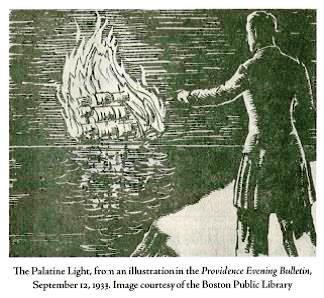
The Palatine Light is a famous maritime apparition—a spectral, flaming ghost ship said to haunt the waters near Block Island, Rhode Island. While the ghostly tale is a staple of New England folklore, it is firmly rooted in the very real, tragic 1738 shipwreck of the Princess Augusta.
In August 1738, the 220-ton British ship Princess Augusta set sail from Rotterdam under the command of Captain George Long. Aboard were fourteen crew members and 240 German immigrants from the Palatinate region, who were bound for Philadelphia with hopes of reaching a German settlement in Virginia. The journey quickly turned into a nightmare when the ship's water supply became severely contaminated, sparking a deadly illness that wiped out 200 passengers and half the crew, including Captain Long.
First Mate Andrew Brook took command as severe storms pushed the vessel far north of its route, forcing the survivors to endure three months of brutal weather. During this time, Brook mercilessly extorted the desperate passengers, demanding payment for the dwindling rations. On December 27, 1738, the battered and leaking ship wrecked in a blinding snowstorm at Sandy Point, on the northern tip of Block Island.
According to historical depositions, Brook and his crew rowed to safety, initially abandoning the surviving passengers aboard. The locals of Block Island intervened, eventually convincing Brook to let the passengers disembark the following day. The islanders helped retrieve their belongings and buried roughly twenty passengers who died shortly after reaching land. Today, a 1947 marker near the Mohegan Bluffs commemorates the Palatine Graves, though no physical remains have been found to fully substantiate the burial site or the wreck itself.
Shortly after the wreck, two conflicting versions of the night's events emerged. The islanders maintained that they acted valiantly, saving the survivors and providing critical aid. Conversely, because Block Island had an unsavory reputation as a haven for scavengers who supposedly lit false beacons to intentionally crash ships, mainlanders suspected the locals had lured the ship to shore to steal its cargo.
The ultimate fate of the ship is where history blends into myth. While some evidence suggests the ship might have been repaired, most historical accounts claim it was deemed unsalvageable, pushed out to sea, and set on fire. The most haunting part of the legend asserts that a passenger—often named Mary Van Der Line—was driven mad by the ordeal, refused to leave the vessel, and burned alive as it sank.
The folklore was cemented in the public consciousness in 1867 when renowned poet John Greenleaf Whittier published his poem, "The Palatine," after hearing the tale from a Newport folklore collector. To this day, some locals report seeing the fiery apparition of the ship sailing past Block Island on the Saturday between Christmas and New Year's Eve, with witnesses claiming to still hear the screams of the woman left behind.