Europa
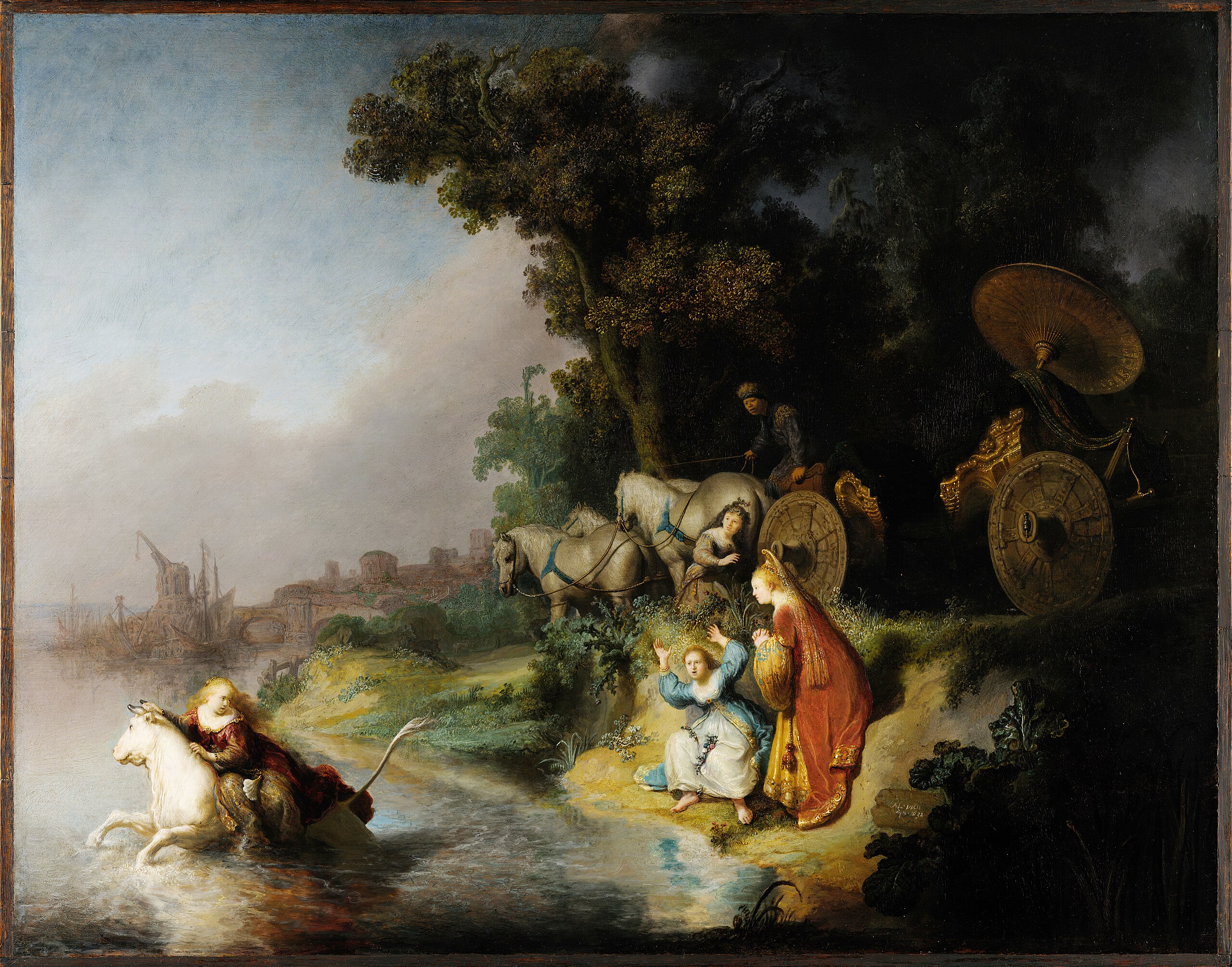
In Greek mythology, Europa (Ancient Greek: Εὐρώπη) stands as a foundational figure of the Cretan cycle, a Phoenician princess of Tyre whose abduction by Zeus served as the legendary catalyst for the establishment of European civilization. As the daughter of King Agenor, her narrative is primarily preserved through early literary fragments, such as the Hesiodic Catalogue of Women, and is visually attested in Greek pottery as early as the mid-7th century BC. The central myth recounts that Zeus, captivated by her beauty, manifested as a preternaturally tame white bull and integrated himself into her father’s royal herds.
While Europa was gathering flowers near the shore, she was lured by the creature's docility into mounting its back; at that moment, Zeus plunged into the Mediterranean, swimming to the island of Crete where he ultimately revealed his divine identity.
Upon her arrival in Crete, Europa became its first queen and the mother of three sons, most notably King Minos. To mark their union and ensure her protection, Zeus bestowed upon her several legendary artifacts: a necklace forged by the smith-god Hephaestus and a triad of supernatural guardians. These gifts included the bronze automaton Talos, who patrolled the Cretan shores; a javelin that never missed its mark; and the hound Laelaps, the infallible hunter whose later pursuit of the Teumessian fox would result in a cosmic paradox.
Zeus eventually commemorated the white bull’s form in the heavens as the constellation Taurus, a catasterism distinct from the later "Cretan Bull" associated with Heracles and the Minotaur.
Scholars often interpret the Europa myth through various analytical lenses, ranging from the theological to the rationalistic. Some mythologists suggest the story originated from the sacred union (hieros gamos) of the Phoenician deities 'Aštar and 'Aštart, noting that Europa's subsequent marriage to King Asterion—a name shared by the Minotaur and used as an epithet for Zeus—likely derives from these Semitic roots. Conversely, the 5th-century historian Herodotus offered a rationalized, "euhemerized" account, stripping the supernatural elements away to suggest that Europa was actually a Phoenician aristocrat kidnapped by Cretan sailors in a retaliatory cycle of bride-theft following the abduction of Io.
Whether viewed as a garbled historical account of Mediterranean raiding or a symbolic representation of the westward migration of culture and power, the figure of Europa remains an indelible link between the Near East and the classical foundations of the West.