Chimera
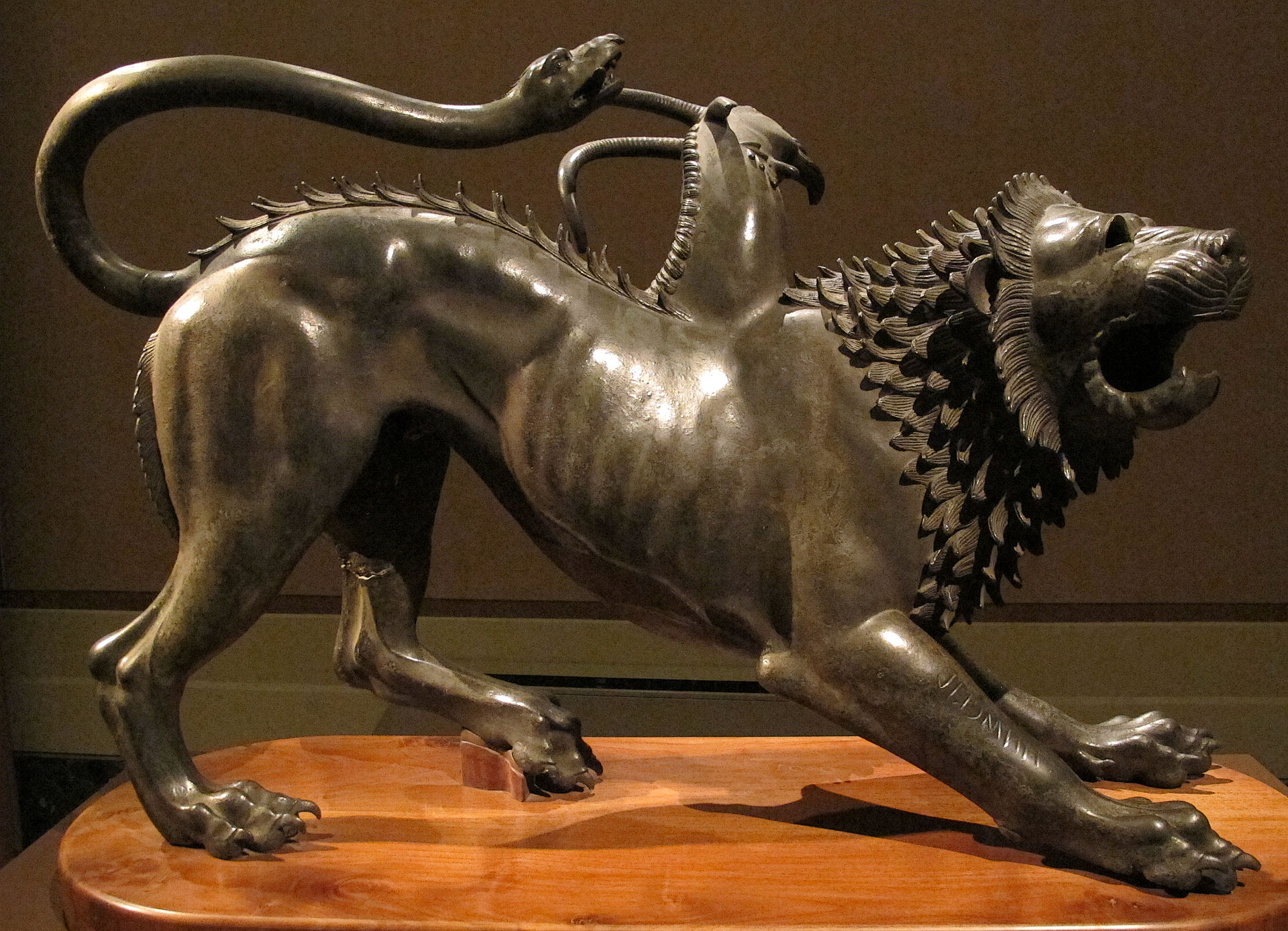
According to Greek mythology, the Chimera, Chimaera, Chimæra, or Khimaira (pronunciation: /kaɪˈmɪərə, kɪ-, -mɛər-/ ky-MEER-ə, kih-, -MAIR-; Ancient Greek: Χίμαιρα, romanized as Chímaira, literally meaning "she-goat") was a monstrous fire-breathing hybrid creature originating from Lycia in Asia Minor (modern-day southwestern Turkey), composed of parts from multiple different animals fused into a single nightmarish being that defied natural categories and embodied the ancients' deepest fears about the chaos and danger lurking beyond civilized boundaries. In its most typical and widely recognized iconographic form, the Chimera is depicted as having the powerful body of a lion—the apex predator symbolizing strength and ferocity—with a goat's head unnaturally protruding from the middle of its back, creating a grotesque secondary head that could attack from unexpected angles, and a tail that terminates not in normal leonine fur but in a living snake's head capable of independent movement and venomous strikes. This tripartite composition created a monster that could attack simultaneously from multiple directions, making it nearly impossible for heroes to defend against all its threats at once.
Some artistic representations and textual descriptions also attribute dragon's wings to the creature, granting it the terrifying additional ability of flight that would allow it to swoop down upon victims from above and escape pursuit by taking to the air, further multiplying the tactical advantages this already formidable monster possessed over any would-be slayer. Within the genealogy of Greek monsters, the Chimera occupied a position of particularly fearsome pedigree. It was the offspring of Typhon—the most deadly and powerful of all monsters in Greek mythology, a storm-giant who challenged Zeus himself for supremacy over the cosmos—and Echidna, the "Mother of All Monsters," a creature that was half beautiful woman and half monstrous serpent.
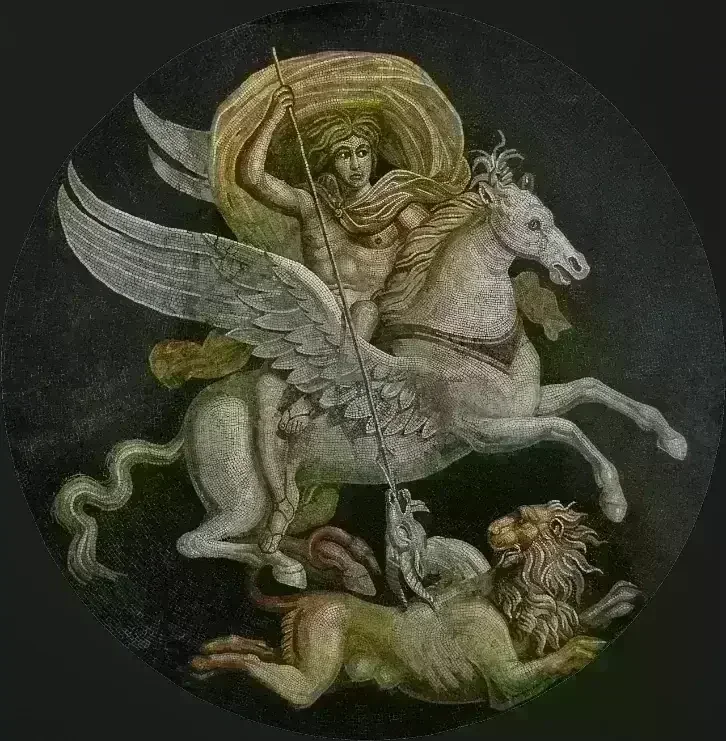
This parentage placed the Chimera among the most terrible beings of Greek mythology, making it a sibling to other legendary monsters including Cerberus (the multi-headed hound guarding the entrance to the underworld), the Lernaean Hydra (the many-headed water serpent slain by Heracles as one of his twelve labors), the Sphinx (which terrorized Thebes with its deadly riddles), and other creatures that represented fundamental threats to civilization and cosmic order. This family of monsters embodied the primordial forces of chaos and destruction that the Olympian gods and their heroic champions struggled to contain and overcome in establishing and maintaining ordered civilization. The Chimera was eventually slain by the Corinthian hero Bellerophon, who accomplished this seemingly impossible feat by riding the winged horse Pegasus, allowing him to attack the monster from above while remaining beyond reach of its lion's claws, goat's horns, and serpent's fangs.
According to the most famous version of the story, Bellerophon defeated the fire-breathing Chimera by mounting a lead-tipped spear or block of lead on his lance and driving it into the monster's throat or mouth; the creature's own fiery breath melted the lead, which then flowed down into its internal organs and killed it from within, demonstrating how the Chimera's own supernatural weapon could be turned against it through clever tactics. The term "chimera" has transcended its specific mythological origins to become a productive word in multiple domains of language and thought. In its broadest modern usage, "chimera" has come to describe any mythical or fictional creature composed of parts taken from various different animals—essentially any hybrid or composite monster, regardless of which specific animals contribute to the amalgamation.
By extension, the term can describe anything at all that is composed of disparate, seemingly incompatible parts or elements combined in unexpected or unnatural ways. It can also characterize ideas, proposals, or creative works perceived as wildly imaginative, highly implausible, fantastical, or dazzlingly inventive in ways that strain credibility or defy conventional categories. In biological and genetic contexts, "chimera" has acquired technical meaning referring to organisms containing cells from two or more distinct genetic lineages, whether occurring naturally through fusion of embryos or artificially created through genetic engineering—a usage that preserves the original mythological sense of an entity combining fundamentally different components into a single being.
In figurative usage derived from but distinct from the literal mythological meaning, "chimera" refers metaphorically to an unrealistic, unrealizable, wild, foolish, or vain dream, fantasy, notion, hope, or objective—something pursued with passion or dedication despite being fundamentally impossible or illusory, much like attempting to capture an actual mythical monster. When someone dismisses a proposal as "chimerical," they are characterizing it as a fanciful impossibility that may seem attractive or inspiring but cannot actually be achieved or realized in practice, warning against wasting time, resources, or hope on pursuing goals that have no genuine prospect of success. This figurative usage carries connotations of self-deception, impracticality, and the human tendency to be seduced by attractive impossibilities, preserving in metaphorical form the ancient Greek understanding of the Chimera as a creature that should not exist, that violated natural order, and that represented dangerous illusions that could destroy those foolish enough to pursue or believe in them without the divine assistance and tactical brilliance that Bellerophon required to overcome the actual monster.