Poludnitsa
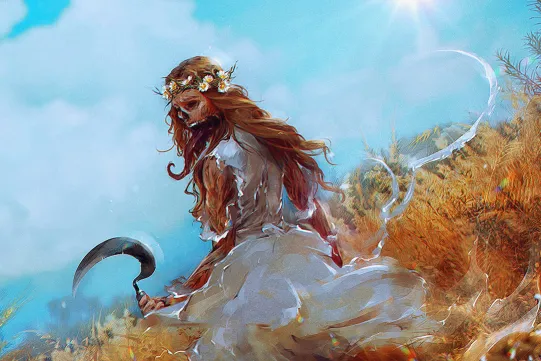
The Poludnitsa (derived from the Slavic poluden, meaning "midday") was a formidable noon demon common to the folklore of Eastern Europe, serving as a lethal personification of sunstroke and the shimmering heat of the summer harvest. Known variously as Lady Midday, the Noonwraith, or the Noon Witch, she was traditionally envisioned as a young woman dressed in stark white who roamed the boundaries of grain fields during the hottest hours. In certain mythological frameworks, she occupied a celestial hierarchy as one of the four sisters of the stars, representing the midday sun alongside Zarya-Zarenitsa (the morning star) and Kupalnitsa (the night star).
While she often appeared as a beautiful maiden, she was also capable of manifesting as an old hag or a young girl, sometimes taking the form of a whirling dust cloud to travel across the plains.
As a guardian of the harvest and an enforcer of the traditional midday rest, the Poludnitsa was a source of profound dread for agricultural workers. Armed with a scythe, a sickle, or a pair of archaic shears, she would accost those who dared to work during the heat of noon, inflicting them with debilitating neck aches, heat exhaustion, or sudden madness. Her interactions with humans were often structured around a high-stakes test of wit; she was known to stop travelers to demand answers to difficult questions or engage them in complex conversation.
Those who failed to answer correctly or attempted to change the subject were met with swift violence, often resulting in decapitation. Conversely, she possessed a more playful, though no less dangerous, side, frequently challenging girls to dancing contests. While she was reportedly impossible to beat, legend held that any mortal capable of out-dancing her would be rewarded with a magnificent dowry.
Regional variations of the myth highlight the entity’s dual role as both a destroyer and a protector of the land. In Northern Russia, she was described carrying a giant frying pan, used either to shield the ripening rye from the sun or to incinerate the crops during their flowering period. In German-speaking Lusatia and Brandenburg, she was known as the Mittagsfrau or the Roggenmuhme ("Lady of the Rye"), a bugbear used to frighten children away from trampling valuable grain.
Perhaps the most ethereal variant was found in Upper Silesia: the Chabernica, or Cornflower Wraith. Dressed in azure with cornflowers in her hair, she punished those who disrespected the fields by whispering them into a deep sleep, subsequently causing paralysis or physical injury. Whether viewed as a tragic specter or a ruthless guardian of the "Angelus" hour, the Poludnitsa remains a primary example of the "noon demon" motif, representing the perilous threshold between human industry and the overwhelming power of the natural world.