Sejong the Great(세종)
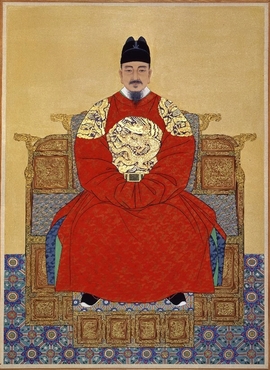
Sejong (Korean: 세종; Hanja: 世宗), born May 15, 1397, and deceased April 8, 1450, is commonly known as Sejong the Great (세종대왕; 世宗大王) and served as the fourth monarch of the Joseon Dynasty. He reigned from 1418 until his death in 1450, presiding over what is widely considered the golden age of Korean civilization. Sejong's legacy rests primarily on his creation of Hangul, the native alphabet of the Korean language, which democratized literacy and enabled Koreans to express their language in written form independent of Chinese characters.
This singular accomplishment, combined with his patronage of science, technology, medicine, and agriculture, his military successes in securing Korea's borders, his implementation of progressive economic reforms, and his sophisticated diplomacy, established Sejong as not only Korea's greatest king but as one of the most accomplished monarchs in world history. Sejong was born the third son of Yi Pang-wŏn, who would become King Taejong and reign from 1400 to 1418. As the third son in a Confucian society practicing primogeniture, Sejong's path to kingship was far from predetermined.
From youth, he demonstrated exceptional intellectual gifts and scholarly aptitude that distinguished him from his older brothers, particularly the troubled crown prince Grand Prince Yangnyŏng, who displayed erratic behavior and disregard for Confucian proprieties. In mid-1418, after years of growing alarm about Yangnyŏng's fitness to rule, King Taejong deposed him as crown prince and designated Sejong as successor despite his junior status. Months later, Taejong abdicated in favor of Sejong, who was crowned king at age twenty-one.
Taejong retained substantial influence as king emeritus until his death in 1422, providing Sejong with invaluable guidance during the crucial early years of his reign. Sejong's thirty-two-year reign was marked by extraordinary developments across virtually every domain of Korean civilization. What distinguished Sejong from many royal patrons was not merely his support for scholarly projects but his active personal participation.
In 1420, early in his reign, Sejong reestablished the Hall of Worthies (Jiphyeonjeon), a government research organization that became the institutional foundation for many of the reign's most significant achievements. The Hall oversaw numerous groundbreaking projects including Ch'ilchŏngsan, the first astronomical calendar developed specifically for Korea's geographical location; Ŭibangyuch'wi, a monumental 365-volume medical encyclopedia; and Nongsa chiksŏl, an agricultural manual adapted to Korean conditions that helped increase agricultural productivity. The most revolutionary achievement of Sejong's reign was his creation of Hangul, the Korean alphabet, promulgated in 1443 and officially published in 1446 as Hunminjeongeum ("The Correct Sounds for the Instruction of the People").
Before Hangul, written Korean relied entirely on Chinese characters, which required years of study and effectively limited literacy to the aristocratic elite. Sejong recognized this as both unjust and inefficient, preventing the vast majority of Koreans from accessing written knowledge. Hangul consisted of 28 letters (reduced to 24 in modern usage) specifically designed to represent Korean sounds with scientific precision.
The system was elegantly simple and could be learned in days rather than years, potentially enabling universal literacy. Sejong personally oversaw its development, explaining in the preface that he created the alphabet because he pitied common people who had thoughts to express but lacked means to write them. Despite fierce resistance from conservative scholars who viewed Chinese characters as markers of civilization and feared losing their monopoly on literacy, Hangul's creation represented one of the most significant achievements in the history of writing systems and would eventually enable nearly universal literacy in modern Korea.
In 1419, Sejong demonstrated decisive military leadership by launching the successful Ōei Invasion against the Japanese island of Tsushima, which had become a base for pirates raiding Korean coastal communities. The Korean expeditionary force decisively defeated the pirates and destroyed their bases. Rather than attempting permanent occupation, Sejong pursued diplomatic engagement that established trade relations and initiated decades of relatively peaceful commerce between Korea and Japan.
Sejong also undertook major military campaigns to expand Korea's northern borders against Jurchen tribes inhabiting Manchuria. Through military expeditions, fort construction, resettlement programs, and assimilation policies, he pushed Korean control northward to approximately the current border along the Yalu and Tumen rivers—borders that have largely endured for six centuries. In foreign relations, Sejong demonstrated sophisticated diplomatic skill in maintaining positive relations with Ming China while asserting Korean autonomy.
The Joseon Dynasty existed within the Chinese tributary system, which required periodic missions bearing tribute and formal acknowledgment of Chinese superiority. Sejong skillfully navigated this system, performing necessary ritualistic submissions while maintaining substantial Korean independence, asserting Korean positions when vital interests were at stake while avoiding unnecessary confrontations. Domestically, Sejong implemented significant tax and land reforms designed to reduce corruption and improve agricultural productivity.
His reforms introduced more equitable tax assessment methods, reduced overall tax rates, and implemented oversight mechanisms to reduce official corruption. Remarkably, these reforms reduced tax burdens on peasants while maintaining government revenues—a success attributable to increased agricultural production and reduced corruption. Sejong also led a massive expansion of Neo-Confucianism's influence and corresponding decrease in Buddhism's social and political power, promoting Confucian education and reducing Buddhist institutions' resources and influence.
However, Sejong was privately Buddhist despite his public policies, and as he aged he increasingly vocalized his Buddhist faith, creating tension with orthodox Confucian officials at court. Sejong suffered from recurring health problems throughout much of his life, particularly during his later years, experiencing diabetes-related symptoms, vision problems leading to near-blindness, and various other ailments. Beginning in 1445, recognizing his declining capacity, he delegated daily administrative affairs to the crown prince, his eldest son who would become King Munjong.
Sejong died on April 8, 1450, at age fifty-two and was buried in the royal tomb Yeongneung. In contemporary South Korea, Sejong is regarded as the supreme icon of Korean cultural achievement and national identity. His image appears on the 10,000 won banknote, numerous statues honor his memory, and Sejong City—South Korea's administrative capital established in 2012—bears his name.
His creation of Hangul is commemorated annually on Hangul Day. This extraordinary veneration reflects South Korean recognition that Sejong's achievements provided essential foundations for Korean national identity. In contrast, some North Korean texts reportedly evaluate Sejong more skeptically through Marxist-Leninist analysis as a feudal oppressor, though even these sources generally acknowledge Hangul's significance and his cultural contributions.