Jazirah al-Tennyn
Jazirah al-Tennyn (Arabic: جزيرة التنين, literally "Island of the Dragon" or "Sea Serpent Island") is a legendary island from medieval Arabic geographical and cosmographical literature, said to lie somewhere in the Indian Ocean off the Arabian Peninsula's coast, protected or menaced by fearsome sea serpents or dragons that gave the island its evocative name. The island became associated with the legendary exploits of Alexander the Great (known in Arabic as Iskandar or Dhu'l-Qarnayn), who according to medieval Islamic versions of the Alexander Romance performed heroic deeds liberating various peoples from monstrous oppressors during his supposed travels to the ends of the earth. Modern scholars have speculated about possible real-world identifications for this legendary island, with some suggesting it may refer to or have been inspired by Yemen's Socotra Island (Arabic: Suquṭrā), a large, ecologically unique island in the Arabian Sea famous since ancient times for its endemic dragon's blood trees (which produce a blood-red resin), its distinctive flora and fauna found nowhere else on earth, its strategic location on ancient maritime trade routes, and its appearance in various ancient and medieval geographical texts under different names.
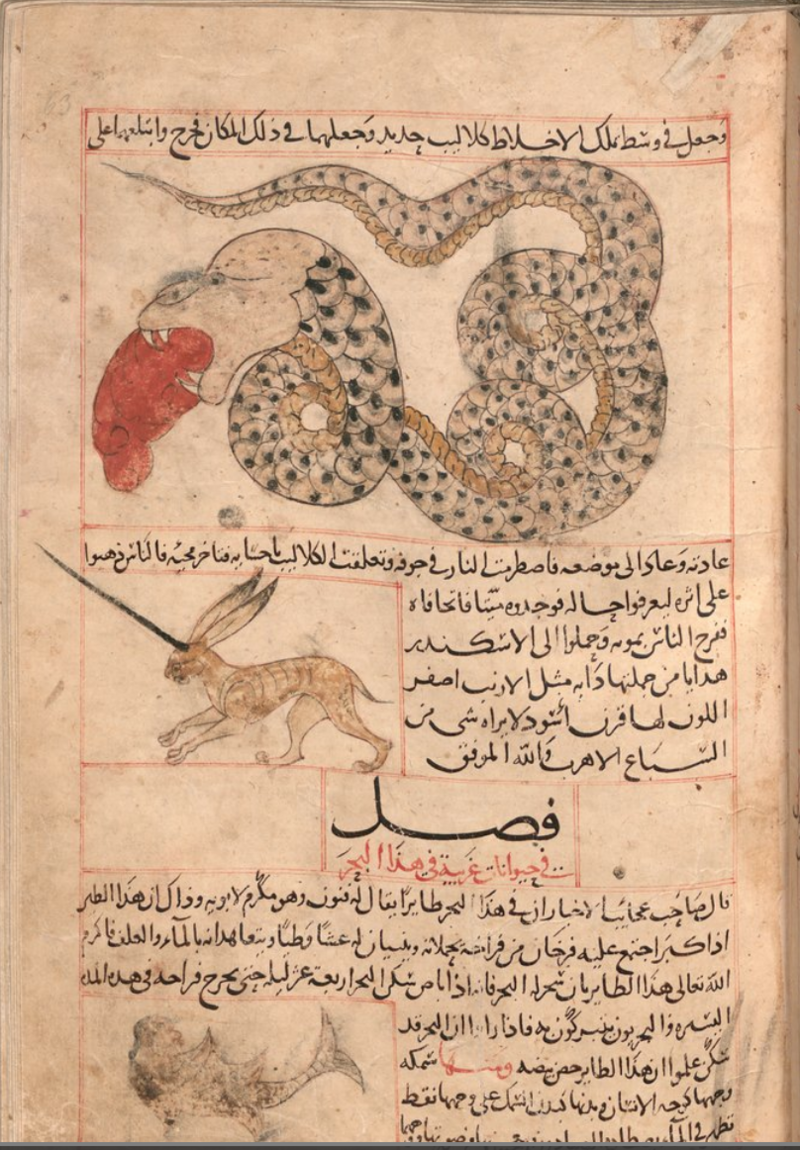
Socotra's isolation, exotic reputation, dangerous surrounding waters, and association with dragons through both its dragon's blood trees and possibly large monitor lizards or crocodiles observed by ancient mariners could plausibly have contributed to legendary elaborations that transformed it into the fabulous Dragon Island of Arabic literature. The legendary island is also identified as the home of the al-Mi'raj (also spelled Al'Mihraj or Almiraj), a mythical creature described as a large horned rabbit or hare—essentially a rabbit with a single prominent horn protruding from its head like a unicorn, making it conceptually similar to the Western cryptozoological jackalope (a North American folkloric rabbit with antelope horns) or to various unicorn traditions found across different cultures. This fantastical horned rabbit was said to possess supernatural properties including the ability to cause all other animals to flee in terror upon seeing it despite its relatively small size and herbivorous nature, suggesting it radiated magical power or divine aura that instinctively affected other creatures.
The most detailed surviving description of Jazirah al-Tennyn and its dragon comes from the influential Persian geographer and cosmographer Zakariya al-Qazwini (1203-1283), who included an account of the island in his celebrated mid-thirteenth-century cosmographical encyclopedia "ʿAjā'ib al-makhlūqāt wa-gharā'ib al-mawjūdāt" (The Wonders of Creation and Oddities of Existence). Qazwini's work, which aimed to catalog the marvels and curiosities of God's creation throughout the known world, combined genuine geographical and natural historical information with legendary material, travelers' tales, and fantastic accounts drawn from earlier Greek, Persian, and Arabic sources, creating a comprehensive medieval Islamic worldview that made no clear distinction between what modern readers would classify as natural history versus mythology. In Qazwini's account, Jazirah al-Tennyn is described as a large, permanently inhabited island filled with mountains and dense forests, suggesting substantial size and natural resources capable of supporting human communities.
According to the legend recorded by Qazwini, during the time when Alexander the Great's conquests brought him to this distant island (part of the legendary expansion of Alexander's historical campaigns into purely fabulous geography where he supposedly reached the ends of the earth and encountered marvels unknown to ordinary mortals), a monstrous dragon terrorized the island's inhabitants, holding them hostage through its overwhelming power and insatiable appetite. The dragon had established a terrible arrangement with the terrified islanders: it demanded tribute of two full-grown oxen to be provided daily as food to satisfy its enormous appetite, essentially imposing a ruinous tax that would gradually deplete the island's livestock resources and impoverish the community. The account emphasizes that when the required sacrifice was not provided on schedule—whether because the islanders attempted to resist, or simply could not meet the impossible demand—the beast would fly into a terrible rage characterized by fire flashing dramatically from its eyes and mouth in displays of supernatural fury.
In this enraged state, the dragon would rampage across the island, destroying everything in its path including homes, crops, livestock, and people, leaving devastation and death wherever it went and ensuring that the terrorized inhabitants dared not refuse its demands despite the unsustainable burden. The islanders, lacking the military capabilities to kill or drive away such a powerful monster through conventional weapons and force, lived in desperate fear until Alexander the Great arrived and learned of their plight. Rather than attempting to confront the dragon directly in combat—a strategy that presumably had been tried and failed, or that seemed suicidal given the creature's size, ferocity, fire-breathing capabilities, and armored scales that might deflect ordinary weapons—Alexander devised a clever stratagem that used the dragon's own voracious appetite against it, demonstrating the cunning intelligence and problem-solving abilities that made him legendary as both warrior and thinker.
Alexander instructed the islanders to create two elaborate decoys shaped and sized to resemble real oxen, constructing these false offerings from ox-hides carefully sewn and stuffed to create realistic-looking simulacra that would fool the dragon's eyes if not its other senses. Crucially, rather than filling these decoy oxen with normal stuffing materials, Alexander directed that they be packed with a deadly combination of caustic and incendiary substances: sulfur (which could burn with intense heat and produce toxic fumes), quicklime (calcium oxide, which reacts violently with moisture to produce intense heat and caustic alkaline substances that could burn organic tissue), and numerous sharp iron hooks designed to tear and pierce internal organs. These stuffed decoys were then shaped, positioned, and presented to resemble the normal daily tribute of two oxen that the dragon expected.
When the dragon arrived to claim its customary meal, it saw what appeared to be two ordinary oxen and, being either too hungry, too confident, or too unintelligent to detect the deception through smell or other senses, swallowed the false offerings whole or in large pieces as dragons presumably did with cattle, consuming them rapidly without careful examination. Once inside the dragon's digestive system, the deadly payload activated: the sharp iron hooks embedded in the false oxen tore through the dragon's stomach lining and intestinal walls, creating internal wounds and hemorrhaging; simultaneously, the quicklime reacted with the moisture in the dragon's digestive tract, producing intense heat and caustic chemical burns; and the sulfur may have combusted or released toxic compounds, adding to the internal destruction. The combined effect of mechanical tearing from the hooks and chemical poisoning and burning from the reactive substances killed the monster from within, causing it to collapse and die in apparent agony.
The dragon's death brought the terrified islanders tremendous relief, liberation, and cause for celebration, ending the impossible tribute demands and the constant fear of the monster's destructive rages. In gratitude for their deliverance, the islanders reportedly presented Alexander with precious gifts including, according to some versions of the tale, the fabulous al-Mi'raj or horned rabbit that dwelt on their island—a creature so rare and wondrous that only a hero of Alexander's stature deserved to possess it. This legend of Jazirah al-Tennyn and its dragon reflects several important aspects of medieval Islamic literature and thought: the incorporation of Alexander the Great into Islamic legendary traditions as a righteous world-conqueror and problem-solver who used both force and intelligence to overcome challenges; the medieval fascination with dragons and monsters as representations of chaos and evil that required heroic intervention; the valuing of cunning strategy and technological innovation over brute force in overcoming seemingly impossible challenges; and the conviction that distant islands and unknown regions of the world contained marvels, monsters, and wonders that demonstrated God's creative power while also providing opportunities for legendary heroes to perform the extraordinary deeds that separated them from ordinary mortals.
Whether Jazirah al-Tennyn ever referred to any real location like Socotra or was purely an imaginary island existing only in the medieval Islamic geographical imagination, it served important cultural functions in entertaining audiences, instructing them about problem-solving and leadership, and populating the distant edges of the known world with the fantastic and marvelous creatures that medieval cosmography deemed appropriate for regions beyond ordinary human experience.