Fujiwara no Hidesato
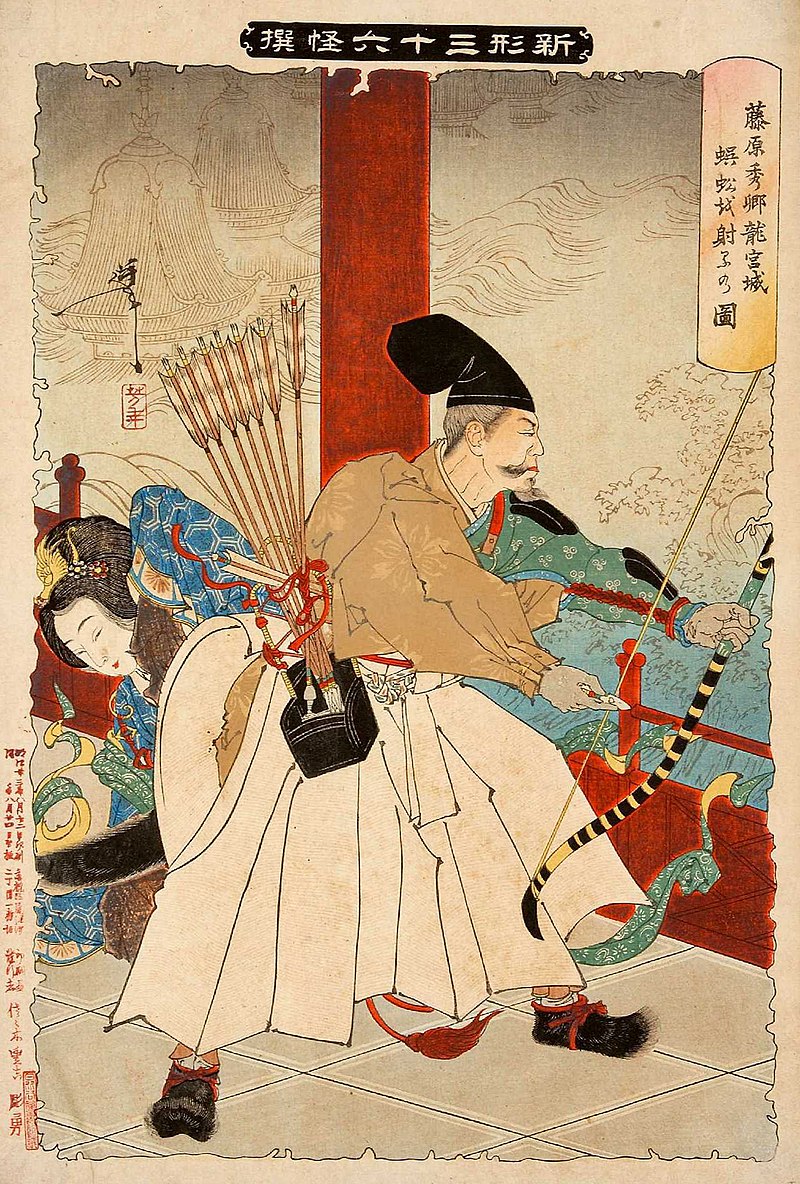
Fujiwara no Hidesato (藤原 秀郷) was a Japanese aristocrat, courtier, military commander, and samurai lord who lived during the tenth century in the Heian period. Celebrated for his martial prowess and valor, he is considered the common ancestor of numerous Japanese clans, including the Ōshū branch of the Fujiwara family. Hidesato served under Emperor Suzaku and fought alongside Taira no Sadamori in 940 to suppress the rebellion led by Taira no Masakado.
His prayer for victory before this pivotal battle is commemorated annually in the Kachiya Festival. Following his success, Hidesato was appointed Chinjufu shōgun (Defender of the North) and named Governor of Shimotsuke Province. Beyond his historical military achievements, Hidesato became a legendary folk hero.
According to popular tradition, he slew a giant centipede in Ōmi Province that had been terrorizing the Dragon Palace beneath Lake Biwa. This exploit earned him the nickname Tawara Tōda or Tawara no Tōta. The centipede legend recounts how Hidesato was recruited for this task by a giant dragon-serpent, who was actually an emissary from the Ryūgū-jō (Dragon Palace).
After Hidesato defeated the monstrous centipede (mukade) of Mount Mikami, he was brought before the Dragon King and lavished with rewards. Among these gifts was a magical rice sack (tawara) that never emptied, from which his nickname allegedly derives. A more prosaic explanation suggests that "Tawara," also written as "田原," may simply represent either a surname or place name.
This centipede tale, known as The Tale of Tawara Tōda, combined with a romanticized account of his campaign against Masakado, forms the Tawara Tōda Monogatari. These narrative texts were extensively reproduced in picture scrolls and illustrated books throughout the Edo period, cementing Hidesato's place in Japanese popular culture. The Ise Shrine's Jingū Chōkokan Museum houses two swords purportedly once owned by Hidesato.
The first is a kenukigata tachi (a "tweezer-type" sword), which tradition claims was the blade Hidesato received from the Dragon Palace. It later became an heirloom of the Akahori clan before passing through various hands and arriving at the shrine in 1793. While Hidesato's ownership cannot be verified, the sword dates to the appropriate historical period.
The second sword at the museum is called Mukadegiri, meaning "Centipede-cutter." Although inscriptions attribute it to the eighth-century swordsmith Shinsoku, experts have dated the blade to the fourteenth century. Another "tweezer-type" sword allegedly belonging to Hidesato is preserved at Chikubu Island's Hōgon-ji temple. Hidesato's dual legacy as both historical military figure and legendary dragon-slayer illustrates how Japanese culture wove together factual accomplishment and mythological storytelling, transforming a successful tenth-century warrior into an enduring folk hero whose exploits continued to captivate audiences for centuries.