Eleanor of Arborea
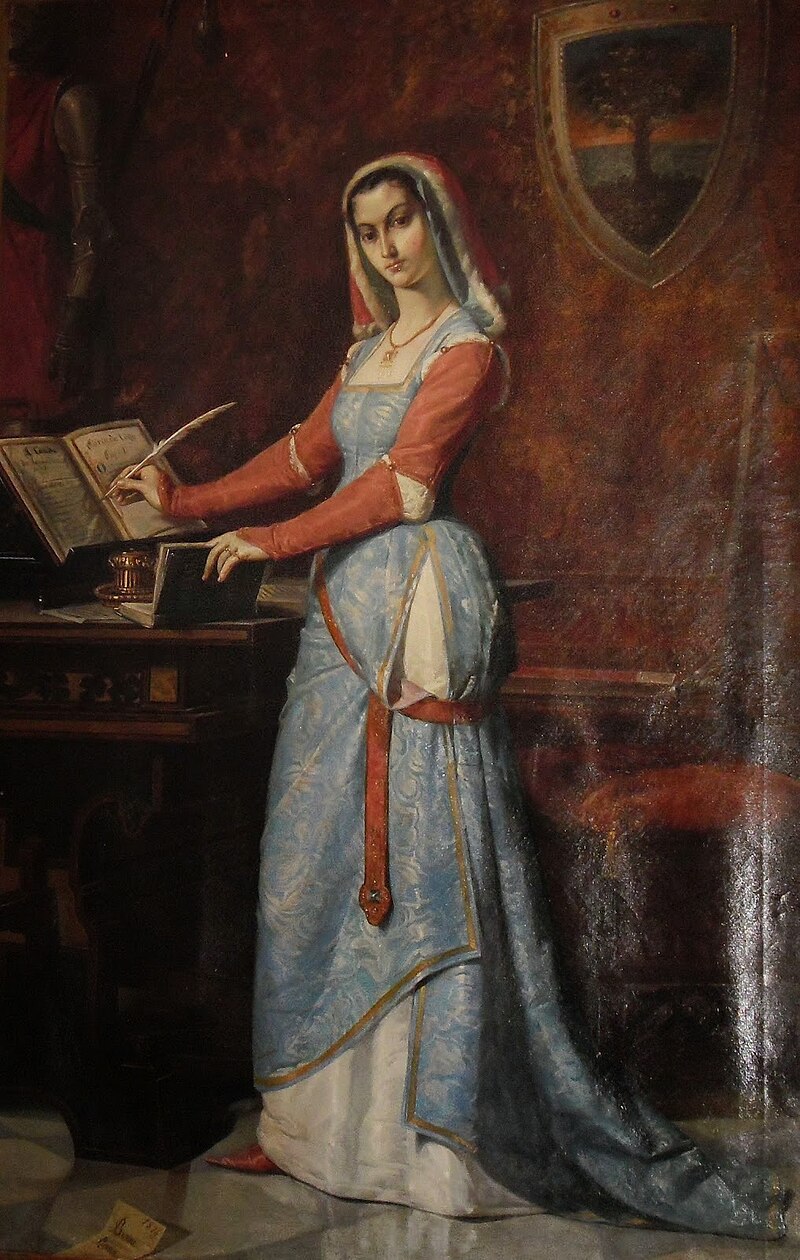
Eleanor of Arborea is a legendary figure from Oristano, Italy, dated to ~1347 AD (Middle Ages).
Eleanor of Arborea (Sardinian: Elianora de Arbarée or Elianora De Serra Bas; Italian: Eleonora d'Arborea or Eleonora De Serra Bas; 1347–June 1404) stands as one of the most powerful and influential rulers in Sardinian history, serving as one of the final judges of the Judicate of Arborea. She remains Sardinia's most celebrated heroine, revered not only for her political and military leadership but also for her profound legal legacy through her revision of the Carta de Logu, a groundbreaking legal code originally promulgated by her father Marianus IV and later revisited by her brother Hugh III. Born into the ruling House of Serra-Bas in 1347, Eleanor was the daughter of Judge Marianus IV of Arborea, one of the four independent judicates that divided medieval Sardinia.
Her upbringing prepared her for the political complexities of Sardinian affairs during a period when the island was contested by the Crown of Aragon, which sought to consolidate control over the entire island, and the indigenous judicates that fought to preserve their independence. Eleanor married Brancaleone Doria, an Italian nobleman from a powerful Genoese family, forging an alliance that would prove strategically valuable in the struggles ahead. Eleanor assumed power as regent for her son Frederick in 1383 following the death of her brother Hugh III, who had succeeded their father.
The transition came at a critical moment when Arborea faced mounting pressure from Aragonese expansion. Rather than serving as a mere placeholder, Eleanor proved herself a formidable ruler in her own right, demonstrating exceptional diplomatic skill and military acumen. She effectively became judge in all but name, wielding supreme authority over the judicate's affairs.
Under Eleanor's leadership, Arborea experienced a remarkable resurgence. She successfully rallied Sardinian resistance against Aragonese domination, uniting various factions and cities under her banner. Her military campaigns proved remarkably effective, and at the height of her power, she controlled nearly the entire island except for a few coastal fortresses that remained in Aragonese hands.
Eleanor's forces captured numerous strategic locations, and she negotiated from a position of considerable strength with the Crown of Aragon. Her success stemmed not merely from military prowess but from her ability to inspire loyalty among her subjects and present Arborea as the defender of Sardinian independence against foreign encroachment. Eleanor's most enduring achievement, however, lies in her legal reforms.
In 1392, she issued a substantially revised and expanded version of the Carta de Logu, transforming what had been her father's legal framework into one of the most progressive legal codes of medieval Europe. The Carta de Logu addressed civil, criminal, and rural matters with remarkable sophistication and equity. Notably, it included provisions protecting women's rights and property, safeguarding the environment through conservation measures for forests and wildlife, and establishing clear legal procedures that applied across social classes.
The code's protection of natural resources was particularly forward-thinking, with regulations governing hunting seasons, preventing the destruction of nesting birds, and protecting certain tree species. These environmental protections reflected Eleanor's understanding that Sardinia's prosperity depended on sustainable use of its resources. The Carta de Logu also contained surprisingly humane provisions for its time, including limitations on the death penalty and protections for the accused.
Its clarity, practicality, and relative fairness made it remarkably durable. The code remained in force not only throughout Eleanor's lifetime but continued as the legal foundation for much of Sardinia for centuries afterward, lasting in various forms until the nineteenth century when it was finally superseded by the Napoleonic Code. This extraordinary longevity testifies to the code's quality and adaptability.
Eleanor ruled until her death in June 1404, likely from plague during one of the periodic epidemics that swept through medieval Europe. Her death marked a turning point for Arborea and for Sardinian independence more broadly. Without her unifying leadership and strategic vision, the judicate's resistance weakened.
Within a few decades, Arborea fell completely under Aragonese control, marking the end of indigenous Sardinian self-rule. Eleanor's legacy has endured far beyond her lifetime. In Sardinian collective memory, she represents resistance to foreign domination, wise governance, and progressive leadership.
Her combination of military capability, political shrewdness, and commitment to just laws makes her an exceptional figure in medieval European history. Statues and monuments honoring her can be found throughout Sardinia, and her image appears on the regional flag. She is celebrated not as a warrior queen alone, but as a lawgiver and protector of her people whose vision extended beyond immediate military concerns to the establishment of a just social order.
Eleanor of Arborea remains a powerful symbol of Sardinian identity and a reminder of the island's distinct historical trajectory within the broader narrative of medieval Mediterranean politics.