Dahu
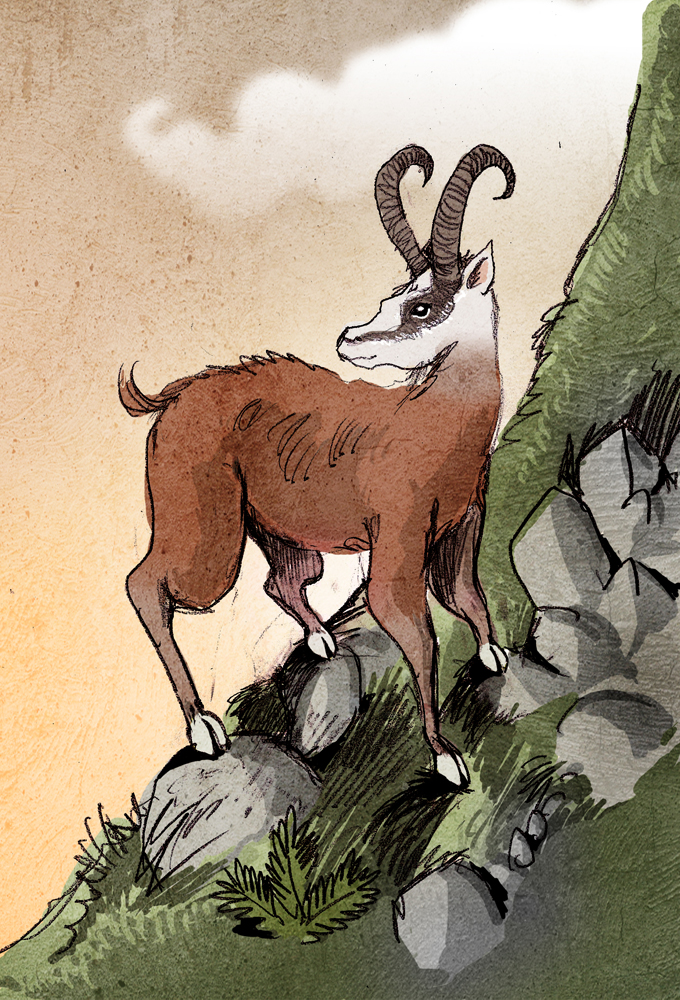
The dahu (French pronunciation: [da.y]) is a legendary creature resembling a mountain goat, well known in France and in French-speaking areas of Switzerland and Italy, particularly the Aosta Valley. Described as a quadrupedal mammal, the dahu may have been inspired by the chamois, a small horned goat-antelope once common in European mountain ranges, and it also shares similarities with the ibex.
Its name varies from region to region. In Jura it is called the dahut or dairi, in the Vosges the darou, in Picardy the daru, in Burgundy the darhut, and in Val Camonica the daù. In Aubrac and Aveyron it is known as the tamarou, and in Catalonia and Andorra it is called the tamarro. A young dahu is referred to as a dahuot.
The most distinctive feature of the dahu is its asymmetrical legs: the legs on one side of its body are shorter than the legs on the other side. This unique adaptation allows the animal to remain balanced on steep slopes and walk around the sides of mountains with ease. However, the limb difference means a dahu can only travel in one direction around the mountain.
Two types exist: the laevogyrous dahu, with shorter legs on the left, moves counterclockwise, while the dextrogyre dahu, with shorter legs on the right, moves clockwise. These have also been described using the terms dahu senestrus and dahu desterus.
The “dahu hunt” (French: chasse au dahu) is a long-standing prank, similar to the snipe hunt. In this practical joke, pranksters lead an unsuspecting participant into the mountains at night, claiming they are going to catch a dahu, and then abandon them. Another version involves two people: one holding a bag at the base of the slope, and the other imitating dahu calls from above. When the dahu turns to investigate the sound, it supposedly loses its balance and tumbles into the waiting bag.
In the 20th century, the dahu became a well-known figure in French popular culture, especially in Lorraine, the Alps, the Jura, and French-speaking Switzerland. Its fame grew toward the late 19th century when the rise of mountain tourism brought wealthy but inexperienced city visitors to rural areas. Mountain guides, seeing an opportunity, would entice gullible tourists into a night-long dahu hunt, describing the creature as a rare and valuable prize. The hunt often meant spending hours alone on a cold slope in an uncomfortable crouch.
By the latter half of the 20th century, the number of naive participants had declined, and the hunt lived on mainly as a summer camp joke. Today, the dahu is widely recognized as a humorous tall tale. The Alps Museum at Bard Fort in the Aosta Valley has dedicated part of its permanent exhibition to the animal, and the story has spread to other mountain regions such as the Pyrenees. Recreational “dahu hunts” are still organized in France and Switzerland.