Yue Fei(岳飛)
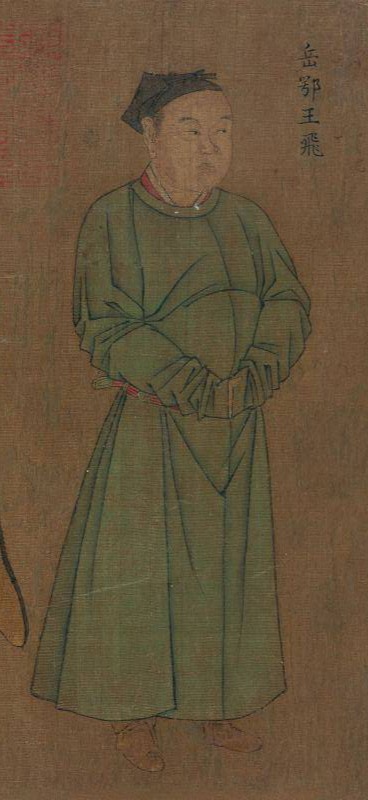
Yue Fei (Chinese: 岳飛; March 24, 1103 – January 28, 1142), courtesy name Pengju (鵬舉), was a brilliant Chinese military general of the Song dynasty who is revered as one of China's greatest patriotic heroes for leading Southern Song forces with remarkable success against the Jurchen-led Jin dynasty during the twelfth-century wars for control of northern China. His military achievements and unwavering commitment to recovering territories lost to the Jin made him immensely popular among both soldiers and civilians, but his aggressive stance against negotiating peace with the Jin ultimately led to his downfall. In 1142, shortly after a negotiated peace settlement was reached with the Jin dynasty, Yue Fei was arrested on false charges of treason orchestrated by officials favoring accommodation with the Jin, including the powerful chancellor Qin Hui.
He was executed at age thirty-nine in what is widely recognized as a grave miscarriage of justice motivated by political considerations rather than genuine crimes. He was posthumously pardoned, vindicating his loyalty and acknowledging the injustice of his execution. Yue Fei is depicted in the Wu Shuang Pu (無雙譜, Table of Peerless Heroes) by Jin Guliang, recognizing his place among China's most exemplary historical figures.
Yue Fei's ancestral home was in Xiaoti, Yonghe Village, Tangyin, Xiangzhou, Henan (in present-day Tangyin County, Anyang, Henan). His reputation underwent gradual rehabilitation as the injustice of his execution became increasingly acknowledged. Emperor Xiaozong granted him the posthumous name Wumu (武穆) in 1169, twenty-seven years after his death, officially recognizing his military virtues and loyalty.
Later, Emperor Ningzong further honored his memory by posthumously granting him the noble title King of E (鄂王) in 1211, elevating him to royal status and symbolically restoring the honor that had been stripped from him through his wrongful execution. Since his death and especially following the fall of the Song dynasty to Mongol conquest in 1279—an event that retrospectively vindicated Yue Fei's warnings about foreign threats and his advocacy for strong military resistance—Yue Fei has been widely venerated as a culture hero throughout China. He has evolved into the preeminent paragon of loyalty in Chinese culture, representing unwavering dedication to one's country and principles even in the face of personal destruction.
His story—of a brilliant general betrayed by corrupt officials while faithfully serving his emperor and nation—resonates powerfully with Chinese values emphasizing loyalty, righteousness, and self-sacrifice. Temples dedicated to Yue Fei exist throughout China, where he is honored not merely as a historical figure but as a moral exemplar whose life teaches essential lessons about integrity, patriotism, and the tragic consequences when corrupt politicians undermine devoted servants of the state. His famous tattoo, reportedly inscribed on his back by his mother with the characters "serve the country with utmost loyalty" (精忠報國), has become an iconic symbol of Chinese patriotism that continues to inspire reverence and emulation centuries after his death.