Yermak Timofeyevich
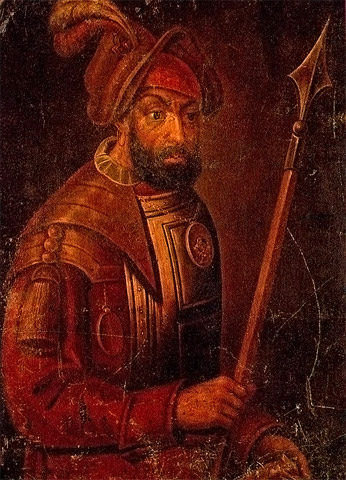
Yermak Timofeyevich (Russian: Ермак Тимофеевич, IPA: [jɪrˈmak tʲɪmɐˈfʲejɪvʲɪt͡ɕ]; born supposedly 1532, died August 5 or 6, 1585) was a Cossack ataman (military leader or chieftain) who initiated the Russian conquest of Siberia during the reign of Tsar Ivan IV "the Terrible," opening vast territories beyond the Ural Mountains to Russian colonization, exploitation, and eventual incorporation into the Russian Empire. Through his military campaigns against the Tatar Khanate of Sibir in the early 1580s, Yermak began the process of Russian eastward expansion that would eventually extend Russian dominion across the entire breadth of northern Asia to the Pacific Ocean, transforming Russia from a relatively compact European state into the world's largest territorial empire. He has become a towering hero in Russian folklore, mythology, and national historical consciousness, celebrated as the bold conqueror who opened Siberia to Russian civilization and whose exploits embodied the adventurous, pioneering spirit of Russian expansion.
Russian commercial and strategic interests in the lucrative Siberian fur trade—particularly the pursuit of sable, fox, ermine, and other valuable pelts that commanded extraordinary prices in European and Asian markets—fueled the Russian desire to expand eastward into the largely unknown territories beyond the Ural Mountains. The Tatar Khanate of Kazan, established by Ulugh Muhammad as one of the successor states to the fragmented Golden Horde that had once ruled over much of Russia, controlled the middle Volga River region and represented both an obstacle to Russian expansion and the logical gateway into Siberia due to its geographic position. In 1552, Tsar Ivan the Terrible's modernized army, equipped with artillery and firearms that gave Russian forces decisive advantages over the Tatars' traditional cavalry tactics, captured and overthrew the Khanate of Kazan in a campaign that represented one of the first major Russian conquests of non-Russian territories and established the pattern of imperial expansion that would characterize subsequent Russian history.
After the successful takeover of Kazan, which eliminated a major rival power and opened the way for further eastward movement, the tsar looked to the Stroganov family—a dynasty of immensely powerful and wealthy merchant-entrepreneurs who had been granted vast territorial concessions and commercial privileges in the Urals region—to spearhead the practical work of eastward expansion beyond the nominal boundaries of Russian control. The Stroganovs possessed the financial resources, organizational capabilities, and commercial motivations to invest in expensive and risky expeditions into unknown territories where the Russian state apparatus had limited reach. In the late 1570s, the Stroganovs recruited Cossack fighters—semi-independent warrior communities originally composed of escaped serfs, adventurers, and refugees from various backgrounds who had formed autonomous military societies on the frontiers of the Russian, Polish, and Ottoman states—to conduct military operations into Asia on behalf of the tsar's imperial interests and the Stroganovs' commercial ambitions.
These recruited Cossack warriors, recognizing Yermak's military experience, leadership abilities, and personal charisma, elected him as the commander (ataman) of their armed expedition. In 1582, Yermak assembled and led a force of approximately 840 men—a relatively small army by conventional military standards but composed of experienced, tough, and well-armed fighters equipped with firearms that gave them overwhelming tactical advantages against the numerically superior but technologically inferior Tatar forces they would face. This expedition set out from Stroganov territories to attack and conquer the Khanate of Sibir (also called the Siberian Khanate), a Tatar state ruled by Kuchum Khan that controlled territories in western Siberia and represented the primary organized political authority in the region.
On October 26, 1582, in a battle near the Tatar capital of Qashliq (also called Isker or Sibir, located near present-day Tobolsk), Yermak and his Cossack soldiers achieved a decisive victory, defeating and overthrowing Kuchum Khan's Tatar forces and capturing the capital. This battle, though relatively small in scale compared to major European military engagements of the era, has been mythologized in Russian historical consciousness as marking "the conquest of Siberia"—the symbolic moment when Russian power definitively crossed the Urals and when Siberia's fate as part of the Russian Empire was essentially determined, even though actual Russian control over the vast Siberian territories would require decades of subsequent military campaigns, fort construction, and colonization to consolidate. Yermak and his Cossacks remained in Siberia following their initial victory, establishing a Russian presence in the region and continuing military operations against Kuchum Khan's forces, which had retreated but not been completely destroyed.
The Cossacks endured enormous hardships including brutal Siberian winters, supply shortages, disease, and constant skirmishing with Tatar forces and hostile indigenous peoples. Despite these difficulties, they maintained their position until 1585. On the night of August 5-6, 1585, while Yermak's force was encamped along the Irtysh River, a military raid organized by the still-defiant Kuchum Khan launched a surprise nighttime attack that ambushed and overwhelmed Yermak's party.
According to the most famous version of his death—which, like much about Yermak, may blend fact with legend—Yermak attempted to escape by swimming across the river but drowned, dragged under by the weight of a heavy chain mail coat that had been gifted to him by Tsar Ivan the Terrible, dying in the very armor meant to honor and protect him. His body was later recovered by Tatars and, according to some accounts, treated with a mixture of respect and ritual significance befitting a worthy enemy, before eventually being interred by Russian forces who returned to the region. The specific details of Yermak's life, including his physical appearance, his social and ethnic background, his earlier career before the Siberian expedition, and even the precise dates of key events in his campaigns, remain subjects of controversy and debate among historians.
This uncertainty exists because the documentary sources that chronicle his life and expeditions were written years or decades after the events they describe, often by authors who had not personally witnessed the occurrences they recounted, and these texts frequently contain contradictions, legendary embellishments, and details that seem designed to serve ideological or propaganda purposes rather than to provide sober historical records. Some accounts portray Yermak as a former river pirate and bandit who found redemption through service to the tsar; others emphasize his supposedly noble character and loyal service; still others focus on his military genius and personal courage. Separating historical reality from later mythologization in Yermak's biography remains extremely difficult and perhaps impossible given the nature of available evidence.
Despite—or perhaps partly because of—these historical ambiguities and uncertainties, Yermak's life and conquests exercised profound and lasting influence on Siberian colonial relations, Russian imperial ideology, and the geopolitical transformation of northern Asia. His expeditions sparked intense Russian interest in Siberia's vast territories, natural resources, and potential for exploitation, leading to a sustained campaign of Russian eastward expansion that would continue for the next century until Russian explorers and colonizers reached the Pacific Ocean in the 1640s. Yermak's conquests established the Tsardom of Russia as an imperial power capable of projecting military force and asserting sovereignty east of the Urals, transforming Russia's self-conception from a primarily European state into a Eurasian empire spanning two continents.
The conquest of Siberia would eventually provide Russia with enormous territories for colonization, vast mineral and fur resources that enriched the Russian state and merchant classes, and strategic depth that would prove crucial in subsequent conflicts. Yermak thus became not merely a historical figure but a founding myth of Russian imperialism, celebrated in folk songs, epic poems, paintings, monuments, and popular culture as the heroic pioneer who opened Siberia to Russian civilization and whose bold spirit represented the expansionist destiny that Russian nationalist ideology proclaimed for the Russian people—a legacy that continues to resonate in Russian historical memory and national identity into the present, even as historians debate the actual facts of his life and contemporary scholars critically examine the colonial violence, indigenous dispossession, and imperial exploitation that Yermak's celebrated conquests initiated.