Wojciech Bartosz Głowacki
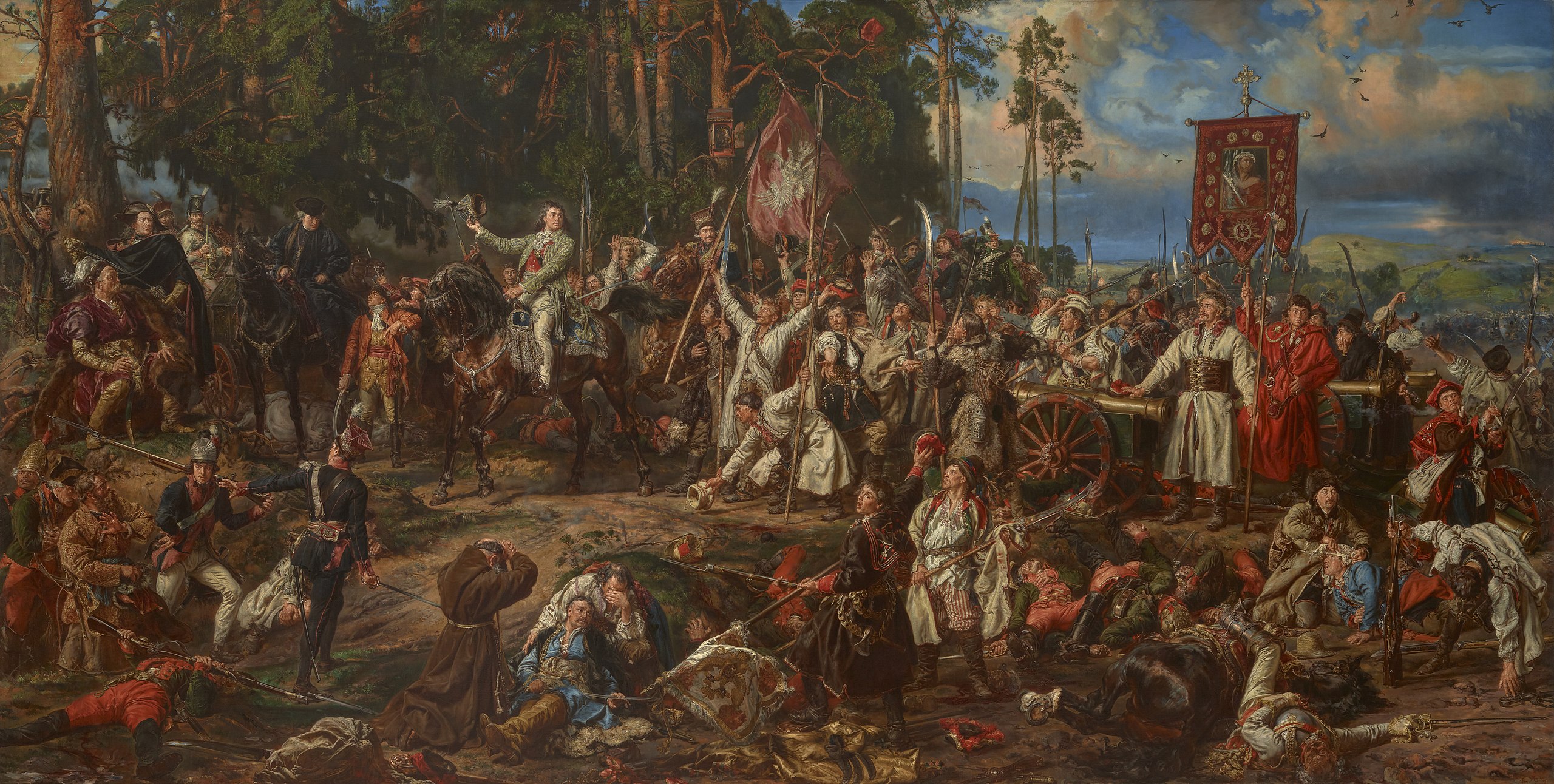
Wojciech Bartos(z) Głowacki (1758–1794), known also as Bartosz Głowacki, was a Polish peasant who became the most celebrated member of the kosynierzy (peasant volunteer infantry armed with war scythes) during the Kościuszko Uprising of 1794, one of the most significant Polish resistance movements against foreign domination. Born as Wojciech Bartosz to a family of serfs, he achieved national hero status during the Battle of Racławice on April 4, 1794, when he performed an act of exceptional courage by capturing a Russian cannon, reportedly extinguishing its burning fuse with his own cap to prevent it from firing. For this remarkable deed, he was immediately promoted by Tadeusz Kościuszko to the rank of chorąży (ensign or standard-bearer) and received the surname "Głowacki" in place of his peasant name.
Tragically, he was mortally wounded during the Battle of Szczekociny on June 6 of that same year, dying from his injuries within days. Since his heroic actions and untimely death, he has become one of the enduring symbols of the Kościuszko Uprising and an embodiment of Polish valor, courage, and the participation of common people in the struggle for national independence. Bartosz was born around 1765 (though some sources suggest 1758) as a serf belonging to Antoni Szujski, a member of the Polish nobility who owned the land and the people who worked it.
He was probably born in the village of Rzędowice, although some historical sources identify Zakrzów as his birthplace. The uncertainty regarding both his exact birthplace and date stems from the destruction of church documents that would have recorded these details during the tumultuous events of 1794, leaving historians with incomplete information about his early life. In 1783, Bartosz married Jadwiga Czernikowa, and together they had three daughters: Helena, Cecylia, and Justyna.
The family lived in severe poverty characteristic of Polish serfs in the late eighteenth century. Their situation was so dire that their house collapsed some years before Jadwiga's death (she died before Bartosz, leaving him a widower). Their landholding was extremely modest, consisting of between four and nine morgs (a morg being a traditional Polish unit of land area, roughly equivalent to half a hectare or slightly over an acre)—barely sufficient to support a family.
They did not even own a horse, which was essential for effective farming and represented a significant marker of relative prosperity among the peasantry. Only after Bartosz achieved fame at the Battle of Racławice did their circumstances improve somewhat, when Lord Szujski, perhaps recognizing the propaganda value of supporting the hero or feeling genuine gratitude, provided them with a cow and some other animals. Bartosz was conscripted into military service following the decree of the Order Commission (Komisja Porządkowa) issued on March 25, 1794, which mandated the conscription of one man from every five households (literally "chimneys," using the household hearth as the unit of measurement).
This desperate measure reflected the uprising's need for soldiers and represented an unprecedented mobilization of the peasant class for military purposes. In a supplementary decree issued on March 28, the commission pragmatically allowed peasants to report for service armed with scythes rather than requiring more specialized military weapons that few peasants possessed or could afford. This decision led to the creation of the distinctive kosynierzy infantry regiments, in which peasants wielded war scythes—agricultural implements modified by straightening the blade and mounting it parallel to the handle to create a formidable stabbing and slashing weapon.
Ironically, Bartosz was selected as the conscript from his lord's estate not because of any recognized martial qualities or patriotic fervor, but because Szujski's administrative staff viewed him as a troublemaker—possibly due to complaints about his treatment, resistance to excessive labor demands, or simply an independent spirit that made him difficult to control. The estate managers decided that sending him off to war was an expedient way to remove a problematic serf while simultaneously fulfilling their conscription obligation. Bartosz arrived at the military camp near Racławice at the beginning of April 1794, having had virtually no military training or experience.
On April 4, 1794, barely days after his arrival, Bartosz participated in the famous Battle of Racławice, where Tadeusz Kościuszko, the Polish-Lithuanian military leader and hero of the American Revolution who had returned to lead the uprising against Russian and Prussian occupation, confronted and defeated a Russian army under General Alexander Tormasov. The kosynierzy proved vital to the Polish victory despite their peasant origins and improvised weapons. When ordered to assault the Russian artillery positions—normally a suicidal task given that artillery could devastate attacking infantry—the scythe-wielding peasants charged with remarkable courage and determination.
They swarmed the Russian gun emplacements, overrunning them after the artillery managed only a single devastating salvo, capturing the guns before they could be reloaded and turned against the advancing Polish forces. It was during this chaotic and bloody assault that Bartosz Głowacki achieved the deed that would immortalize him in Polish history and folklore. According to the most popular account, he was among the first—possibly the very first—to reach the Russian artillery positions.
Observing that one of the cannons was loaded, primed, and about to fire into the ranks of his advancing comrades, Bartosz acted with extraordinary presence of mind and courage. He grabbed his own cap from his head and used it to extinguish the burning fuse that would have ignited the cannon's powder charge, preventing the gun from firing and saving numerous Polish lives. This quick-thinking act of bravery, combined with his fierce fighting and his vocal expressions of pro-uprising sentiment and patriotism that impressed his officers, came to the attention of Kościuszko himself.
Kościuszko, recognizing both the military value and powerful symbolic significance of this peasant hero, immediately promoted Bartosz to the rank of chorąży (ensign) in the newly created regiment of Cracow's Grenadiers (Grenadierzy Krakowscy), an elite unit rather than the peasant kosynierzy. This promotion represented an extraordinary elevation in social status. Bartosz was released from serfdom—gaining personal freedom that his ancestors had lacked for generations—and received legal ownership of his land, transforming him from a bound serf working another man's property into a free landowner.
He was probably not formally ennobled (granted noble status), as this would have required more elaborate procedures, but his liberation and land ownership alone represented dramatic upward mobility. His surname was changed from the distinctly peasant "Bartosz" to "Głowacki," which was his mother's maiden name. Historical sources disagree about whether this name change was Bartosz's own choice—perhaps seeking to honor his mother or to adopt a more respectable-sounding name—or whether the name was bestowed upon him by Kościuszko as part of his elevation in status.
On June 6, 1794, now bearing officer rank and fighting with the grenadiers rather than the peasant scythe-bearers, Głowacki participated in the Battle of Szczekociny. This engagement proved disastrous for the Polish forces. The Polish army, approximately 15,000 strong and already weakened by previous campaigns, faced a combined Prussian and Russian force numbering some 27,000 soldiers with superior artillery and cavalry.
The outnumbered and outgunned Poles fought bravely but were decisively defeated, suffering heavy casualties and being forced to retreat in disorder. Głowacki was among the 346 Polish soldiers evacuated from the battlefield with serious wounds. However, his injuries proved too severe for the limited medical capabilities available to the uprising's forces.
He died from his wounds sometime between June 6 and June 9, 1794, barely two months after his moment of glory at Racławice. He was probably buried in Kielce Cathedral on June 9, though records are uncertain—a somber end for a man who had briefly experienced fame, freedom, and recognition before dying in service to the cause that had transformed his life. Bartosz Głowacki became one of the most famous Polish soldiers of the Kościuszko Uprising and joined the ranks of Polish national heroes, his story resonating across generations and political systems.
The knowledge of his courageous deeds was deliberately spread and emphasized by Polish patriots and educators who wanted to demonstrate that the Polish-Lithuanian Commonwealth was defended not exclusively by its most privileged class—the nobility (szlachta), who traditionally monopolized military service and political power—but also by the least privileged members of society, the peasants who constituted the vast majority of the population but had historically been excluded from military glory and national recognition. This narrative served important ideological purposes, suggesting that Polish national identity and the struggle for independence transcended class boundaries and that the common people shared ownership of Poland's destiny. Głowacki's story proved especially valuable to Polish patriots during the long period of Poland's partitions (1795-1918), when the country was divided among Russia, Prussia, and Austria and ceased to exist as an independent state.
His example demonstrated that ordinary Poles could perform extraordinary deeds and that national resistance was not dependent solely on the nobility, who might be co-opted or neutralized by the occupying powers. Later, the communist People's Republic of Poland (1944-1989) enthusiastically appropriated and promoted Głowacki's story for its own propaganda purposes. For a communist regime that officially championed the working class and peasantry over the former nobility and bourgeoisie, a peasant military hero who had fought against tsarist Russia (which the communist government presented as the predecessor of the friendly Soviet Union, conveniently ignoring that Głowacki died fighting Russians) was an invaluable propaganda tool.
The regime used Głowacki's story to argue that Polish communism continued the authentic traditions of popular resistance while the nobility and bourgeoisie had supposedly betrayed the nation—a selective and distorted interpretation of history that nevertheless ensured that Głowacki's name and deeds remained well known to successive generations of Poles. Thus, Bartosz Głowacki's brief life and heroic death have been continuously remembered, reinterpreted, and deployed for various political purposes across more than two centuries, transforming a poor serf who captured a cannon into an enduring symbol whose meaning has been contested and reshaped by different ideological movements while his core story of courage and sacrifice has remained constant.