Wampus cat
The wampus cat is a cat-like creature from American folklore that exhibits remarkably varied appearances and characteristics depending on regional tradition, ranging from genuinely frightful and dangerous to comical and absurd, reflecting the diverse cultural contexts and storytelling purposes across different parts of the United States where the legend appears. Early scholarly references collected by the American Dialect Society, which has documented American regional speech and folklore since the late nineteenth century, described the wampus cat through multiple conflicting definitions that reveal the creature's fluid and evolving nature in oral tradition. Some informants characterized it as "a creature heard whining about camps at night"—an unseen nocturnal presence whose eerie vocalizations disturbed hunters, campers, and travelers in the wilderness, creating atmosphere of supernatural dread without ever being directly observed.
Others described it as "a spiritual green-eyed cat, having occult powers," emphasizing supernatural rather than physical characteristics and suggesting the creature functioned more as a spectral or magical entity than as a flesh-and-blood predator. Still other accounts defined it simply as "an undefined imaginary animal," acknowledging that the wampus cat existed primarily as a deliberately vague concept whose very indefiniteness contributed to its effectiveness as a source of campfire stories and tools for frightening the credulous. Writing in 1951, the distinguished Ozark folklorist Vance Randolph, who extensively documented the folk traditions of the Missouri and Arkansas highlands, provided yet another distinctive description of the wampus cat as "a kind of amphibious panther which leaps into the water and swims like a colossal mink," portraying it as a semi-aquatic predator of enormous size that combined the terrestrial hunting prowess of a panther with the aquatic agility of a mink enlarged to monstrous proportions.
This amphibious characterization suggests possible connections to other water-dwelling cryptids and fearsome critters of American folklore and indicates the wampus cat's ability to hunt across multiple environments, making it an even more formidable and inescapable threat in the imaginations of those who feared encountering it. The wampus cat moved from purely folkloric tradition into documented local panic when it was mentioned in numerous newspaper accounts during the 1930s throughout the Piedmont region of North Carolina, where a series of mysterious livestock killings generated genuine concern among rural communities. Local farmers and residents accused the creature of killing their cattle, sheep, pigs, and other farm animals, attributing these predations to the legendary wampus cat rather than to more prosaic explanations such as feral dogs, coyotes, or large wildcats.
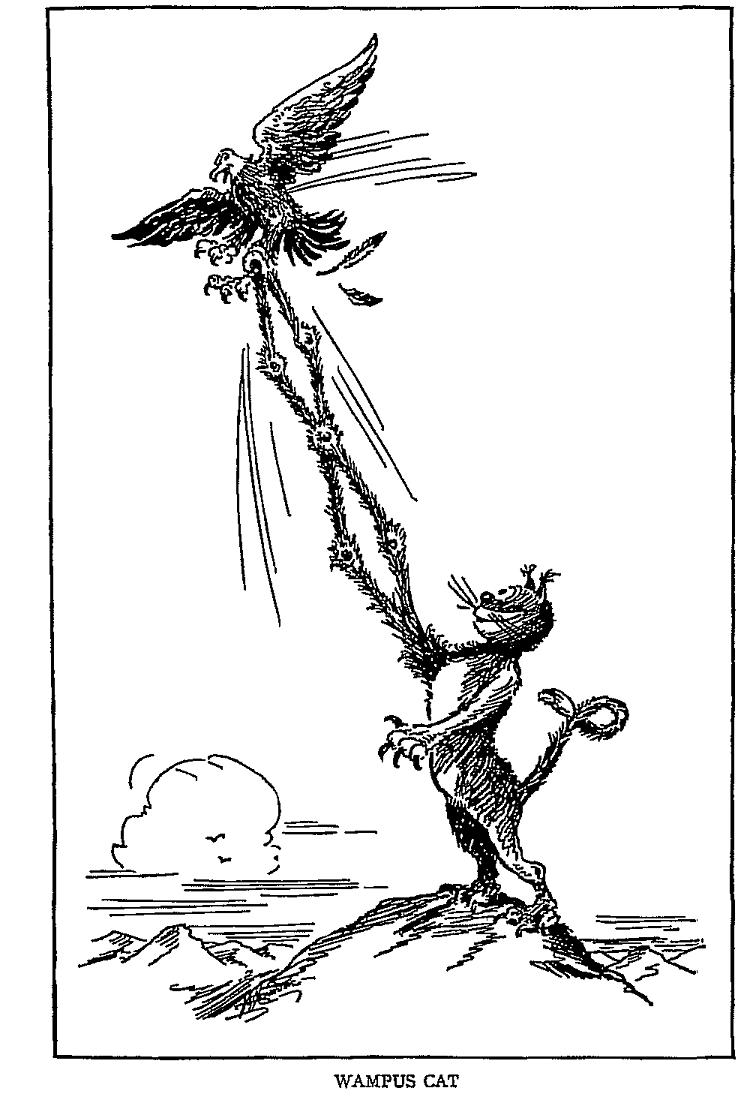
These newspaper reports demonstrate how folkloric creatures could be invoked to explain real but mysterious events, providing a culturally familiar narrative framework for understanding livestock losses that might otherwise remain frighteningly inexplicable. Henry H. Tryon's deliberately humorous 1939 book Fearsome Critters, which catalogued and elaborated upon the legendary creatures of lumberjack folklore and tall tale traditions, provided yet another regionally specific version of the wampus cat, claiming it was native to Idaho rather than the Appalachian or Ozark regions where most earlier accounts placed it.
Tryon's playfully pseudo-scientific description emphasized the creature's most distinctive feature: an "amazing right forearm" equipped with retractable claws or hooks that "works like a folding pruning hook on the pantographic principle"—comparing the limb's mechanical action to a pantograph, a linked parallelogram device used for copying drawings at different scales. This absurdly specific biomechanical detail, combining seemingly precise observational language with obviously fantastical content, exemplifies the deadpan humor characteristic of fearsome critter literature. Tryon completed his mock-scientific treatment by assigning the wampus cat the binomial nomenclature Aquilamappreluendens forcipe, a completely invented pseudo-Latin taxonomic name constructed to sound plausibly scientific while being entirely nonsensical, parodying the formal naming conventions of legitimate zoology and highlighting the satirical nature of fearsome critter lore, which simultaneously mocked both the gullibility of greenhorns who might believe such tales and the pretensions of scientific classification systems that claimed to catalog and explain the natural world with Latin names and precise descriptions.
The wampus cat's persistent presence across multiple regional traditions, its adoption as a mascot by numerous American schools and sports teams (particularly in Appalachia and the South), and its continued appearance in contemporary folklore and cryptozoology discussions demonstrate the enduring appeal of this protean creature whose very indefiniteness and adaptability have allowed it to survive and evolve across different cultural contexts, serving variously as a cautionary figure, an expression of regional identity, a subject of humor, and a reminder of the mysteries and dangers that rural Americans have historically associated with the dark forests and wild places beyond the safety of human habitation.