Underwater panther
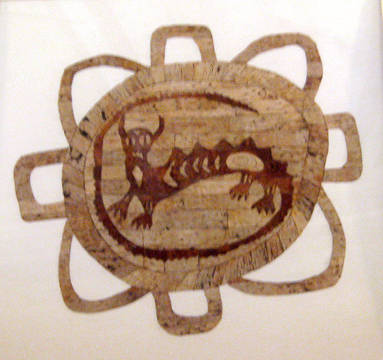
An underwater panther, known in Ojibwe as Mishipeshu (syllabic: ᒥᔑᐯᔓ) or Mishibijiw (ᒥᔑᐱᒋᐤ), pronounced [mɪʃʃɪbɪʑɪw], is among the most important and powerful mythical water beings in the spiritual traditions of many Indigenous peoples of the Northeastern Woodlands and Great Lakes region, holding particular significance among the Anishinaabe peoples. This formidable creature represents one of the fundamental forces in Indigenous cosmology, embodying the dangerous and unpredictable power of deep waters and serving as a central figure in countless traditional stories, spiritual teachings, and cultural practices that have been transmitted across generations for centuries. The name Mishipeshu translates literally as "the Great Lynx," though the creature's appearance far exceeds that of any ordinary feline.
It possesses the head and powerful paws of a giant cat, displaying the predatory features and fierce countenance of a lynx magnified to supernatural proportions. However, unlike terrestrial cats, its body is covered entirely in scales like those of a fish or serpent, creating a chimeric fusion of mammalian and aquatic characteristics. Most distinctively, dagger-like spikes or horns run along the length of its back and tail, creating a formidable defensive and offensive armament that emphasizes the creature's dangerous nature.
These copper-colored or metallic spikes were sometimes depicted in pictographs and petroglyphs as gleaming and sharp enough to tear canoes apart or impale unwary travelers. According to Anishinaabe tradition, Mishipeshu makes his home in the depths surrounding Michipicoten Island in Lake Superior, one of the Great Lakes' most remote and spiritually significant locations. The creature is considered an immensely powerful being in the mythological and spiritual traditions of several Indigenous North American tribes, particularly the Anishinaabe (a collective term encompassing several related peoples), the Odawa (Ottawa), Ojibwe (Chippewa), and Potawatomi nations of the Great Lakes region spanning both Canada and the United States.
These peoples have maintained complex relationships with Mishipeshu for countless generations, viewing the underwater panther with a mixture of respect, fear, and reverence as a force that must be properly acknowledged and placated through offerings and proper spiritual conduct when traveling on the waters. Beyond the Anishinaabe cultural sphere, the Innu people of northeastern Canada also possess their own Mishibizhiw stories and traditions, demonstrating the widespread cultural significance of this aquatic supernatural being across different Indigenous nations. To the Algonquin peoples, the underwater panther was considered the most powerful being of the underworld realm, holding dominion over the mysterious and dangerous depths beneath the surface of lakes and rivers.
The Ojibwe traditionally regarded Mishipeshu and others of his kind as the supreme masters of all water creatures, exercising authority over fish, aquatic mammals, and particularly over snakes and serpents, which were understood to be the underwater panthers' servants or manifestations of their power. This hierarchical understanding of water spirits placed the underwater panther at the apex of aquatic supernatural beings, making proper relationship with these creatures essential for safe water travel, successful fishing, and survival in the lake and river environments that were central to Great Lakes Indigenous lifeways. Some versions of the Nanabozho creation legend—the sacred narratives describing the culture hero and trickster figure who shaped the world and taught the Anishinaabe people how to live—refer to entire communities or clans of water lynx rather than a single creature, suggesting that Mishipeshu represents not just an individual monster but a species or category of powerful water spirits inhabiting various bodies of water across the Great Lakes region.
These stories often depict complex interactions between Nanabozho and the underwater panthers, sometimes involving conflict when the water beings threaten humans or interfere with Nanabozho's creative work, and sometimes involving negotiation or cooperation, reflecting the nuanced understanding that these powerful beings could be both dangerous enemies and potential allies depending on how relationships were maintained. Some archaeologists and anthropologists studying prehistoric Native American cultures believe that underwater panthers or closely related feline-serpent hybrid beings were major components of the Southeastern Ceremonial Complex (also called the Southern Cult or Mississippian Ideological Interaction Sphere), a widespread religious and ideological system that flourished among the Mississippian culture peoples in the prehistoric American Southeast from approximately 900 to 1500 CE. Evidence for this connection comes from elaborate artistic depictions found on shell gorgets, copper plates, pottery, and other ritual objects excavated from major Mississippian sites such as Cahokia, Spiro, Etowah, and Moundville, which frequently feature feline-serpent hybrid creatures with characteristics remarkably similar to the underwater panthers of Great Lakes traditions.
These artifacts suggest that powerful water beings combining feline and reptilian features occupied significant positions in the spiritual and cosmological systems of a wide range of Indigenous North American cultures across vast geographic areas, possibly indicating either deep historical connections between different cultural groups or the independent development of similar mythological concepts in response to shared environmental and spiritual concerns about the mysterious and dangerous nature of deep waters and the beings that might inhabit them.