Titusz Dugovics
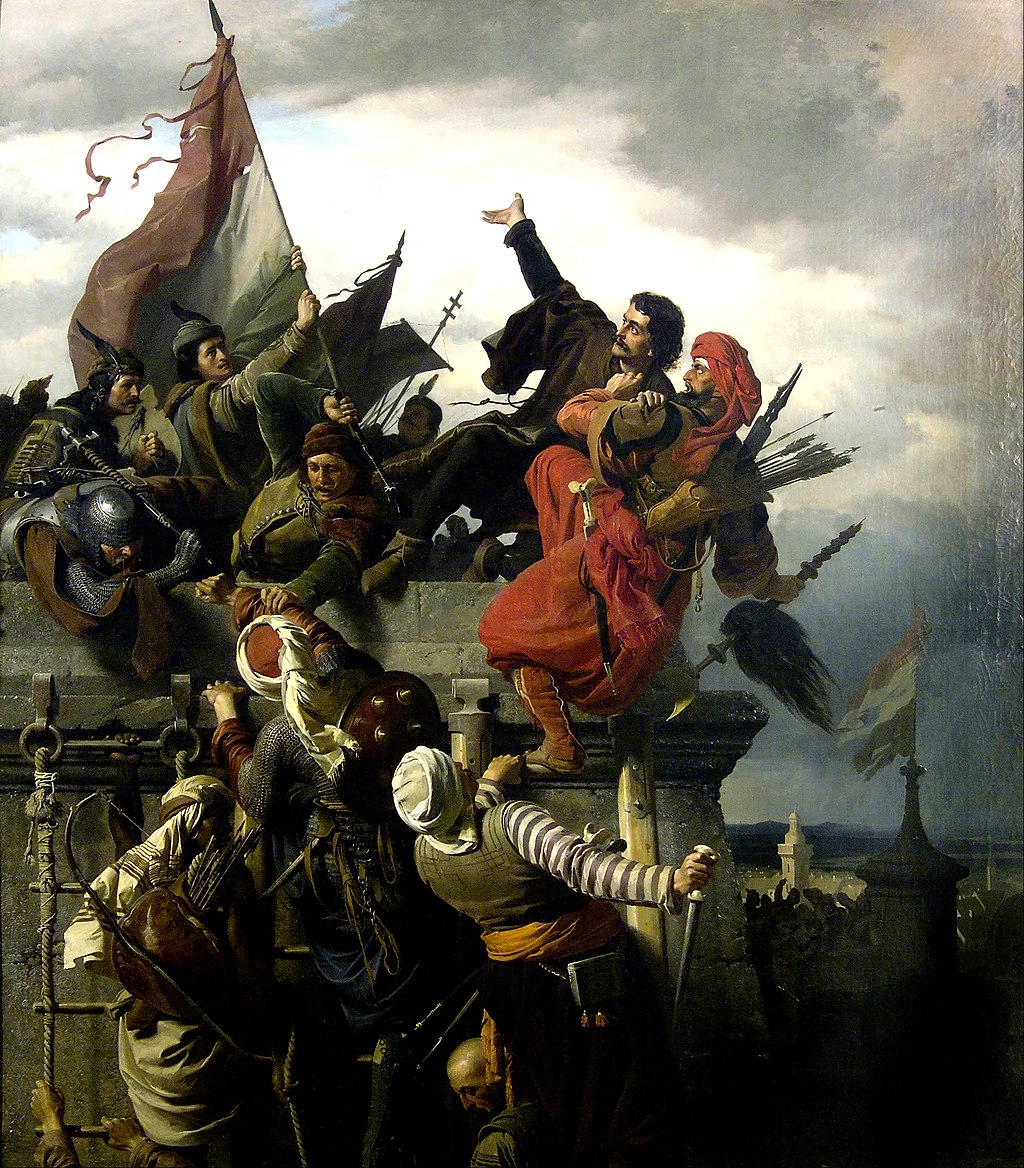
Titusz Dugovics (Titus Dugović) was the legendary name later given to an anonymous Hungarian soldier who died during the Siege of Belgrade on 21 July 1456. According to the tale, when an Ottoman Janissary climbed the castle walls to plant the Turkish standard, the soldier seized him and dragged him from the battlements. Both men fell to their deaths, but the act prevented the banner from being raised and became a symbol of defiance.
This story grew into one of the most enduring examples of patriotic self-sacrifice in Hungarian tradition. It came to represent not only the courage of Hungary’s defenders at Belgrade but also the broader struggle of Christian Europe against Ottoman expansion. The victory at Belgrade was historically decisive, halting the Turks’ advance into Central Europe for decades.
The earliest mention of the deed appears in the chronicles of the Italian historian Antonio Bonfini at the end of the 15th century. He described only an unnamed Hungarian soldier, a version echoed by the Serbian writer Konstantin Mihailović, who placed the same motif at the Siege of Jajce in 1464. Early Czech sources even claimed the nameless hero as one of their own. The figure of “Titusz Dugovics” did not appear in Hungarian history until much later.
In the 18th and 19th centuries, as Hungarian national identity strengthened, the anonymous soldier’s act was recast as a symbol of anti-Ottoman resistance. Around 1821, Imre Dugovics, a member of a Croatian-Hungarian noble family, produced forged documents that linked the unnamed hero to his supposed ancestor “Titusz Dugovics.” The forgery deceived the respected scholar Gábor Döbrentei, who published the name, ensuring its rapid spread in national memory. Since then, Titusz Dugovics has been celebrated in literature, art, and public commemoration, with numerous streets named in his honor.
Although historians such as Tibor Szőcs argue that Dugovics himself never existed and that the name was a 19th-century invention, the legend retains cultural power. What remains certain is that during the desperate fighting of July 1456, an unknown soldier did sacrifice his life on the walls of Belgrade, and that deed has lived on as a timeless emblem of heroism.