THE SIDE-HILL GOUGER
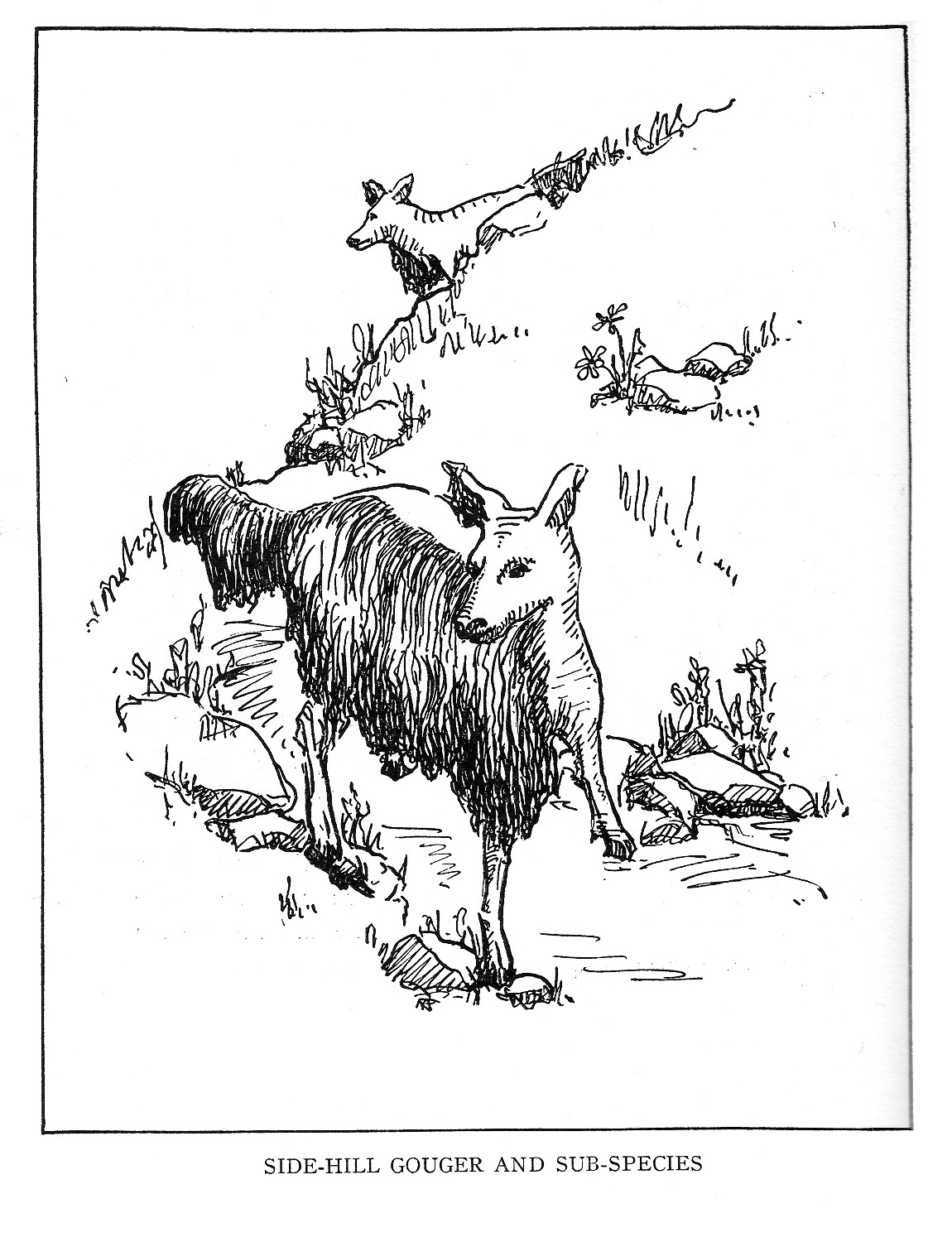
There has long been lively disagreement about the proper common name of this curious creature. Folks from the East often call it the “Side-hill Badger,” while Californians argue for “Side-hill Winder.” Others swear by names like “Godaphro,” “Prock,” or “Side-hill Wowser.” A handful of more technical-minded souls even insist that “Gyascutus” is the only true term. Yet in most circles the majority vote goes to “Gouger,” and so we will settle on that.
The Gouger is found only in hilly country, and with good reason. Its legs on one side of the body are shorter than those on the other, which forces it to travel around slopes in a single direction. A typical litter contains six to eight pups, though every so often one is born with the leg arrangement reversed.
These odd youngsters rarely remain with their normal siblings once weaned, for they can only circle the hillside in the opposite direction. Ordinary Gougers, however, leave behind the distinctive half-gouged trails that woodsmen recognize so well. Such tracks were once common in New England, though nowadays they are more often seen in the wooded hills of the West.
Mr. Bill Ericsson of North Haven, Maine, tells an amusing tale about how the Gougers first spread westward. According to him, the New England population grew so crowded that food ran short, and some had no choice but to move on.
At last a mismatched pair—one with the standard legs and one with the reversed set—struck out together to find a new home. Hillsides and slopes gave them no trouble, but whenever they came to flat ground they faced a problem. To solve it, they leaned against each other with their longer legs on the outside, waddling along like two drunken men staggering home from town.