Spear of Longinus
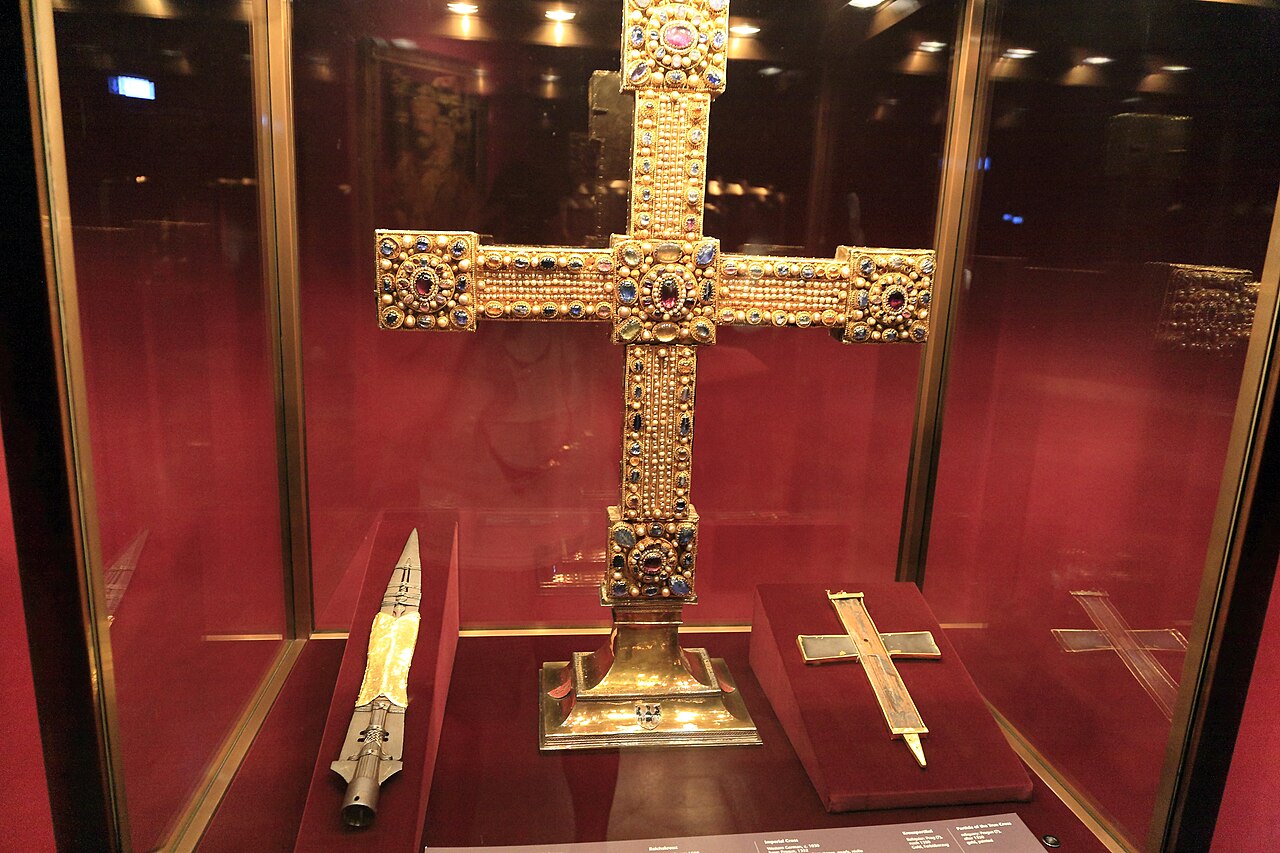
Spear of Longinus is a legendary artifact from Hofburg, Austria, dated to ~530 AD (Middle Ages).
The Holy Lance, also known as the Spear of Longinus or the Spear of Destiny, is a legendary Christian relic purported to be the weapon used by a Roman soldier to pierce the side of Jesus during his crucifixion. While the lance receives only a brief, unnamed mention in the Gospel of John, it subsequently became a focal point of extensive medieval extrabiblical tradition and hagiography. As one of the primary "Instruments of the Passion," the spear has been revered for centuries as both a sacred object of pilgrimage and a potent symbol of divine authority and military invincibility.Documented accounts of relics identified as the Holy Lance began to surface as early as the 6th century, with the earliest recorded sightings occurring in Jerusalem.
According to tradition, the soldier who wielded the spear was later identified as Saint Longinus, a centurion who purportedly converted to Christianity after witnessing the miracles following the death of Christ. By the Late Middle Ages, several European monarchs and religious centers claimed to possess the true spearhead—or at least fragments of it—leading to the proliferation of diverse relics across the continent. These artifacts were not only used in liturgical ceremonies but were frequently carried into battle as talismans of victory; for instance, the Crusaders' morale was famously revitalized during the Siege of Antioch in 1098 following the purported discovery of the lance beneath the city's cathedral.In the contemporary era, four major relics are traditionally identified as the Holy Lance or its significant components, each housed in geographically distinct locations:Vienna, Austria: The most prominent version, part of the Imperial Regalia of the Holy Roman Empire, characterized by a distinctive gold cuff and a nail purportedly from the True Cross.Vatican City: Preserved within Saint Peter's Basilica, though it is rarely displayed to the public.Vagharshapat, Armenia: Housed at the Mother See of Holy Etchmiadzin, featuring a unique, flattened spearhead design.Antioch: Historically associated with the First Crusade, though its current status is often debated by historians.The Vienna Holy Lance remains the most culturally significant iteration, currently on display at the Hofburg Palace.
During the 20th century, the relic gained further notoriety through various pseudohistorical claims regarding its alleged occult powers, most notably the myth that Adolf Hitler sought the spear to harness its "guarantee of victory." Whether viewed as a legitimate historical artifact from the 1st century or a masterfully crafted medieval symbol of statehood, the Holy Lance persists as a primary example of the "sovereign relic" motif, representing the enduring intersection of religious faith, political legitimacy, and the legendary power of the Passion.