Satori(覚)
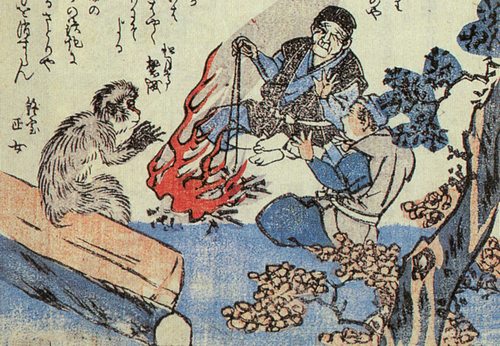
Satori (覚; literally "consciousness" or "awareness") are mind-reading, monkey-like yōkai (supernatural creatures) in Japanese folklore said to inhabit the mountains of Hida and Mino provinces (present-day Gifu Prefecture in central Japan). These creatures represent one of the more psychologically unsettling categories of yōkai due to their ability to read and vocalize human thoughts. According to traditional accounts, people encounter satori while walking along remote mountain paths or resting in mountain shelters.
Upon reading a person's mind, the satori immediately speaks the person's thoughts aloud faster than the human could articulate them, creating a deeply disconcerting experience where one's private mental processes are exposed and announced before they can even be consciously expressed. Some theories suggest satori are the degraded or fallen incarnations of mountain deity children who have declined from divine status and transformed into yōkai form, reflecting broader Japanese folkloric themes about the transformation or corruption of spiritual beings. Satori would appear before travelers at mountain huts and shelters, and some accounts claim they would attempt to eat or kill humans if given opportunity, marking them as potentially dangerous creatures.
However, they possess a notable vulnerability: if something unexpected happens that the satori did not foresee—essentially anything that occurs outside their mind-reading predictions—they become stricken with overwhelming fear and immediately flee. This weakness suggests their confidence depends entirely on their precognitive abilities, and when those abilities fail to predict events, they become psychologically vulnerable. Alternative interpretations hold that satori present no actual danger to humans and would not dare harm those who work honorably on the mountain, suggesting possible coexistence between humans and satori provided humans maintain proper respect and conduct.
The satori appears in Toriyama Sekien's influential yōkai compendium "Konjaku Gazu Zoku Hyakki" (Continued Illustrations of the Hundred Demons from the Present and the Past). However, Toriyama's depiction was modeled after the yamako (玃)—an ape-man from Chinese legends—as portrayed in the "Wakan Sansai Zue" (Illustrated Sino-Japanese Encyclopedia) and similar works. Toriyama's accompanying text stated "there are yamako (玃) deep in the mountains of Hida and Mino," suggesting he gave this creature the Japanese name "satori" specifically because of their ability to "read" (satoru) people's minds, creating a name that reflected their characteristic power rather than simply adopting the Chinese terminology.
The yamako in Chinese legends was an ape-like humanoid creature, but in the Japanese "Wakan Sansai Zue," it was reinterpreted as a mind-reading animal inhabiting Hida and Mino. The Chinese character 玃 can be pronounced "kaku," and the Japanese character 覺 (simplified to 覚), which also can be pronounced "kaku" and means "awareness" or "consciousness," was selected as a fitting replacement character. This character was subsequently misread or reinterpreted as "satori" (using the kun'yomi or native Japanese reading rather than the on'yomi or Chinese-derived reading), leading to the emergence of "satori" as a distinctly Japanese yōkai differentiated from the original Chinese yamako, demonstrating how Japanese folklore adapted and transformed Chinese legendary creatures into uniquely Japanese forms through linguistic reinterpretation and cultural adaptation.
Alternative theories propose that satori are based on or related to the yamabiko, another yōkai depicted in Toriyama Sekien's "Konjaku Gazu Zoku Hyakki" and the "Hyakkai Zukan" and other yōkai collections. The yamabiko is traditionally known as a creature or phenomenon that imitates or echoes human voices in mountains—essentially a supernatural explanation for echo phenomena. The renowned folklorist Kunio Yanagita, in his work "Yōkai Dangi" (Discussions of Yōkai), argued that the folklore tradition of satori reading and speaking people's thoughts and the legend of yamabiko imitating people's voices share a common origin—both representing uncanny experiences in mountain settings where one's own words or thoughts are mysteriously repeated or reflected back, creating unsettling encounters with forces that mirror human consciousness or speech in ways that blur boundaries between self and other, internal and external.
The satori legend reflects several important aspects of Japanese folklore and psychology: anxieties about loss of privacy and mental autonomy; the unsettling experience of having one's inner thoughts exposed; the power of the unexpected to overcome even supernatural abilities; and mountain settings as liminal spaces where normal rules don't apply and where encounters with the uncanny become possible. The creature also exemplifies how Japanese yōkai taxonomy evolved through complex interactions between Chinese legendary sources, Japanese linguistic reinterpretation, artistic systematization by Edo-period scholars like Toriyama Sekien, and ongoing folk traditions that continued to shape and reshape these creatures' characteristics and meanings.