Sassui Punnhun
Sassui Punnhun (also known as Sassi Punnu) is one of the great tragic romances of Sindh, Punjab, and Balochistan. The story is set in Bhambore, Sindh, and in the deserts of Makran, and tells of a devoted lover who braves hardship and danger while searching for her stolen husband.
In Sindh, it is remembered as one of the Seven Queens of Sindh celebrated by Shah Abdul Latif Bhittai, alongside Umar Marvi, Momal Rano, Sohni Mehar, Lilan Chanesar, Sorath Rai Diyach, and Noori Jam Tamachi. In Punjab, it is one of the four great folk romances, together with Heer Ranjha, Sohni Mahiwal, and Mirza Sahiban.
The earliest record of the tale appears in the writings of Qazi Qadan, later in the Risalo of Shah Abdul Karim of Bulri, and finally in Shah Jo Risalo by Shah Abdul Latif Bhittai, where it is celebrated as an allegory of divine love. The story was also retold in Punjabi by Hashim Shah.
Punnhun, also called Punnu, was the son of Jam Aali (or Ari), a Baloch prince of Kech in Balochistan. Sassui was the daughter of the Raja of Bhambore. At her birth, astrologers warned that she would bring dishonor to the royal family, so she was placed in a wooden box and cast into the Indus. A childless washerman of Bhambore found her, took her in as a blessing, and raised her as his own daughter.
Sassui grew to be astonishingly beautiful, and stories of her beauty spread to Kech, where they reached Prince Punnhun. Determined to see her, he traveled to Bhambore disguised as an ordinary man and sent his clothes to the washerman so that he could catch a glimpse of Sassui. When they met, the two fell deeply in love.
Sassui’s adoptive father was reluctant, hoping she would marry only a washerman, but Punnhun offered to prove his worth by taking up the washerman’s trade. Though he failed at washing clothes, he secretly filled the garments with gold coins so that no one would complain, and Sassui’s father at last consented to the marriage.
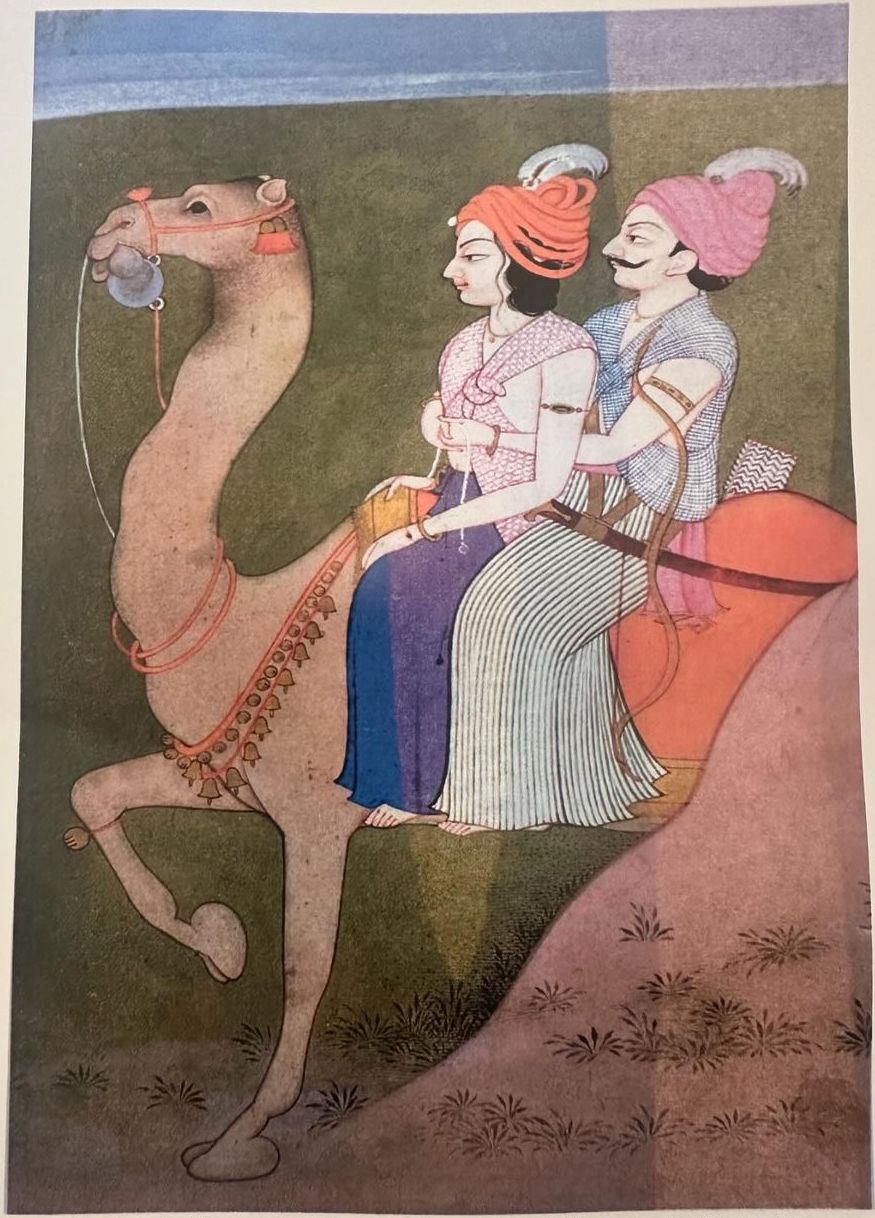
Punnhun’s family, however, opposed the union of a Baloch prince with a washerman’s daughter. His brothers came to Bhambore, feigned support for the marriage, and during the celebrations intoxicated him with wine. When he was senseless, they placed him on a camel and carried him back to Kech.
At dawn, Sassui awoke to find her husband gone. Grief-stricken, she set out on foot across the desert, calling Punnhun’s name with every step. She walked until her feet blistered and her lips cracked with thirst. Along the way, she met a shepherd who gave her water, but then, overcome by her beauty, tried to violate her. Sassui prayed for deliverance, and the earth opened to conceal her.
When Punnhun awoke in Kech and realized what had happened, he fled back toward Bhambore. On the way he learned from the shepherd of Sassui’s fate. Crying out her name, he prayed for the same release, and once more the earth split open, taking him into the same mountain valley where Sassui had vanished. Tradition holds that their graves lie together there, a symbol of love and faithfulness that endures beyond death.
Today, sites linked to the legend remain: the Fort of Punnhun near Kech Makran in Balochistan, and the alleged joint graves of Sassui and Punnhun near Lasbela, about 45 miles west of Karachi.
Shah Abdul Latif Bhittai immortalized their story in his Sufi verses, presenting it as a timeless metaphor for devotion, longing, and union with the divine.