Roger I of Sicily
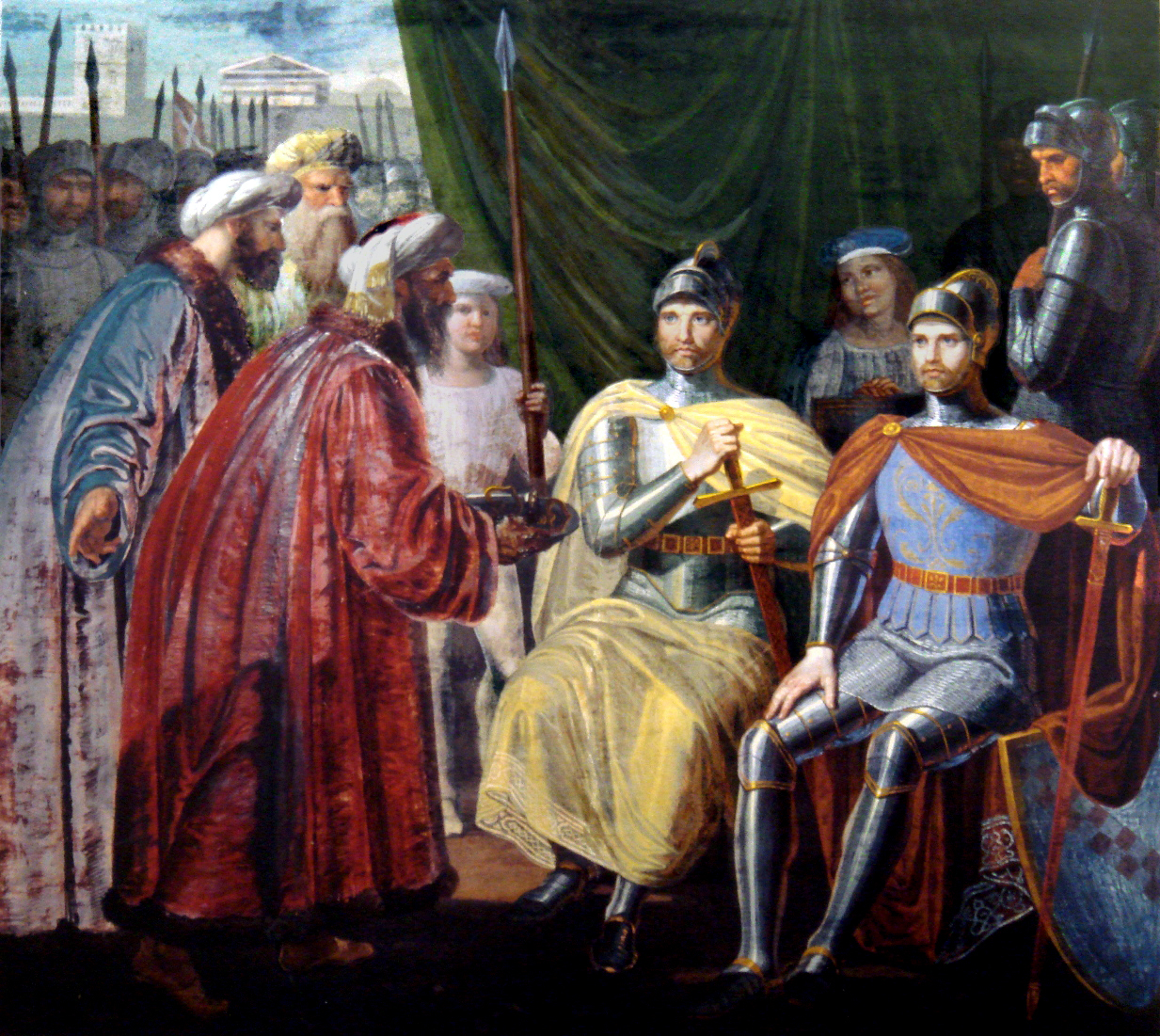
Roger I (Italian: Ruggero; Arabic: رُجار, romanized: Rujār; Maltese: Ruġġieru; Norse: Rogeirr), born approximately 1031 and deceased June 22, 1101, was commonly known by the nicknames "Roger Bosso" and "Grand Count Roger." He was a Norman nobleman of remarkable military and administrative ability who became the first Grand Count of Sicily, ruling from 1071 until his death in 1101 and transforming a fragmented Muslim emirate into a powerful, multicultural Christian state that would become one of the wealthiest and most sophisticated kingdoms in medieval Europe. Roger's conquest and governance of Sicily represented not merely a military achievement but a profound cultural and political transformation that would shape Mediterranean history for centuries, establishing Norman dominance in southern Italy and creating a unique fusion of Norman, Byzantine, Arab, and Latin cultures that made Sicily a center of learning, commerce, and artistic achievement during the High Middle Ages.
As a prominent member of the House of Hauteville, a Norman family that rose from relatively modest origins in the Cotentin Peninsula of Normandy to become one of the most powerful dynasties in Christendom, Roger embodied the martial prowess, political ambition, and opportunistic adaptability that characterized the Norman expansion throughout Europe and the Mediterranean during the eleventh century. The Hauteville family's remarkable ascent from minor Norman nobility to rulers of vast territories in southern Italy and Sicily stands as one of the most dramatic examples of social mobility and territorial conquest in medieval history. Roger and his brothers—particularly Robert Guiscard, who became Duke of Apulia and Calabria—exemplified the combination of military skill, political cunning, and administrative competence that enabled the Normans to carve out substantial principalities in regions far from their Scandinavian and Norman homelands.
Roger participated in several major military expeditions against the Emirate of Sicily, which had been under Muslim rule since the ninth century when Arab and Berber forces conquered the island from the Byzantine Empire. These campaigns began in 1061 when Roger, still a relatively young man in his early thirties, joined his considerably older brother Robert Guiscard in an invasion of Sicily. The Muslim Emirate of Sicily, though wealthy and culturally sophisticated, had become politically fragmented and militarily weakened by internal divisions among various Arab and Berber factions, creating vulnerabilities that the Normans skillfully exploited.
The Norman conquest proceeded gradually over three decades rather than through a single decisive campaign, as Roger and his forces systematically captured Sicilian cities and fortifications through a combination of military force, diplomatic negotiations with local Muslim rulers willing to switch allegiances, and exploitation of factional conflicts within the emirate.
The year 1071 marked a pivotal moment in Roger's career when his brother Robert Guiscard, recognizing Roger's military accomplishments and needing to secure his loyalty and continued military support, formally invested him with authority over the portions of Sicily that Norman forces had already conquered. This investiture established Roger as the principal Norman ruler in Sicily, though initially his territory comprised only parts of the island while substantial Muslim-controlled regions remained independent. The relationship between the two brothers combined genuine familial cooperation with underlying tensions typical of medieval dynastic politics, as Robert held superior rank as Duke of Apulia while Roger possessed greater autonomy and territorial ambitions in Sicily.
Despite occasional disputes over precedence and territorial boundaries, the brothers generally maintained effective cooperation that served both their interests, with Robert focusing primarily on mainland Italian affairs while Roger concentrated on the Sicilian conquest.
Over the following two decades, Roger prosecuted the conquest of Sicily with remarkable persistence, military skill, and political acumen. By 1090, after nearly thirty years of intermittent warfare, diplomatic maneuvering, and gradual territorial consolidation, he had succeeded in conquering the entire island, bringing all of Sicily under Norman Christian rule for the first time since the Muslim conquest centuries earlier. This achievement required not only military victories but also the careful management of a complex, multiethnic, and multireligious society.
Unlike many medieval conquerors who sought to impose cultural and religious uniformity on conquered populations, Roger adopted a relatively pragmatic and tolerant approach toward his Muslim and Greek Orthodox subjects, recognizing that Sicily's prosperity depended substantially on the skills, knowledge, and economic productivity of these communities. He permitted Muslims to continue practicing their faith, retained many Arab administrators and officials who possessed valuable expertise in governance and taxation, and protected Greek Orthodox Christians from Latin persecution, creating a remarkably diverse and tolerant society by medieval standards.
In 1091, Roger extended Norman dominion beyond Sicily itself by conquering Malta, the strategically located island south of Sicily that controlled crucial Mediterranean shipping lanes between Europe and North Africa. Malta's conquest gave Roger control over an even larger maritime domain and enhanced Sicily's position as a dominant naval power in the central Mediterranean. The acquisition of Malta also provided additional revenues and military resources that Roger could deploy in defense of his Sicilian realm and in support of Norman interests throughout the Mediterranean region.
His conquest of Malta demonstrated his understanding of maritime strategy and his ambition to establish Norman hegemony not merely over Sicily but over the broader central Mediterranean basin.
The state Roger created through his decades of conquest and governance represented a remarkable political achievement that combined Norman feudal institutions with Byzantine administrative practices and Arab cultural influences. He established a centralized government that was unusually effective by medieval standards, implementing systematic taxation, maintaining professional administrative bureaucracy, and enforcing royal authority over potentially rebellious feudal nobles. Sicily under Roger's rule became exceptionally prosperous, benefiting from agricultural productivity, extensive maritime trade connecting Europe with the Byzantine Empire and the Muslim world, and the continuation of sophisticated Arab irrigation systems and agricultural techniques that made the island one of the most productive agricultural regions in the Mediterranean.
The capital city of Palermo evolved into one of the largest and wealthiest cities in Europe, rivaling Constantinople and Córdoba in population, commercial vitality, and cultural sophistication.
Roger's administrative and cultural policies established patterns that would characterize the Kingdom of Sicily for generations. He patronized scholars, artists, and architects from diverse cultural backgrounds, creating a court culture that synthesized Norman, Arab, Byzantine, and Latin elements into a distinctive Sicilian identity. Churches were built incorporating Arab architectural motifs alongside Norman and Byzantine elements, official documents were produced in Latin, Greek, and Arabic, and the royal court employed administrators, translators, and scholars from all three cultural traditions.
This multicultural synthesis made Norman Sicily a unique phenomenon in medieval Europe, where religious and cultural tolerance was rare and most rulers sought to impose religious and linguistic uniformity on their subjects.
The state Roger created did not remain independent indefinitely but was merged with the Duchy of Apulia—the mainland southern Italian territories ruled by Roger's nephew and eventual successor—in 1127, more than two decades after Roger's death. This merger unified Norman possessions in southern Italy and Sicily under a single ruler. In 1130, Roger's son, Roger II, who had inherited his father's Sicilian territories and subsequently acquired the Duchy of Apulia, successfully persuaded the Antipope Anacletus II to crown him King of Sicily, transforming the Grand County into a kingdom that would become one of the wealthiest and most powerful states in medieval Europe.
The Kingdom of Sicily that emerged from Roger I's conquests would play a crucial role in Mediterranean politics, serving as a bridge between Christian Europe and the Muslim and Byzantine worlds, participating in the Crusades, and developing sophisticated governmental institutions that influenced later European state formation.
Roger's male-line descendants continued to rule Sicily down to 1194, maintaining the dynasty he had founded for nearly a century after his death. His grandson William I and great-grandson William II continued Hauteville rule, though William II died without male heirs in 1189. The succession then passed through Roger's daughter Constance, who had married Henry VI of the House of Hohenstaufen, Holy Roman Emperor.
When William II died, Constance and Henry claimed the Sicilian throne, and by 1194 the Hohenstaufen dynasty had secured control of Sicily, ending Hauteville male-line rule but continuing the kingdom Roger had founded. The Hohenstaufen rulers, particularly Frederick II, would build upon the administrative, cultural, and political foundations Roger I had established, making Sicily under Frederick II one of the most advanced and culturally sophisticated states in thirteenth-century Europe.
Roger I's legacy extended far beyond his immediate dynastic succession. He demonstrated that the Norman military elite, originally Viking raiders and mercenaries who had settled in Normandy only a few generations earlier, could not only conquer sophisticated civilizations but also govern them effectively, synthesizing diverse cultural traditions into stable and prosperous states. His relatively tolerant policies toward religious and ethnic minorities, though motivated partly by pragmatic considerations rather than modern concepts of tolerance, created a model of multicultural governance that stood in stark contrast to the religious intolerance and ethnic conflict that characterized much of medieval Europe.
The prosperous, culturally vibrant kingdom he established in Sicily would influence Mediterranean history for centuries, serving as a crucial point of contact between Christian Europe and the Muslim world, facilitating the transmission of Arab scientific and philosophical knowledge to the Latin West, and demonstrating the possibility of constructive coexistence among different religious and cultural communities. Roger I thus deserves recognition not merely as a successful military conqueror but as a statesman and administrator whose vision and policies created one of medieval Europe's most remarkable and successful multicultural states.