Rob Roy MacGregor
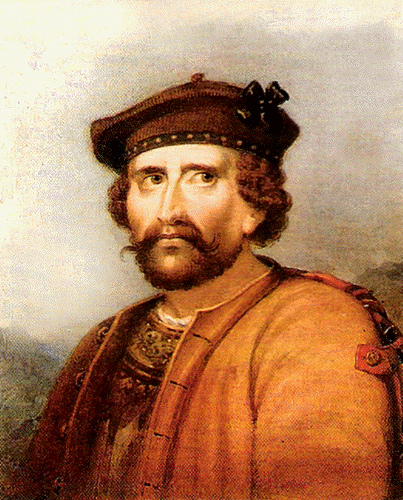
Robert Roy MacGregor (Scottish Gaelic: Raibeart Ruadh MacGriogair, meaning "Red Robert MacGregor"; March 7, 1671 – December 28, 1734), commonly known as Rob Roy, was a Scottish Highland clan leader, cattle drover, and Jacobite who became an outlaw after financial ruin and persecution by powerful enemies, subsequently achieving enduring status as a Scottish and Jacobite folk hero celebrated for his defiance of authority, his Robin Hood-like reputation for protecting the poor, and his embodiment of Highland resistance to Lowland and English domination during the tumultuous period following the Glorious Revolution and the Jacobite uprisings of the early eighteenth century. Born into the MacGregor clan—a Highland clan that had been officially proscribed and outlawed by the Scottish and British governments, with members forbidden from using their own surname under penalty of death, a persecution stemming from the clan's reputation for cattle raiding and their support for various rebellions—Rob Roy grew up in a society where his very identity was criminalized by state authority. Despite these legal disabilities, he initially pursued a respectable career as a cattle drover and dealer, borrowing money to expand his livestock trading business.
However, in 1712, financial disaster struck when one of his chief herdsmen absconded with a large sum of money that Rob Roy had borrowed from the powerful Duke of Montrose, leaving him unable to repay the debt. Montrose, rather than showing leniency or accepting a repayment plan, used this default as an opportunity to destroy Rob Roy, seizing his lands, evicting his wife and children from their home in winter, and pursuing him relentlessly through legal and extralegal means. This persecution transformed Rob Roy from a respectable businessman into an outlaw who took to the hills and glens of the Scottish Highlands, conducting a personal war of revenge against Montrose and his allies through cattle raiding, protection rackets (where he offered Highland communities protection from other raiders in exchange for payment), and occasional acts of brigandage.
His intimate knowledge of Highland terrain, his clan connections, his personal charisma, and his reputation for courage made him extremely difficult for authorities to capture despite numerous attempts, and he became a persistent thorn in the side of the powerful Duke of Montrose and the government forces that periodically hunted him. Rob Roy's outlawry coincided with the Jacobite cause—the movement to restore the Catholic Stuart dynasty to the British throne after James II had been deposed in the Glorious Revolution of 1688 and replaced by the Protestant William and Mary. Rob Roy participated in the Jacobite rising of 1715, fighting at the Battle of Sheriffmuir, though his military contribution was modest and his motivations combined genuine Jacobite loyalty with his personal vendetta against Montrose, who supported the Hanoverian government.
The failure of the 1715 rising left Rob Roy continuing his outlaw existence, though he eventually negotiated a form of accommodation with authorities and died peacefully in his bed in 1734 at age 63 rather than meeting a violent end. Rob Roy's transformation from historical outlaw into legendary folk hero occurred through multiple cultural processes. During his lifetime and immediately after his death, he was celebrated in Lowland Scottish and English popular culture through ballads, chapbooks, and eventually Daniel Defoe's 1723 account "Highland Rogue," which portrayed him as a Scottish Robin Hood who stole from the rich (particularly from his enemy the Duke of Montrose) and helped the poor, embodying virtues of courage, generosity, and resistance to tyranny and oppression.
Sir Walter Scott's 1817 novel "Rob Roy" further romanticized and popularized his story during the nineteenth-century vogue for Highland culture and Jacobite romanticism, cementing his status as a Scottish national hero who represented Highland independence, traditional clan loyalties, and resistance to the modernizing, anglicizing forces that were transforming Scottish society. In both Scottish and Jacobite cultural memory, Rob Roy came to symbolize far more than the historical cattle dealer turned outlaw that he actually was, instead representing the Highland way of life threatened by Lowland Scottish and English economic and political power, the Jacobite cause and loyalty to the Stuart dynasty against the Hanoverian usurpers, the defiance of ordinary people against oppressive aristocratic authority, and the romantic appeal of the outlaw who lives by his own code outside corrupt legal systems. His story has been retold countless times in literature, film, and popular culture, making Rob Roy MacGregor one of Scotland's most recognizable historical figures and ensuring his place in the pantheon of folk heroes whose legends express cultural values, historical grievances, and national identities that transcend and often contradict the more complex and morally ambiguous realities of their actual historical lives and actions.