Prince Marko
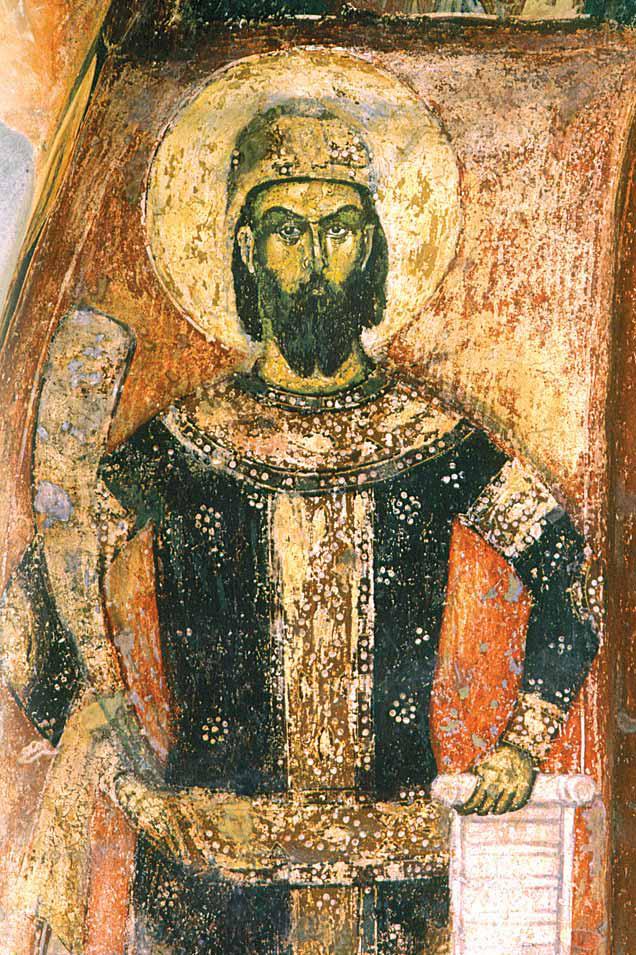
Marko Mrnjavčević (Serbian Cyrillic: Марко Мрњавчевић, pronounced [mâːrko mr̩̂ɲaːʋt͡ʃeʋit͡ɕ]), born approximately 1335 and killed May 17, 1395, held the position of de jure Serbian king from 1371 to 1395. However, his actual authority was confined to territory in western Macedonia centered on the town of Prilep, making him a de facto regional ruler rather than the sovereign of a unified Serbian realm. He is known by various titles across South Slavic traditions: as Prince Marko (Macedonian: Kрaле Марко; Serbian Cyrillic: Краљевић Марко, Kraljević Marko, IPA: [krǎːʎeʋit͡ɕ mâːrko]) and King Marko (Macedonian: Kрaл Марко; Serbian Cyrillic: Краљ Марко; Bulgarian: Крали Марко).
In South Slavic oral tradition and epic poetry, he evolved into a legendary figure of immense cultural significance during the centuries of Ottoman domination over the Balkans, transcending his relatively modest historical role to become an enduring symbol of resistance and heroism. Marko's father, King Vukašin, served as co-ruler alongside Serbian Tsar Stefan Uroš V during a period marked by declining central authority and the progressive fragmentation of the Serbian Empire into semi-independent principalities ruled by powerful regional nobles. Vukašin controlled substantial territories including lands in northwestern Macedonia and Kosovo.
In 1370 or 1371, recognizing his son's potential and seeking to establish dynastic continuity, Vukašin crowned Marko as "young king"—a title that positioned him as the prospective successor to the childless Tsar Uroš on the Serbian throne and granted him junior royal status during his father's lifetime. On September 26, 1371, the course of Serbian history changed dramatically when Vukašin was killed and his army decisively defeated at the Battle of Maritsa against Ottoman forces. This catastrophic defeat on the banks of the Maritsa River represented a turning point in Ottoman expansion into the Balkans and shattered Serbian military power in the southern regions.
Approximately two months after this disaster, Tsar Uroš died, leaving the Serbian throne vacant. These two deaths within such a short period formally elevated Marko to the kingship of the Serbian lands according to the succession arrangement his father had established. However, the reality of his position bore little resemblance to his royal title.
The Serbian nobility, who had grown increasingly autonomous during the preceding decades of weakened central authority, refused to acknowledge Marko as their supreme ruler. Each nobleman prioritized his own territorial interests and independence, making the reunification of Serbian lands under a single monarch impossible. The fragmented political landscape meant that Marko's royal title carried symbolic weight but lacked practical authority beyond his own immediate territories.
Confronted with the overwhelming power of the Ottoman Empire and unable to command the allegiance of his fellow Serbian nobles, Marko pragmatically accepted Ottoman vassalage sometime after 1371. This arrangement required him to pay tribute, provide military contingents when summoned, and acknowledge Ottoman suzerainty, but it allowed him to retain control over his core territories and maintain his position as a regional ruler. By 1377, substantial portions of the lands he had inherited from his father Vukašin had been seized by rival Serbian noblemen who exploited the power vacuum and political chaos following the Battle of Maritsa.
King Marko thus found himself reduced to governing a relatively modest territory in western Macedonia, far removed from the expansive realm his title suggested. Despite his diminished political circumstances, Marko devoted resources to religious and cultural patronage. He funded the construction of the Monastery of Saint Demetrius near Skopje, commonly known as Marko's Monastery, which was completed in 1376.
This monastery stands as a tangible legacy of his reign and demonstrates his commitment to supporting the Orthodox Church despite his limited resources. The monastery's frescoes and architecture represent important examples of late medieval Serbian ecclesiastical art and continue to attract visitors and pilgrims. Marko's life ended on May 17, 1395, when he perished in battle at Rovine while fighting alongside Ottoman forces against the Wallachians under the command of Voivode Mircea the Elder.
As an Ottoman vassal, he was obligated to participate in military campaigns at the sultan's command, even when this meant fighting against fellow Christians. According to some legendary accounts, Marko prayed before the battle that he would be killed rather than forced to fight against Christians, reflecting the moral conflict inherent in his position as both a Christian ruler and an Ottoman vassal. His death in this engagement concluded a life characterized by the tension between nominal royal status and practical subservience, between Christian identity and Ottoman service.
Although Marko Mrnjavčević possessed modest historical significance as an actual ruler—governing only a small territory for roughly two decades as an Ottoman vassal—he underwent a remarkable transformation in South Slavic oral tradition and folklore. He emerged as one of the most prominent and beloved characters in the epic poetry and folk songs of the Balkans, particularly in Serbian, Macedonian, and Bulgarian traditions. In these narratives, the historical complexities and compromises of his real life were stripped away and replaced with an idealized portrait of heroic resistance.
He is venerated as a national hero by Serbs, Macedonians, and Bulgarians alike, remembered in Balkan folklore as an exceptionally strong, fearless, and just protector of the common people who fought tirelessly against injustice and stood as a bulwark against Turkish oppression during the Ottoman occupation. The legendary Prince Marko of folklore bears only a superficial resemblance to the historical figure. In epic poetry, he possesses superhuman strength, wields a massive sword and mace, rides a supernatural horse named Šarac, and engages in fantastic adventures that pit him against Ottoman warriors, dragons, and various supernatural adversaries.
He is portrayed as a champion of the weak and oppressed, a defender of Christian values, and an embodiment of South Slavic resistance to foreign domination. This folkloric Marko became a vessel for the hopes, values, and collective memory of South Slavic peoples enduring centuries of Ottoman rule, offering them a heroic figure who represented their aspirations for freedom and justice. The disconnect between the historical Marko—an Ottoman vassal who died fighting for the sultan—and the legendary Marko—an implacable enemy of the Ottomans—illustrates how folklore transforms history to serve the psychological and cultural needs of a people.
Through countless songs, stories, and cultural references spanning centuries, Prince Marko has maintained his position as one of the most enduring and significant figures in South Slavic cultural heritage, demonstrating how legend can eclipse history when a people require heroes to sustain their identity through periods of oppression and hardship.