Porus
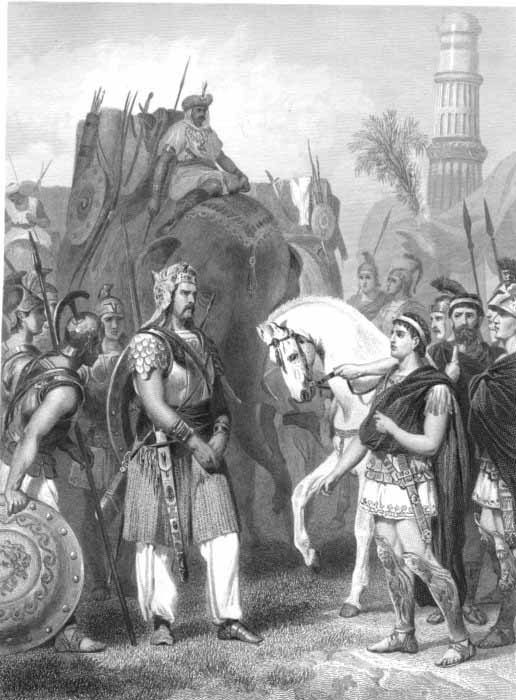
Porus, also known as Poros (Ancient Greek: Πῶρος Pôros; fl. 326–321 BC), was an Indian king whose domain stretched between the Jhelum (Hydaspes) and Chenab (Acesines) rivers, a fertile region called Chaj Doab in present-day Punjab, Pakistan. He is known only from Greek accounts, which vary considerably, since Indian traditions do not mention him.
These sources describe him as a powerful ruler who commanded an army of infantry, cavalry, chariots, and war elephants. In 326 BC, he famously faced Alexander the Great at the Battle of the Hydaspes, where he positioned his elephants in the front lines and attempted to block Alexander’s crossing of the river. However, Alexander’s forces executed a clever night maneuver to cross upstream, and in the ensuing battle Porus’ cavalry was overwhelmed, his elephants turned back in confusion against his own men, and his army was surrounded.
Despite the crushing defeat, Porus fought until wounded and remained defiant even when captured. Impressed by his bravery, Alexander not only spared his life but reinstated him as ruler and expanded his territory, granting him dominion over lands as far as the Beas River.
Scholars have debated Porus’ origins. Michael Witzel and Hem Chandra Raychaudhuri suggest he descended from the Pūrus, a Vedic tribe diminished after the Battle of the Ten Kings, while others argue he may have been linked to the Shurasenas of Mathura, based on Greek descriptions of Indian worshippers of “Herakles,” a figure often identified with Krishna or Vishnu. Strabo noted that his realm contained nearly 300 cities, and he had a history of rivalry with Taxila, reportedly killing its ruler Ambhiraj, his maternal uncle.
This enmity carried into Alexander’s campaign, as Omphis (Ambhiraj’s son) allied with the Macedonians to counter Porus. After the Hydaspes, Porus assisted Alexander in further campaigns, including the siege of Sangala, where his elephants played a decisive role in breaking enemy defenses. When Alexander’s exhausted troops refused to march beyond the Beas, Porus was confirmed as ruler of all land east of the Jhelum, making him one of the most prominent local kings left in power.
Following Alexander’s death in 323 BC, Porus retained authority with recognition from Antipater, the new regent of the empire, but was eventually killed around 321–315 BC by Eudemus, Alexander’s satrap in Punjab, who sought to strengthen his own position in the region.