Pocahontas
Pocahontas (US pronunciation: /ˌpoʊkəˈhɒntəs/, UK: /ˌpɒk-/; born Amonute, also known as Matoaka and, after her Christian baptism, Rebecca Rolfe; born approximately 1596, died March 1617) was a Native American woman of the Powhatan people whose life became inextricably entangled with the English colonial settlement at Jamestown, Virginia, making her one of the most famous and mythologized Native American figures in American history. She was the daughter of Wahunsenacawh (known to the English as Chief Powhatan), the paramount chief who ruled over a powerful network of tributary tribes collectively forming the Tsenacommacah—known to the English colonists as the Powhatan Confederacy or Powhatan Chiefdom—which encompassed the Tidewater region of what is today the eastern portion of the U.S. state of Virginia, including the coastal plains and river valleys where English colonization first took root in North America.
The circumstances of Pocahontas's involvement with the Jamestown colonists remain contested and have been heavily romanticized, distorted, and mythologized over the four centuries since the events occurred. The most famous story about her—popularized by Captain John Smith's accounts written years after the alleged events and further embellished by subsequent writers, artists, and filmmakers—claims that as a young girl of about ten or eleven years old, she dramatically saved Smith from execution by her father's warriors by throwing herself over his body and begging for his life. However, this narrative has been seriously questioned by scholars, historians, and Pocahontas's documented descendants, who point out numerous problems with Smith's account: he did not mention this dramatic rescue in his initial writings about Virginia but only added the story years later after Pocahontas had become famous in England and after she had died and could not contradict his version; the "execution" he described may have been a ritual adoption ceremony that he misunderstood due to cultural differences; and Smith had a pattern of claiming that exotic foreign women had saved his life in his various adventure narratives, suggesting a literary formula rather than historical fact.
What is historically documented is that in 1613, during a period of escalating hostilities between the Powhatan Confederacy and the English colonists who were aggressively expanding their territorial claims and making increasingly unreasonable demands, Pocahontas was captured by English colonists led by Captain Samuel Argall. She was seized through deception and treachery—lured aboard an English ship by a Patawomeck chief who collaborated with the English—and was held for ransom in Jamestown. The English demanded that Chief Powhatan return English prisoners, weapons, and tools that had been taken during conflicts, using Pocahontas as a hostage to coerce her father's compliance.
This kidnapping represented a traumatic violation that transformed Pocahontas from a free member of Native royalty into a captive whose body and fate became bargaining chips in colonial power struggles. During her captivity, which lasted approximately a year, Pocahontas was subjected to intensive pressure to abandon her Powhatan identity and cultural practices. She was "encouraged"—a euphemistic term that likely conceals various forms of coercion, isolation, and psychological pressure applied to a teenage girl held prisoner far from her family and community—to convert to Christianity.
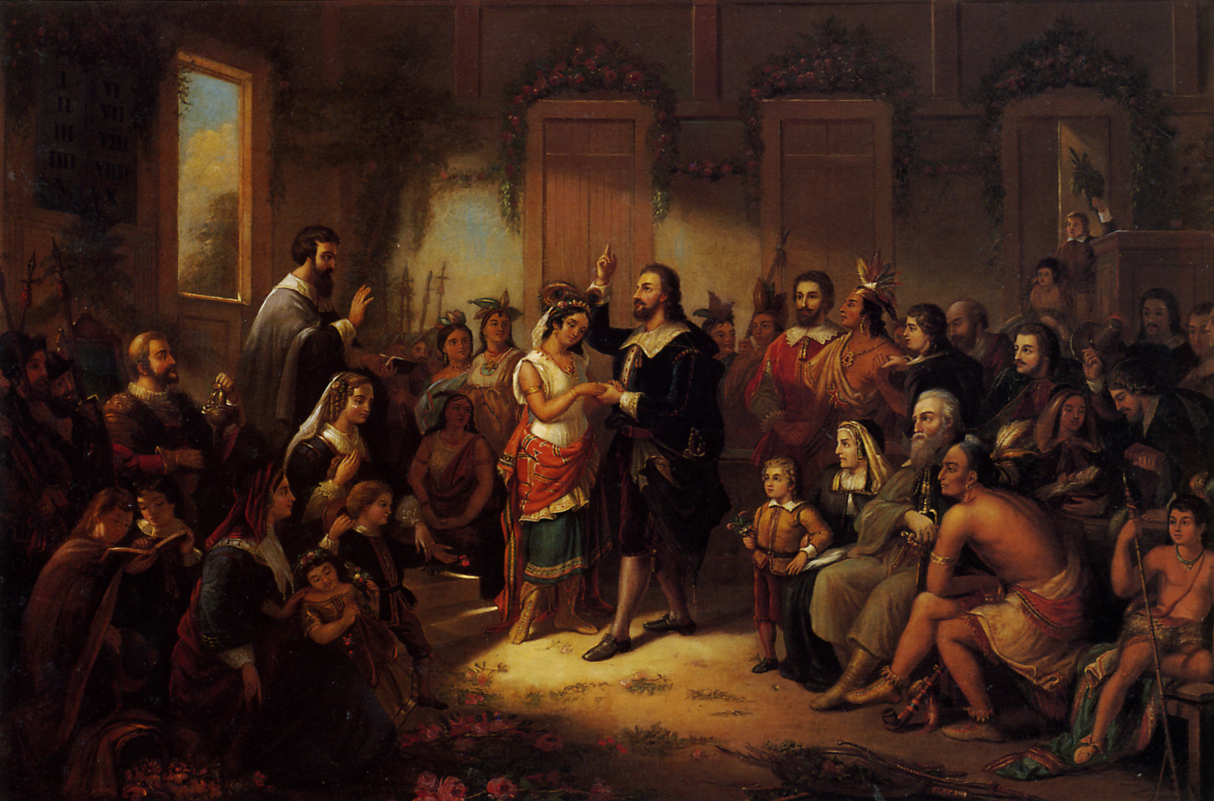
She was baptized under the Christian name Rebecca, symbolically dying to her Native identity and being reborn as an English Christian woman, at least in the colonists' understanding of the transformation they were engineering. In April 1614, at approximately seventeen or eighteen years of age, Pocahontas married John Rolfe, an English tobacco planter who had successfully cultivated a profitable strain of tobacco that would become the economic foundation of the Virginia colony. The marriage occurred under deeply ambiguous circumstances: Pocahontas was still technically a captive, her father had not been able to meet all the ransom demands, and the extent to which she freely consented to this marriage versus accepting it as the best available option in her captive circumstances remains impossible to determine with certainty.
In January 1615, she gave birth to their son, Thomas Rolfe, who would become an important figure linking English and Powhatan descent lines. In 1616, the Virginia Company, which had sponsored the Jamestown colony and desperately needed to attract additional investment to prevent the failing settlement from collapsing financially, arranged for the Rolfe family to travel to London. Pocahontas was presented to English society as a showcase example of the "civilized savage"—proof that Native Americans could be converted to Christianity, adopt English customs and manners, and be transformed into proper English subjects, thereby justifying the colonial enterprise and suggesting that Virginia offered opportunities not merely for resource extraction but for the profitable "improvement" of Indigenous peoples through cultural assimilation.
This propaganda purpose underlying her visit meant that Pocahontas was displayed, examined, and exhibited almost as a curiosity or exotic specimen, though the English also recognized her royal status and accorded her some of the courtesies due to foreign nobility. During this trip, she may have encountered Squanto (Tisquantum), a Patuxet man from New England who had his own traumatic history of being kidnapped by English explorers and who would later play a crucial role in the survival of the Plymouth Colony—a possible meeting that would have brought together two Native individuals whose lives had been dramatically altered by English colonization and who had both been transported to England and displayed as examples of Indigenous people. Pocahontas became a genuine celebrity in London, creating a sensation among English society fascinated by this "Indian princess" who had supposedly chosen English civilization over her savage origins.
She was elegantly entertained at high-society gatherings, received by various nobles and dignitaries, and attended a masque (an elaborate courtly entertainment combining theater, music, and dance) at Whitehall Palace, where she may have been presented to King James I and Queen Anne, though accounts vary. This public exposure subjected her to intense scrutiny, curiosity, and the exhausting demands of serving as a living advertisement for the Virginia Company's colonial project while navigating a completely foreign culture whose language, customs, social hierarchies, and physical environment (including diseases to which she had no immunity) must have been profoundly disorienting. In 1617, after spending months in England, the Rolfe family prepared to sail back to Virginia, but Pocahontas fell gravely ill as their ship traveled down the Thames River toward the open ocean.
She died at Gravesend, Kent, England, in March 1617, at only twenty or twenty-one years of age. The causes of her death remain unknown—possibilities include smallpox, pneumonia, tuberculosis, or other diseases, as well as the possibility of poisoning, though this last theory lacks credible evidence. She was buried in the churchyard of St George's Church in Gravesend, but the exact location of her grave has been lost because the church was destroyed by fire in the seventeenth century and rebuilt, and the churchyard was subsequently reorganized, meaning that while Pocahontas's burial site is somewhere within the church grounds, its precise location cannot be identified.
This lost grave carries symbolic resonance: the woman whose identity was erased through forced conversion and colonial appropriation also had her final resting place lost to history, buried in foreign soil far from her homeland and people. Numerous places, landmarks, geographical features, businesses, and products throughout the United States have been named after Pocahontas, from cities and counties to rivers, parks, streets, and commercial brands, reflecting her enduring presence in American cultural consciousness and her transformation into a national symbol, though often one disconnected from historical reality. Her story has been extensively romanticized, sentimentalized, and fictionalized over the four centuries since her death, with many widely believed aspects of her narrative being entirely fictional or gross distortions of historical events.
The romantic legend typically portrays her as having fallen in love with John Smith, saving his life, and later choosing to embrace English civilization because she recognized its superiority—a narrative that serves colonial and American nationalist ideologies by suggesting that even Indigenous people acknowledged the legitimacy and desirability of European conquest and cultural dominance, thereby absolving colonialism of its violence and coercion. Many of the stories told about Pocahontas by the English explorer John Smith—particularly the dramatic rescue scene that has become the most famous episode associated with her—have been vigorously contested and rejected by her documented descendants, who object to the romanticization, distortion, and exploitation of their ancestor's story for purposes that erase the violence, trauma, and coercion she experienced and that transform her from a real human being who suffered under colonialism into a mythological figure who supposedly validated colonial conquest through her alleged love for her colonizers and eager embrace of their culture. Pocahontas has been the subject of countless works of art, literature, theater, film, and other cultural productions, ranging from nineteenth-century romantic poetry and paintings to twentieth-century Hollywood films (including Disney's animated version) that have further distanced her image from historical reality.
Many prominent Americans have claimed descent from Pocahontas through her son Thomas Rolfe, who survived his mother's death, returned to Virginia, and had descendants who intermarried with English colonial families. These claimed descendants include members of the First Families of Virginia (the aristocratic families who trace their lineage to the earliest English settlers and who used Pocahontas descent to claim both aristocratic English ancestry and a romantic connection to American soil that predated other colonists), First Lady Edith Wilson (wife of President Woodrow Wilson), American character actor Glenn Strange (best known for playing Frankenstein's monster in Universal horror films and Sam the bartender on the television series Gunsmoke), and astronomer Percival Lowell (famous for his observations of Mars and his predictions about Planet X that eventually led to Pluto's discovery). This widespread claiming of Pocahontas as an ancestor reflects her unique position in American mythology as a figure who can be simultaneously claimed as Native American royalty and as an ancestor who supposedly chose to become English, allowing her descendants to claim both prestigious Indigenous heritage and validation of colonial conquest—a paradoxical status that continues to make Pocahontas one of the most contested, mythologized, and culturally significant figures in American history, whose real life and experiences remain obscured beneath centuries of romantic legends, colonial propaganda, and nationalist myth-making that have served ideological purposes far removed from the traumatic historical reality of a young Native woman caught between two worlds in violent collision.