Paul Revere
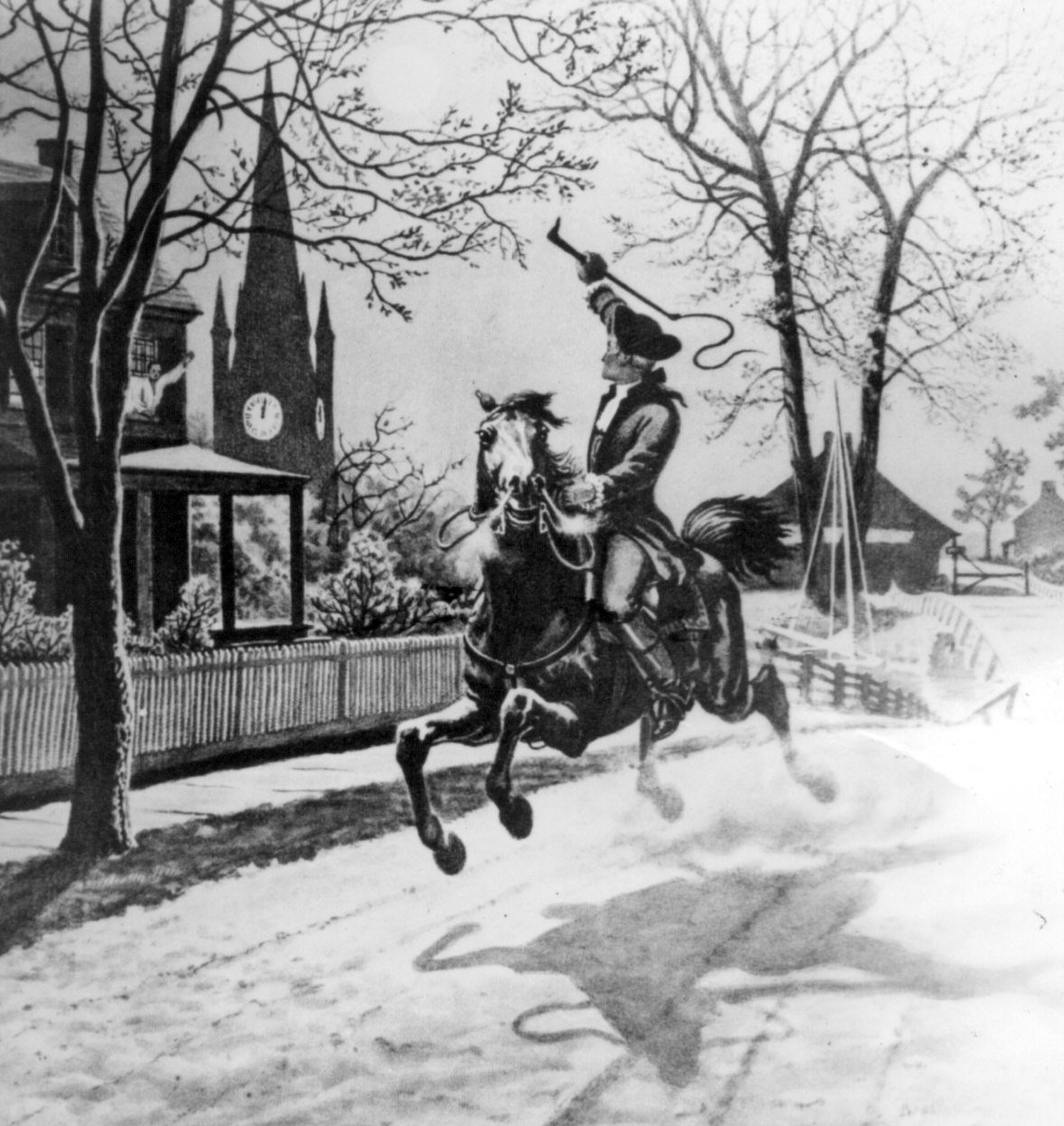
Paul Revere (pronunciation: /rɪˈvɪər/; born December 21, 1734 Old Style, which corresponds to January 1, 1735 New Style after calendar adjustment; died May 10, 1818) was an American silversmith, engraver, military officer, and industrialist who achieved enduring fame for his role during the opening months of the American Revolutionary War in Massachusetts, particularly for his dramatic midnight ride on April 18-19, 1775, when he rode through the countryside to alert colonial minutemen and militia forces of the approach of British regular troops prior to the battles of Lexington and Concord—the first military engagements of the Revolutionary War. This ride, though only one episode in Revere's long and varied career, transformed him into an iconic American folk hero whose name became synonymous with patriotic action, vigilance against tyranny, and the spirit of grassroots resistance that characterized the American independence movement. Born in the densely populated North End neighborhood of Boston, Revere was the son of a French Huguenot immigrant silversmith (Apollos Rivoire, who anglicized his name to Paul Revere).
Young Paul learned his father's craft and eventually became a highly skilled and prosperous silversmith and engraver, earning recognition for the quality of his work in creating silver vessels, jewelry, and decorative objects for Boston's wealthy elite. His silversmithing provided a comfortable income and established him as a respected craftsman and prominent member of Boston's artisan class—the skilled workers and small business owners who formed an important constituency in colonial urban politics and who would prove crucial to the revolutionary movement. Beyond silverwork, Revere also created engravings, including political propaganda prints such as his famous (though historically inaccurate) depiction of the Boston Massacre, which helped inflame colonial anger against British military presence and policies.
During the escalating political crisis of the 1760s and early 1770s that preceded open warfare, Revere emerged as a strong and active supporter of the Patriot cause, joining the Sons of Liberty—the network of activists who organized resistance to British taxation and imperial policies through protests, boycotts, and occasionally violence against royal officials and their property. Revere's skills as a rider, his trustworthiness, his connections across different social classes in Boston and surrounding towns, and his commitment to the Patriot cause made him an ideal courier and organizer. He helped to establish and maintain an intelligence and alarm system designed to monitor the movements, plans, and activities of British forces garrisoned in Boston, ensuring that colonial militia and political leaders would receive timely warning of British military operations that threatened Patriot leaders, military supplies, or colonial self-governance.
Revere's most famous contribution to the revolutionary cause came on the night of April 18-19, 1775, when he and William Dawes (and later Samuel Prescott) rode out from Boston to warn colonial leaders and militia that British troops were marching to Concord to seize military supplies and possibly arrest Patriot leaders Samuel Adams and John Hancock. Revere's midnight ride—actually undertaken around 10 PM to midnight before his capture by a British patrol—succeeded in alerting numerous communities along his route, allowing minutemen and militia to assemble and confront the British troops the following morning at Lexington and Concord. While the historical reality involved multiple riders and Revere himself was captured before reaching Concord (though he managed to warn Adams and Hancock before his capture), the ride became legendary and was dramatically immortalized in Henry Wadsworth Longfellow's 1861 narrative poem "Paul Revere's Ride," which begins with the famous lines "Listen, my children, and you shall hear / Of the midnight ride of Paul Revere." Longfellow's poem, written during the Civil War to inspire Northern patriotism, took considerable poetic license with historical facts but succeeded brilliantly in cementing Revere's status as an American folk hero and making his name familiar to generations of schoolchildren who memorized the stirring verses.
Following his famous ride, Revere continued serving the Patriot cause in various capacities. He was commissioned as an officer in the Massachusetts Militia and participated in several military operations. However, his military service ended inglorious after his involvement in the Penobscot Expedition of 1779, one of the most catastrophic American military campaigns of the Revolutionary War.
This disastrous attempt to dislodge a British force from Penobscot Bay in present-day Maine resulted in the destruction of the entire American naval force and humiliating defeat. Revere, who commanded the artillery during the expedition, faced accusations of insubordination and cowardice from the expedition's commander, but after a lengthy controversy and a court-martial hearing, he was formally absolved of blame and his honor was officially restored, though the episode remained a painful chapter in his life that contrasted sharply with the glory of his midnight ride. Following the conclusion of the Revolutionary War and American independence, Revere returned to his original trade of silversmithing, continuing to produce high-quality silver objects that are today prized by museums and collectors as examples of early American decorative arts.
However, Revere demonstrated remarkable entrepreneurial vision and business acumen by using the substantial profits from his expanding silversmith business to finance ventures into new fields of manufacturing that were essential to the young nation's economic development and military self-sufficiency. He established operations in iron casting, producing tools, hardware, and other iron goods; bronze bell casting, creating church bells that rang throughout New England communities (some of which still ring today); and cannon casting, contributing to American military capabilities. He also pioneered the forging of copper bolts, spikes, and fittings used in shipbuilding and construction.
Revere's most significant industrial achievement came in 1800 when he became the first American to successfully develop the technology and manufacturing process to roll copper into thin, uniform sheets suitable for use as protective sheathing on the hulls of naval vessels. Copper sheathing prevented marine growth and wood-boring organisms from damaging wooden ship hulls, dramatically extending vessels' service lives and improving their speed and maneuverability—crucial advantages for both naval warships and merchant vessels. Revere's copper rolling mill in Canton, Massachusetts, supplied copper sheathing for numerous American warships, including the USS Constitution ("Old Ironsides"), and established American independence in this strategically important manufacturing capability, eliminating dependence on British suppliers.
This industrial legacy, though less famous than his midnight ride, represented a substantial contribution to American economic development and military strength during the early national period. Paul Revere died on May 10, 1818, at age 83, having lived to see American independence secured, the Constitution established, and the young republic survive its early challenges. He left behind a complex legacy: as a folk hero immortalized in poetry whose actual midnight ride, while genuinely important, has been mythologized beyond historical accuracy; as a skilled craftsman whose silver work represents some of the finest examples of early American decorative arts; as a patriot activist who risked his life and livelihood for colonial resistance and American independence; and as an innovative industrialist who helped establish American manufacturing capabilities essential to the nation's economic independence and military security.
His life thus encompassed multiple facets of early American history—craft tradition, revolutionary politics, military service, and industrial development—making him a figure whose significance extends well beyond the famous ride that made his name a permanent part of American historical memory and national mythology.