Pard
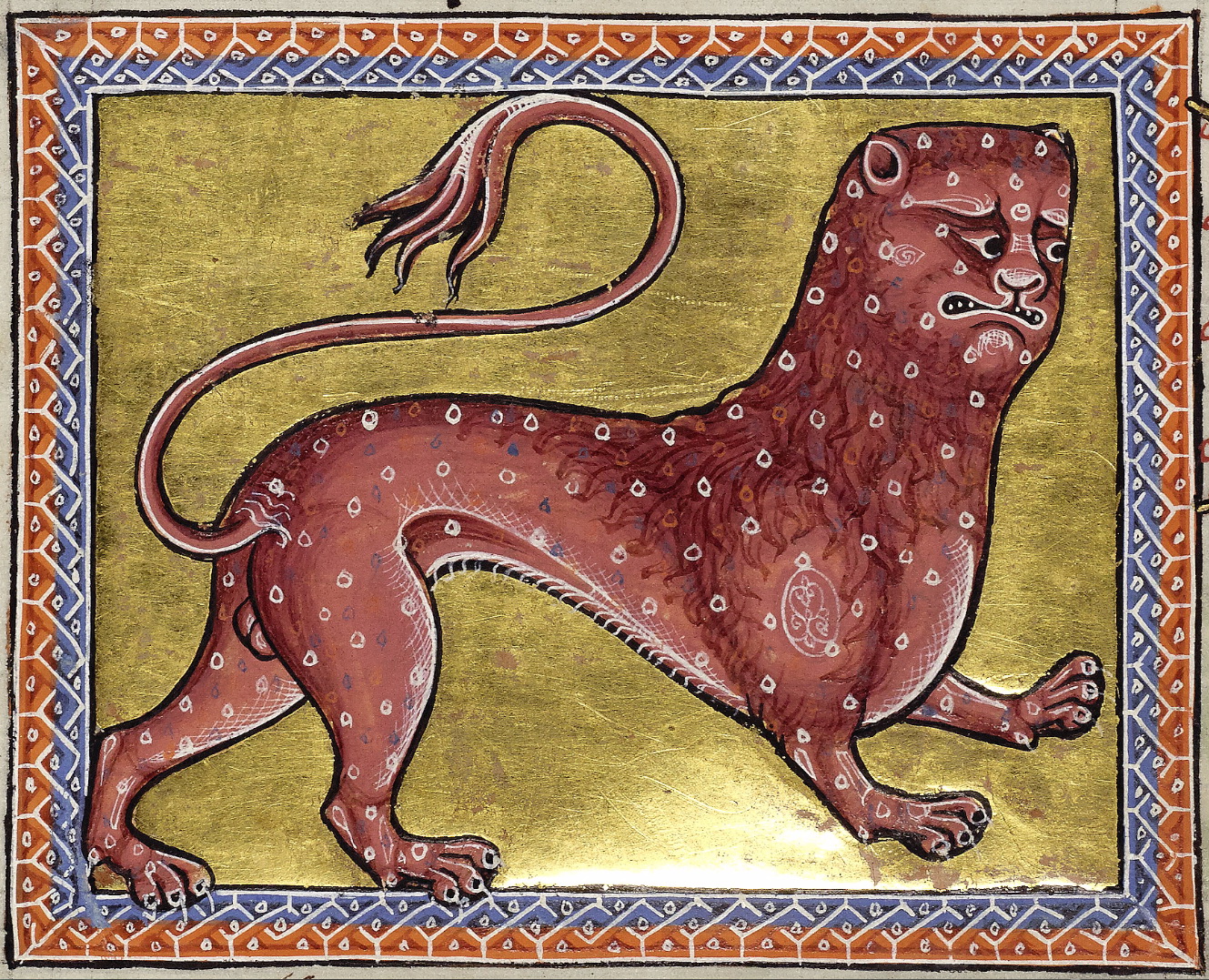
A pard (Ancient Greek: πάρδος, pardos) is the Greek and subsequently medieval Latin term for the leopard, which appears extensively in medieval bestiaries—encyclopedic compilations of real and legendary animals with moral and religious interpretations—and in Pliny the Elder's monumental first-century work Natural History (Historia Naturalis), one of the most influential texts on the natural world transmitted from classical antiquity to medieval Europe. The term "pard" served as the standard designation for leopards in European scholarly and literary texts throughout the medieval period and into the Renaissance, and it remains embedded in the English word "leopard" itself, which derives from the medieval Latin leo-pardus, literally meaning "lion-pard," reflecting an erroneous medieval belief that leopards were hybrid offspring produced by the mating of lions and pards (a confusion that demonstrates medieval natural history's tendency to explain unfamiliar animals through combination of familiar ones). Over the centuries, artistic and textual depictions of the pard varied considerably across different manuscripts, regions, and time periods, reflecting the challenges medieval Europeans faced in accurately representing an animal most of them had never personally observed.
Some artistic adaptations portrayed pards with prominent manes similar to lions, while others depicted them without manes in a more anatomically accurate manner. In later medieval and early modern representations, pards were sometimes shown with notably shorter tails than leopards actually possess, possibly due to artistic convention, manuscript copying errors, or confusion with other large cats. Despite these variations in secondary characteristics, one consistent representation remained standard across most depictions: pards were invariably portrayed as large, powerful felines distinguished by their spotted coats—the characteristic rosette pattern that marked them as distinct from lions, tigers, and other great cats and made them recognizable across different artistic traditions even when other anatomical details were rendered inaccurately or fancifully.