Nue
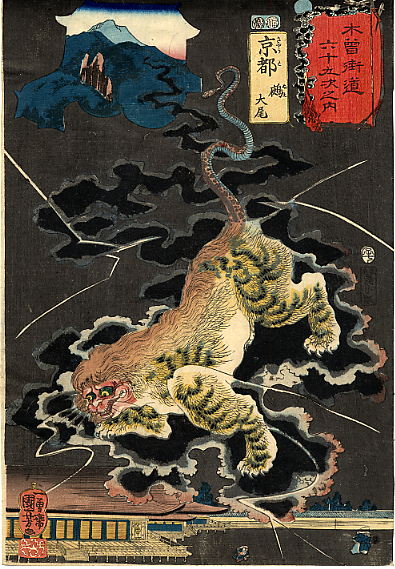
The Nue (鵺, 鵼, 恠鳥, or 奴延鳥) is a legendary yōkai (supernatural creature) or mononoke (vengeful spirit) from Japanese mythology, renowned as one of the most fearsome and grotesque composite creatures in Japanese folklore. In the Tale of Heike, one of Japan's most important medieval epic accounts, the nue is described as a Japanese chimera possessing a nightmarish combination of animal parts: the head of a monkey, the limbs of a tiger, the body of a Japanese raccoon dog (tanuki), and the front half of a snake serving as its tail. This unsettling assemblage of features from different creatures creates a deeply disturbing hybrid that embodies supernatural wrongness and chaos.
In other historical writings and variants of the legend, nothing specific is stated about the creature's torso, leaving this detail ambiguous; in these alternative versions, the nue is sometimes depicted with the torso of a tiger, creating a slightly different but equally monstrous composite form. The Genpei Jōsuiki, another important historical chronicle, provides yet another description, characterizing the nue as possessing the back of a tiger, the limbs of a tanuki, the tail of a fox, the head of a cat, and the torso of a chicken—demonstrating how the creature's exact form varied across different regional traditions and textual sources, though all versions agree on its fundamentally composite and unnatural nature. Beyond its grotesque physical appearance, the nue is particularly notorious for the terribly eerie bird-like cry it produces, transcribed as "hyoo hyoo" sounds that resemble the call of the scaly thrush (a real bird species native to Japan whose melancholy nocturnal song has long been considered ominous in Japanese culture).
This distinctive vocalization serves as an auditory warning of the creature's presence and has become deeply embedded in Japanese cultural consciousness as a harbinger of misfortune and supernatural danger. In the film Akuryōtō (originally a novel by the mystery writer Seishi Yokomizo), the memorable catchphrase "nights where the nue cry are dreadful" specifically refers to this fearsome aspect of the creature's legend, invoking the traditional association between the nue's cry and approaching calamity or death. The nue is also attributed with the supernatural ability of shape-shifting, frequently transforming itself into a black cloud that can fly through the night sky, allowing it to move unseen and strike without warning.
This nebulous form makes the creature particularly difficult to track or combat, as it can appear and disappear seemingly at will. The yōkai is thought to be primarily or exclusively nocturnal, as most historical sightings and legendary encounters occurred during nighttime hours, reinforcing its association with darkness, mystery, and the dangers that emerge when daylight protection fades. Its name when written in certain kanji characters (鵺) can be interpreted to include elements meaning "night" and "bird," linguistically encoding its nocturnal nature and its terrifying cry into its very designation.
The nue is believed to have first started appearing in Japanese historical records and folklore during the late Heian period (794-1185), the elegant but politically turbulent era when much of classical Japanese culture reached its height while the imperial court's actual power declined. For more precise dating of the creature's earliest appearances, different historical sources cite different imperial reigns within this period, including the Emperor Nijō period (1158-1165), the Emperor Konoe period (1141-1155), the Emperor Go-Shirakawa period (1155-1158), or the Emperor Toba period (1107-1123), suggesting that legends about the nue emerged and circulated during the twelfth century when Japan was experiencing significant political instability and social anxiety that often manifests in folklore through the appearance of new supernatural threats. The most famous nue legend involves the creature terrorizing the imperial court during the reign of Emperor Konoe, causing the emperor to fall mysteriously ill, until the legendary warrior Minamoto no Yorimasa shot it down with an arrow, briefly glimpsing its monstrous form before it fell into the Kamo River—a tale that established the nue as a symbol of supernatural evil that threatens even the highest levels of society and requires heroic intervention to defeat.