Neil Armstrong
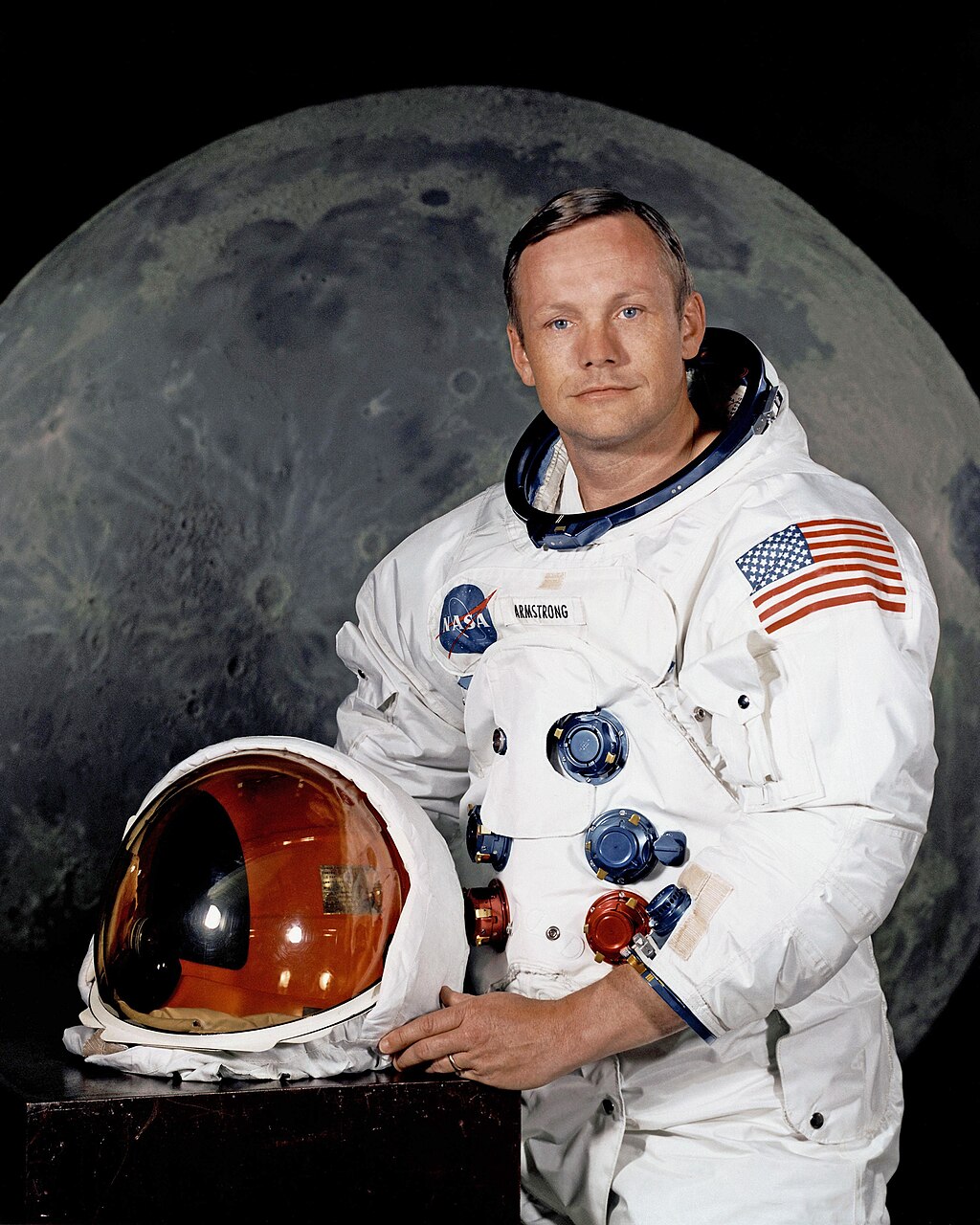
Neil Alden Armstrong (August 5, 1930 – August 25, 2012) was an American astronaut and aeronautical engineer who, as commander of the historic Apollo 11 mission in July 1969, became the first human being to set foot on the Moon—an achievement that represents one of the greatest technological, exploratory, and symbolic accomplishments in human history and that fulfilled humanity's ancient dream of reaching another celestial body. Beyond this defining moment that made him an international icon and household name, Armstrong was also a distinguished naval aviator, combat pilot, pioneering test pilot who pushed the boundaries of flight technology, and university professor who contributed to aerospace education. Armstrong was born and raised near Wapakoneta, Ohio, in a middle-class Midwestern American family that embodied the values of hard work, modesty, and public service that would characterize his entire life.
He developed a passionate interest in aviation from early childhood, earning his pilot's license before he could legally drive a car, and determined to pursue a career in aeronautical engineering. He entered Purdue University to study aeronautical engineering with his tuition paid by the United States Navy under the Holloway Plan, a scholarship program that required recipients to serve as naval officers after graduation. He became a midshipman in 1949 and completed naval flight training to become a naval aviator in 1950 at age twenty, just as the Korean War was beginning.
Armstrong saw combat action during the Korean War from 1951 to 1952, flying seventy-eight combat missions in the Grumman F9F Panther jet fighter from the aircraft carrier USS Essex. During these dangerous missions, he experienced several close calls including having his aircraft severely damaged by anti-aircraft fire, being forced to eject when his plane was hit, and witnessing fellow pilots killed in combat—experiences that forged his legendary calm under pressure and his ability to make quick, rational decisions in life-threatening situations that would later prove crucial during his spaceflight career. After completing his combat service and his naval obligation, Armstrong returned to Purdue University to complete his bachelor's degree in aeronautical engineering in 1955, graduating with the knowledge, skills, and combat-tested maturity that would propel his subsequent career.
Following graduation, Armstrong joined the National Advisory Committee for Aeronautics (NACA)—the predecessor organization to NASA—as a research test pilot at the High-Speed Flight Station at Edwards Air Force Base in California, one of the world's premier locations for cutting-edge aerospace research and experimental flight testing. As a test pilot during the 1950s, Armstrong flew some of the most advanced and dangerous aircraft ever built, serving as project pilot on several Century Series fighters (the supersonic jet fighters designated F-100 through F-106) and making seven flights in the legendary North American X-15 rocket-powered aircraft, which reached the edge of space and achieved speeds exceeding Mach 6 (over 4,000 miles per hour), making it the fastest piloted aircraft ever flown. These X-15 flights gave Armstrong experience with extreme speeds, high altitudes, rocket propulsion systems, and spacecraft-like controls that would directly prepare him for later spaceflight.
He was also selected as a participant in the U.S. Air Force's Man in Space Soonest program and the X-20 Dyna-Soar project, both early human spaceflight initiatives that were eventually canceled but that demonstrated Armstrong's recognition as one of America's elite test pilots worthy of consideration for space missions. When NASA announced it was selecting a second group of astronauts in 1962 following the success of the Mercury program's initial astronaut corps, Armstrong applied and was chosen as one of the "New Nine" astronauts selected that year, joining a group that included several future space heroes and that would form the backbone of the Gemini and Apollo programs.
Armstrong made his first spaceflight as command pilot of Gemini 8 in March 1966, partnered with pilot David Scott. This mission achieved the first docking of two spacecraft in orbit—a crucial capability needed for the Apollo lunar missions—when Armstrong successfully maneuvered his Gemini spacecraft to dock with an unmanned Agena target vehicle, demonstrating the precision flying skills and cool judgment that had made him a superb test pilot. However, shortly after docking, a stuck thruster on the Gemini spacecraft caused the joined vehicles to enter a dangerous, rapidly accelerating roll that threatened to cause the crew to black out from excessive G-forces.
Armstrong made the critical decision to undock from the Agena and use the spacecraft's re-entry control system thrusters to stop the violent rotation, regaining control and saving the mission and his and Scott's lives, though the use of re-entry fuel required mission rules to mandate an emergency early landing. This incident demonstrated Armstrong's exceptional abilities under extreme pressure and his capacity to make correct split-second decisions when facing potentially fatal emergencies. Armstrong was subsequently selected as commander of Apollo 11, the mission that would attempt the first Moon landing if earlier Apollo missions successfully completed all the preparatory steps.
During his intensive training for this mission, Armstrong had another near-fatal incident when he had to eject from the Lunar Landing Research Vehicle (LLRV)—an ungainly flying contraption nicknamed the "Flying Bedstead" that simulated lunar landing conditions—just moments before it crashed and exploded, demonstrating once again his quick reactions and unflappable demeanor in the face of imminent death. This ejection occurred less than a year before the actual Moon landing, and Armstrong calmly returned to training the next day. On July 20, 1969, Armstrong and Lunar Module pilot Buzz Aldrin successfully landed the Apollo 11 Lunar Module Eagle on the Moon's surface in the Sea of Tranquility while Command Module pilot Michael Collins orbited above in the Command Module Columbia.
The landing itself required Armstrong to take manual control when the spacecraft's computer was guiding them toward a boulder-strewn crater, and he flew the LM horizontally to find a safe landing site, touching down with only about twenty seconds of fuel remaining—another demonstration of his superb piloting skills and composure under life-or-death pressure. Approximately six and a half hours after landing, Armstrong opened the hatch, descended the ladder, and at 10:56 PM EDT on July 20, 1969, became the first human to step onto the lunar surface. As he did so, he spoke the carefully prepared but seemingly spontaneous words that would become among the most famous utterances in history: "That's one small step for [a] man, one giant leap for mankind"—a statement whose elegant simplicity and philosophical resonance perfectly captured the moment's significance for human civilization.
(The word "a" before "man" was either not spoken or not transmitted clearly, creating a grammatical awkwardness that has been debated ever since, though Armstrong always maintained he said "a man" rather than "man" to preserve the intended meaning contrasting one individual's action with humanity's collective achievement.) Armstrong's first steps on the Moon were broadcast live via television to an estimated 530 million people worldwide—approximately one-fifth of Earth's entire population at the time—making it one of the most-watched events in human history and creating a shared global moment of wonder, pride, and achievement that briefly transcended Cold War divisions and national boundaries. Over the next two and a half hours, Armstrong and Aldrin conducted scientific experiments, collected lunar soil and rock samples, planted an American flag (while noting that the mission came in peace for all mankind), left commemorative plaques and medallions, and took the iconic photographs that would define humanity's first visit to another world. Collins, orbiting alone above them, performed equally crucial duties maintaining the Command Module and preparing for the rendezvous that would return his crewmates to lunar orbit for the journey home.
Apollo 11 represented a major United States victory in the Space Race against the Soviet Union, fulfilling the ambitious national goal proposed in May 1961 by President John F. Kennedy "of landing a man on the Moon and returning him safely to the Earth" before the end of the 1960s—a goal announced when the United States was losing the space competition to the Soviets and that seemed impossibly ambitious given the technological challenges involved. The successful Moon landing vindicated the enormous investment of national resources, talent, and effort (at its peak, the Apollo program employed over 400,000 people and consumed roughly four percent of the federal budget), demonstrated American technological and organizational superiority, and provided a powerful boost to American prestige and morale during a difficult period marked by the Vietnam War, social unrest, and political assassinations.
Along with Collins and Aldrin, Armstrong was awarded the Presidential Medal of Freedom—the nation's highest civilian honor—by President Richard Nixon shortly after returning to Earth, and the crew collectively received the 1969 Collier Trophy for the greatest achievement in aerospace. President Jimmy Carter later presented Armstrong with the Congressional Space Medal of Honor in 1978, recognizing his extraordinary contributions to space exploration. Armstrong was inducted into the National Aviation Hall of Fame in 1979, and in 2009, he and his Apollo 11 crewmates received the Congressional Gold Medal, one of the highest distinctions Congress can bestow.
Despite achieving worldwide fame that few humans in history have experienced, Armstrong handled celebrity with characteristic humility and reluctance, avoiding the spotlight, declining most interview requests and commercial opportunities, and insisting that Apollo 11's success resulted from the collective efforts of hundreds of thousands of NASA employees, contractors, and engineers rather than the heroism of three astronauts. After he resigned from NASA in 1971, Armstrong deliberately chose a quiet life teaching in the Department of Aerospace Engineering at the University of Cincinnati from 1971 until 1979, where he educated the next generation of aerospace engineers while staying largely out of public view. He did agree to serve on important investigative bodies when requested, including the Apollo 13 accident investigation board in 1970 and the Rogers Commission in 1986, which investigated the Space Shuttle Challenger disaster, where his technical expertise and unimpeachable credibility contributed to understanding these tragedies and improving space safety.
Armstrong lived a private life on his Ohio farm in his later years, rarely giving interviews or making public appearances, and famously refusing to profit from his Moon landing achievement by declining to sign autographs for commercial resale or endorse products. In 2012, Armstrong underwent coronary bypass surgery to relieve blocked coronary arteries, but he died on August 25, 2012, at age 82 due to complications resulting from the surgery, depriving the world of one of the twentieth century's most significant and admirable figures. His death prompted an outpouring of tributes from around the world recognizing not only his historic achievement as the first human to walk on the Moon but also his grace, humility, dedication to service, and embodiment of the best qualities of exploration and scientific endeavor—qualities that made Armstrong not merely a famous astronaut but a genuine hero whose character and accomplishments inspired millions and whose first steps on the lunar surface will be remembered for as long as human civilization endures.