Napoleon
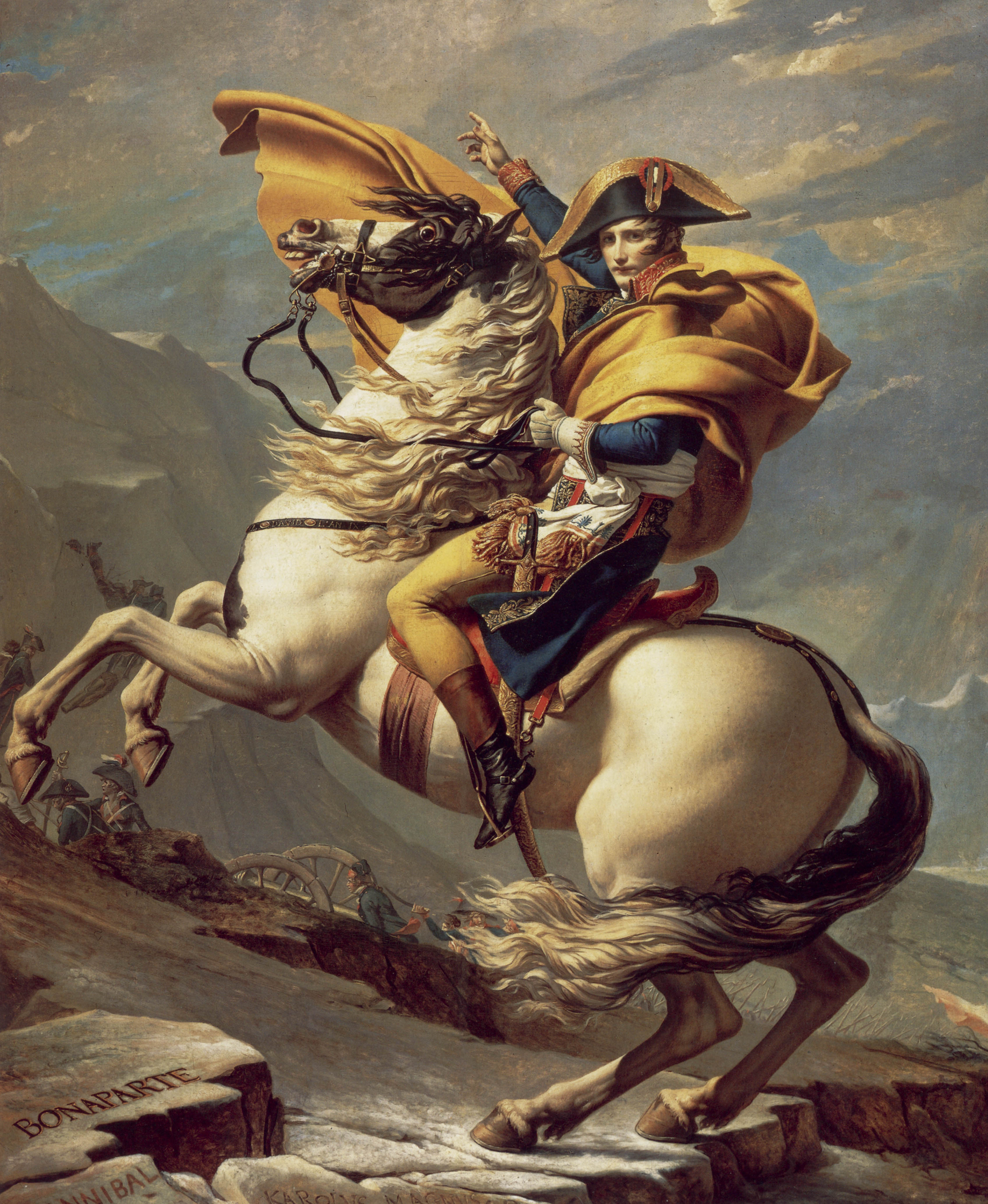
Napoleon is a legendary figure from Maison Bonaparte, France, dated to ~1769 AD (Modern era). It connects to 6 other myths and legends in the Mythosjourney atlas.
Napoleon Bonaparte, born Napoleone di Buonaparte on August 15, 1769, and deceased May 5, 1821, later adopted the regnal name Napoleon I. He served as a French general and statesman who gained prominence during the French Revolution and conducted extensive military campaigns throughout Europe during the French Revolutionary and Napoleonic Wars from 1796 to 1815. He governed the French Republic as First Consul from 1799 to 1804, then ruled the French Empire as Emperor of the French from 1804 to 1814, with a brief return in 1815.
Additionally, he held the titles of King of Italy from 1805 to 1814 and Protector of the Confederation of the Rhine from 1806 to 1813. Born on Corsica to a family of Italian ancestry, Napoleon transferred to mainland France in 1779 and received his commission as an officer in the French Royal Army in 1785. He embraced the French Revolution in 1789 and advanced its principles in Corsica.
His career accelerated rapidly following his successful siege of Toulon in 1793 and his suppression of royalist insurgents in Paris on 13 Vendémiaire in 1795. In 1796, he led a military operation against the Austrians and their Italian allies during the War of the First Coalition, achieving decisive victories that established him as a national hero. His 1798 invasion of Egypt and Syria provided the foundation for his political ascent.
In November 1799, Napoleon orchestrated the Coup of 18 Brumaire against the French Directory, becoming First Consul of the Republic. His victory at the Battle of Marengo in 1800 secured France's triumph in the War of the Second Coalition, and in 1803 he sold the Louisiana territory to the United States. In December 1804, Napoleon crowned himself Emperor of the French, further consolidating his authority.
The collapse of the Treaty of Amiens precipitated the War of the Third Coalition by 1805. Napoleon demolished the coalition through a decisive triumph at the Battle of Austerlitz, resulting in the Holy Roman Empire's dissolution. During the War of the Fourth Coalition, Napoleon defeated Prussia at the Battle of Jena-Auerstedt in 1806, advanced his Grande Armée into Eastern Europe, and overcame the Russians at the Battle of Friedland in 1807.
To expand his trade embargo against Britain, Napoleon invaded the Iberian Peninsula and placed his brother Joseph on the Spanish throne in 1808, igniting the Peninsular War. In 1809, the Austrians challenged France again in the War of the Fifth Coalition, where Napoleon strengthened his European dominance after winning the Battle of Wagram. In summer 1812, he launched a Russian invasion, briefly occupying Moscow before conducting a disastrous winter retreat of his forces.
In 1813, Prussia and Austria allied with Russia in the War of the Sixth Coalition, where Napoleon suffered a crushing defeat at the Battle of Leipzig. The coalition invaded France and seized Paris, compelling Napoleon to abdicate in April 1814. They exiled him to the Mediterranean island of Elba and restored the Bourbon monarchy.
Ten months later, Napoleon escaped from Elba aboard a brig, landed in France with a thousand men, and marched on Paris, reclaiming control of the nation. His adversaries responded by forming a Seventh Coalition, which defeated him at the Battle of Waterloo in June 1815. Napoleon was exiled to the remote South Atlantic island of Saint Helena, where he died of stomach cancer in 1821 at age 51.
Napoleon ranks among history's greatest military commanders, and Napoleonic tactics remain studied at military institutions worldwide. His legacy persists through the modernizing legal and administrative reforms he implemented in France and Western Europe, exemplified by the Napoleonic Code. He created a public education system, eliminated feudal remnants, emancipated Jews and other religious minorities, abolished the Spanish Inquisition, established the principle of legal equality for an emerging middle class, and centralized state authority at the expense of religious institutions.
His conquests catalyzed political transformation and the emergence of nation states. However, he remains controversial due to his role in wars that devastated Europe, his plundering of conquered territories, and his inconsistent civil rights record. He suppressed the free press, ended directly elected representative government, exiled and imprisoned regime critics, reinstated slavery in French colonies, prohibited the entry of black people and mulattos into France, diminished the civil rights of women and children in France, reestablished a hereditary monarchy and nobility, and brutally suppressed popular uprisings against his authority.
Related Myths & Legends
Arthur Wellesley
Dun Mikiel Xerri
