Nandi(नन्दि)
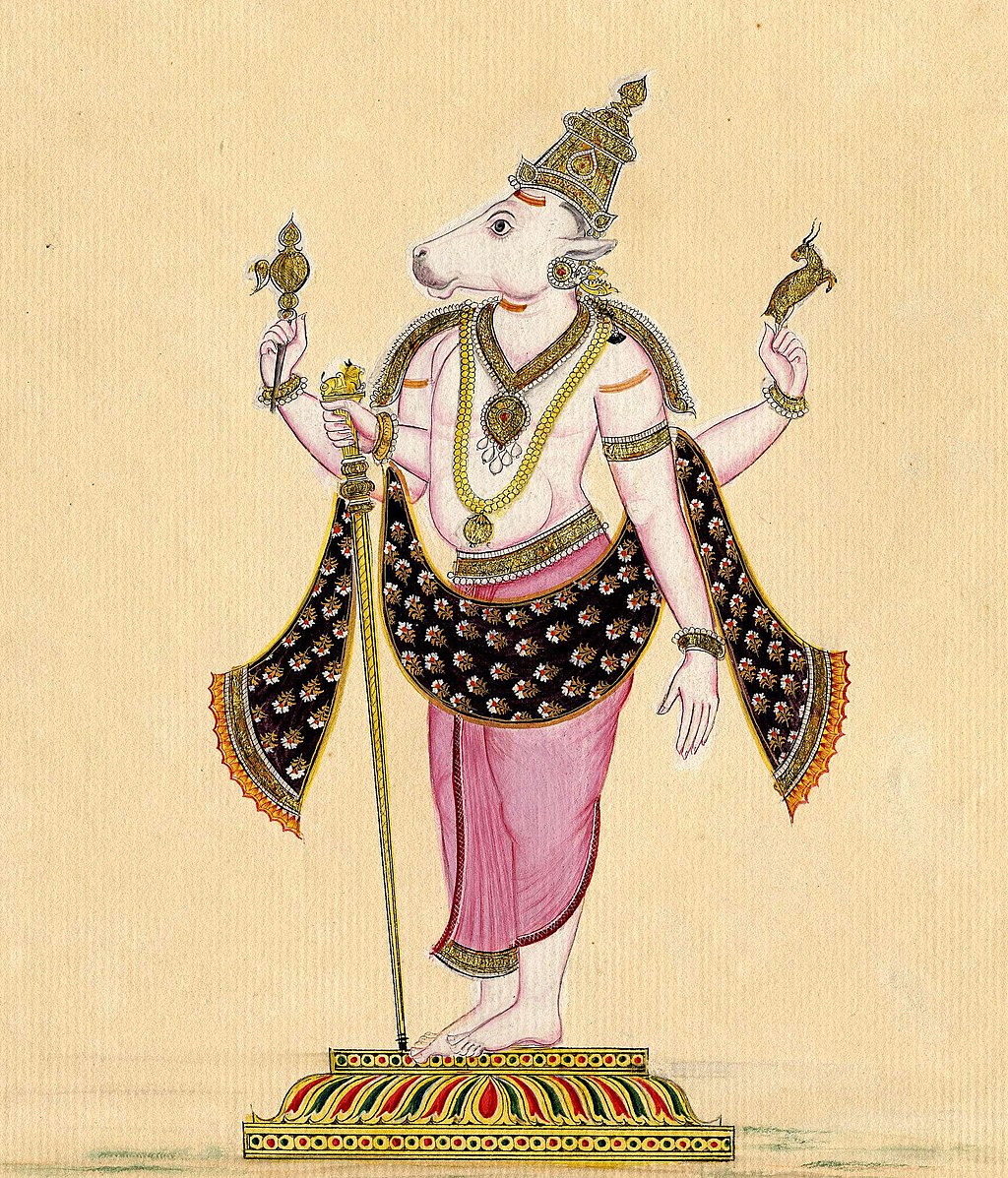
Nandi (Sanskrit: नन्दि), also known as Nandikeshvara or Nandideva, is the sacred bull who serves as the vahana (divine mount) of the Hindu god Shiva, one of the principal deities of the Hindu pantheon. He also functions as the guardian deity of Kailash, the mythical mountain abode of Shiva located in the Himalayas. Nandi's importance in Shaiva worship is evidenced by the fact that nearly all Shiva temples throughout the Indian subcontinent and the Hindu diaspora display stone images of a seated Nandi, characteristically positioned facing the main shrine where Shiva's linga or murti resides, serving as the eternal devotee gazing upon his lord and as an intermediary between worshippers and the deity.
According to Hindu mythology, Nandi is described as the son of the sage Shilada. The circumstances of his birth reflect the power of devotion and ascetic practice central to Hindu religious thought. Shilada underwent severe penance and austerities to obtain a divine boon—a son who would possess immortality and receive the special blessings of Shiva.
His devotion was rewarded, and he received Nandi as his son. The Shiva Purana specifically states that Nandi was born from a yajna (sacrificial fire ritual) performed by Shilada, emphasizing the sacred and supernatural nature of his origin rather than ordinary biological birth. Nandi grew up as an extraordinarily devoted follower of Shiva, and as a young being, he performed his own severe penance and austerities on the banks of the river Narmada with the specific goal of becoming Shiva's gate-keeper as well as his mount—positions of both service and intimacy with the divine.
According to regional legend preserved in Madhya Pradesh, this site of Nandi's penance is identified with Tripur Tirth Kshetra, located at the present-day Nandikeshwar Temple in Jabalpur, which remains an important pilgrimage destination for Shaiva devotees. According to the theological system known as Shaiva Siddhanta, which represents one of the most sophisticated philosophical schools within Shaivism, Nandi occupies an exalted position beyond his role as Shiva's mount. He is considered the chief among the Siddhars (perfected spiritual masters who have attained supernatural powers and divine knowledge), having been personally initiated into the highest teachings by both Parvati (Shiva's consort) and Shiva himself.
This initiation established Nandi not merely as a devoted servant but as a spiritual master in his own right, authorized to transmit sacred knowledge. Hindu tradition holds that Nandi passed on the profound teachings he had received to eight distinguished disciples: the Four Kumaras (the mind-born sons of Brahma who chose to remain eternally young ascetics), Tirumolar (the legendary Tamil Siddha saint who composed the Tirumantiram), Vyagrapada (also known as Pullipani, associated with the development of Bharatanatyam dance), Patanjali (the compiler of the Yoga Sutras, one of Hinduism's foundational texts on yoga philosophy), and Sivayoga Muni. According to tradition, these eight disciples were sent out in eight different cardinal and intermediate directions to spread Nandi's wisdom throughout the world, establishing centers of Shaiva teaching across India and beyond.
Nandi's teachings are preserved and transmitted by the Nandinatha Sampradaya, a lineage of gurus who claim direct spiritual descent from Nandi and who maintain his esoteric teachings, particularly emphasizing yoga, meditation, and devotional practices centered on Shiva worship. Many Puranic legends feature Nandi in various roles that demonstrate both his protective nature and his intimate connection to Shiva. One particularly famous story describes his dramatic conflict with Ravana, the rakshasa (demon) king of Lanka and principal antagonist of the epic Ramayana.
When Ravana came to Mount Kailash seeking an audience with Shiva, he behaved impatiently and disrespectfully while waiting, moving about in a restless and undignified manner. Nandi, serving as the guardian of Kailash, was offended by this behavior and observed that Ravana was acting just like a monkey rather than with the dignity befitting one seeking audience with the supreme lord. In response to this insult, Nandi pronounced a curse upon Ravana, declaring that his mighty kingdom of Lanka would ultimately be burnt and destroyed by a forest-dwelling monkey (vanara), using the very comparison that had prompted the curse.
This curse was later fulfilled when Hanuman, the devoted monkey companion of Lord Rama, traveled to Lanka in search of Sita (Rama's wife, who had been abducted and imprisoned by Ravana in a grove called the Ashoka Vatika), and in the course of his mission set fire to Lanka, causing massive destruction to the rakshasa kingdom and foreshadowing Ravana's eventual defeat. The ancient Tamil text Tiruvilaiyadal Puranam, which recounts the divine sports (lilas) of Shiva, preserves another remarkable story in which Nandi demonstrates his devotion through an unusual incarnation as a whale. According to this legend, Parvati lost her concentration and attention while Shiva was expounding the profound meaning of the Vedas to her—a serious lapse given the sacred nature of these teachings and the privilege of receiving instruction directly from Shiva.
As penance for this failure of attention and devotion, Parvati was required to incarnate on earth as a fisher-woman, living a humble existence far removed from her divine status. Nandi, devoted to both his master Shiva and to Parvati whom he also revered, conceived a plan to reunite the divine couple. He took the extraordinary form of a gigantic whale and began causing significant trouble for coastal communities, disrupting fishing, threatening boats, and creating such havoc that the people desperately sought a solution.
Parvati's father (in her fisher-woman incarnation) declared that whoever could kill the menacing whale would receive his daughter's hand in marriage—a common motif in folklore where a dangerous task wins a bride. Shiva, desiring to be reunited with his beloved consort, took the form of a skilled fisherman, successfully killed the whale (Nandi's assumed form), and thereby won the right to marry Parvati. Upon their marriage, Parvati was restored to her previous divine form, the divine couple was reunited, and the purpose of the penance was fulfilled.
Nandi's sacrifice in taking the form of the whale and allowing himself to be "killed" demonstrates the extraordinary lengths to which his devotion extended, willing to undergo apparent death to serve his lord's ultimate happiness. The Cham Hindus of Vietnam, an ethnic minority who have preserved Hindu religious traditions despite centuries of geographic separation from India and the dominant Buddhist and later Islamic influences in Southeast Asia, maintain a particularly poignant belief concerning Nandi's role in the afterlife. According to Cham Hindu tradition, when a Cham person dies, it is Nandi who compassionately takes their soul on the long spiritual journey from Vietnam back to the holy land of India, which they regard as the ultimate sacred destination and spiritual homeland despite having lived for generations in Southeast Asia.
This belief reflects both the enduring connection Cham Hindus maintain with Indian religious traditions and Nandi's role as a psychopomp (conductor of souls) and compassionate guide who ensures that devotees reach their proper spiritual destination after death, extending his protective and serving functions from Shiva's immediate household to the broader community of Hindu worshippers across geographic and cultural boundaries.