Miloš Obilić
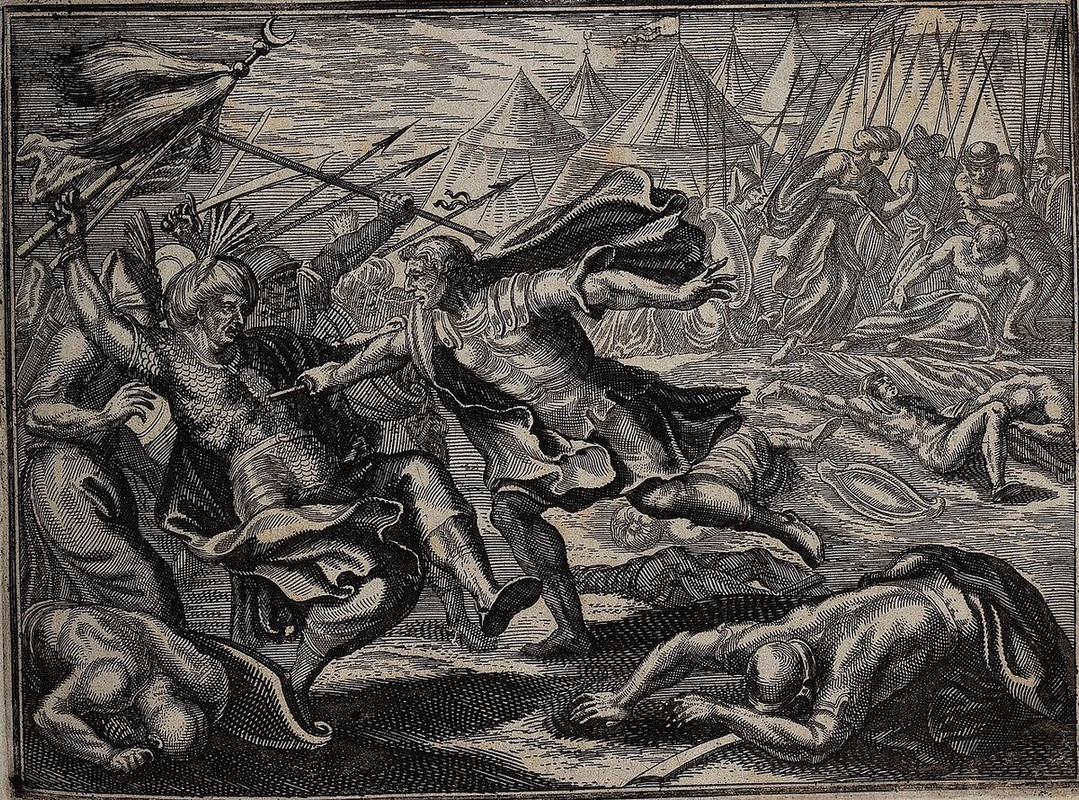
Miloš Obilić (Serbian Cyrillic: Милош Обилић, pronounced [mîloʃ ôbilit͡ɕ]) stands as a legendary Serbian knight and saint within the Serbian Orthodox Church, traditionally portrayed as having served Prince Lazar during the Ottoman invasion of Serbia in the late 14th century. Despite his absence from contemporary historical records, he occupies a prominent position in later accounts of the 1389 Battle of Kosovo as the figure who assassinated Sultan Murad I. The identity of the assassin remained unrecorded in historical sources until the late 15th century, yet the story's widespread circulation across Florentine, Serbian, Ottoman, and Greek sources indicates that various versions of the narrative had disseminated throughout the Balkans within decades of the battle's occurrence.
This rapid diffusion across multiple cultural and linguistic boundaries suggests the story held powerful resonance for diverse audiences seeking to understand and commemorate this pivotal historical moment. His original name is believed to have been Miloš Kobilić, though numerous variations appear in different historical sources, and scholarly consensus regarding his actual historical existence remains elusive. Questions about whether he was a real individual, a composite figure combining multiple people, or an entirely legendary creation continue to generate academic debate.
The Lazar dynasty, working to consolidate its political power and legitimacy in the aftermath of the Battle of Kosovo, played a significant role in developing what became known as the Kosovo Myth—a complex narrative framework that incorporated the legend of Obilić as one of its central components. This mythological construction served important political and cultural functions, providing the dynasty with ideological support and offering the Serbian people a narrative through which to process their defeat and preserve their identity under Ottoman domination. Scholar Jelka Ređep observes that Obilić's legend underwent substantial evolution through oral tradition, gradually becoming a vessel for expressing Serbian cultural ideals of heroism, unwavering loyalty, and self-sacrifice.
The oral transmission of his story across generations allowed each retelling to emphasize and refine these values, transforming him from whatever historical reality might have existed into an idealized representation of Serbian virtue. Over the centuries, he emerged as a central figure in Serbian epic poetry, where successive generations of singers and poets elevated him to the status of a national hero who embodied the essential characteristics of medieval Serbian folklore and collective identity. His legend became inextricably woven into the broader narrative tapestry surrounding the Battle of Kosovo, standing alongside Prince Lazar's martyrdom—his Christ-like sacrifice for his people—and the alleged treachery of Vuk Branković, who was accused of betraying the Serbian forces during the battle.
These three narrative elements—Lazar's holy sacrifice, Branković's betrayal, and Miloš's heroic assassination of the sultan—formed the foundational pillars of Serbian historical memory regarding Kosovo, providing a framework through which the Serbian people interpreted their past and understood their national character. The legend acquired additional dimensions of meaning and importance as centuries passed. By the 19th century, coinciding with the rise of Serbian nationalism and the struggle for independence from Ottoman rule, Miloš Obilić had achieved veneration as a saint within the Serbian Orthodox Church.
This ecclesiastical recognition transformed him from a secular folk hero into a sacred figure whose intercession could be sought through prayer, further cementing his position in Serbian religious and cultural consciousness. His sanctification reflected the deep interconnection between Serbian national identity and Orthodox Christianity, where historical figures and events acquired spiritual significance that transcended their purely historical dimensions. Miloš Obilić's legend extends beyond Serbian tradition and also appears in Albanian epic poetry, demonstrating the shared yet contested historical memory of the Kosovo region.
In Albanian oral tradition, he is remembered as Millosh Kopiliqi, with his birthplace customarily linked to the Drenica region in present-day Kosovo, where villages bearing the name Kopiliq continue to exist. This Albanian version of the legend raises complex questions about ethnic identity, territorial claims, and the interpretation of medieval history in a region characterized by overlapping populations and competing national narratives. The presence of the Obilić legend in both Serbian and Albanian traditions illustrates how the same historical events and figures can be claimed and reinterpreted by different ethnic groups to support their respective historical narratives and territorial assertions.
Despite the legend's prominence and emotional power in multiple cultural traditions, definitive historical evidence confirming the actual identity of Sultan Murad I's assassin remains absent. Scholars emphasizing rigorous historical methodology note that contemporary sources from the period immediately following the Battle of Kosovo do not name the assassin, and later sources that do provide names may reflect legendary accretion rather than historical fact. The lack of conclusive documentation means that while the story of Murad's assassination is well-attested, the specific identity of the person who committed the act—whether Miloš Obilić, Miloš Kobilić, Millosh Kopiliqi, or someone else entirely—cannot be established with certainty.
This historical ambiguity has not diminished the legend's cultural significance; rather, it has perhaps enhanced it, allowing the figure of Obilić to function as a flexible symbol capable of carrying multiple meanings for different communities and different historical moments. The legend thus occupies a space between history and mythology, where factual uncertainty coexists with cultural certainty, and where the power of the story derives not from its historical verifiability but from its capacity to express enduring values and sustain collective identity across generations.