Likho
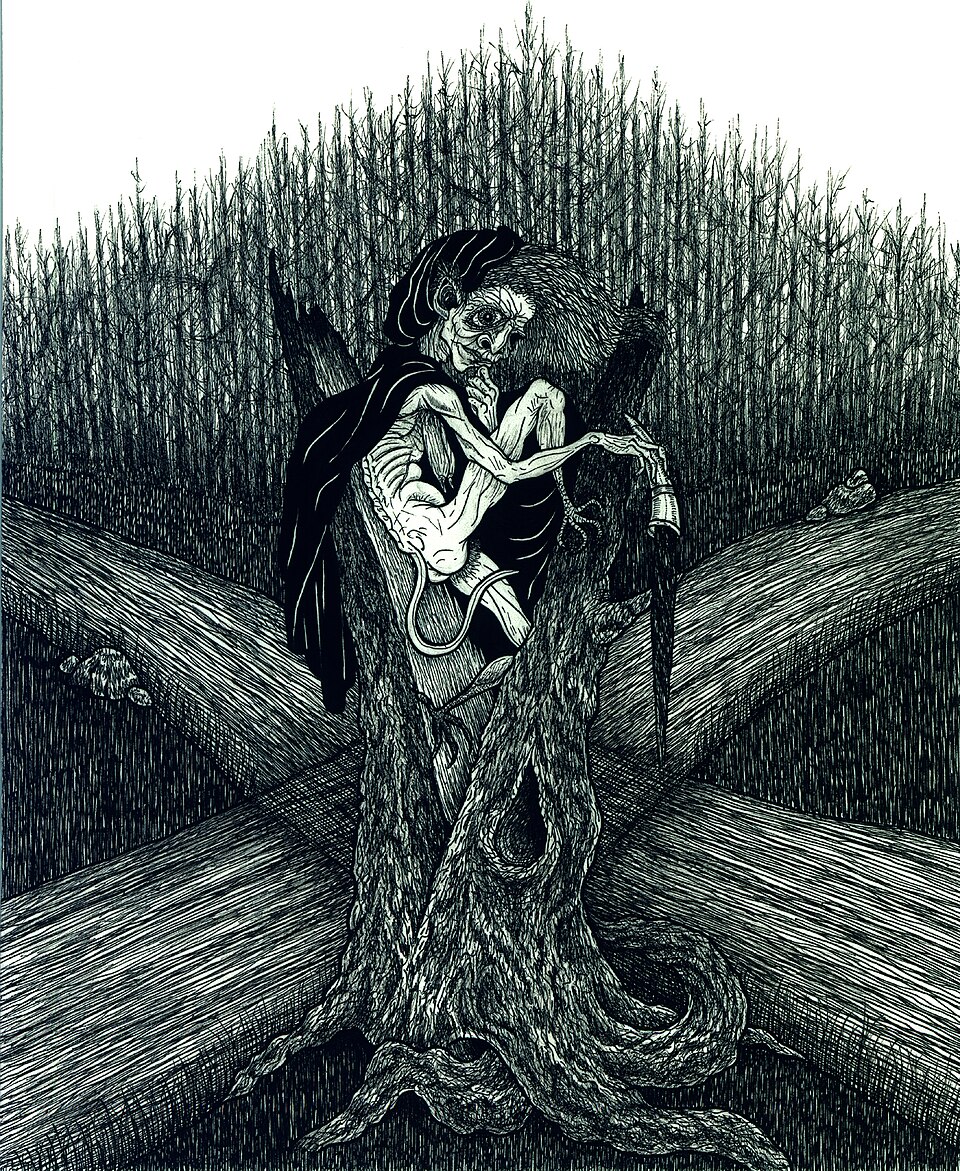
Likho (Belarusian: лі́ха; Polish: licho; Russian: Лихо) is the personification of misfortune and malignant fate in Slavic mythology. Traditionally depicted as an entity that exists outside the major divine pantheon, Likho is a staple of folk narratives and fairy tales rather than formal religious canon. The creature most commonly manifests as a One-eyed Likho (Likho odnoglazoe), taking the form of a gaunt, monocular old woman dressed in black, or occasionally appearing as a malevolent forest goblin.
Its presence signifies a period of grief or ill luck that "clings" to a victim, often physically represented in folklore as a spirit riding upon a person's neck.
The folkloric encounters with Likho typically follow several moralistic archetypes that warn against greed and complacency. In one common narrative, a protagonist successfully cheats Likho and attempts to flee; however, the creature places a valuable object in the hero's path. Driven by greed, the person grabs the item, only to find their hand permanently fused to it, forcing them to amputate their own limb to escape.
Another darker variation involves a victim attempting to drown the Likho by jumping into a river; while the person perishes, the spirit simply floats to the surface, ready to pursue its next target. These tales serve as cautionary parables regarding the inescapable nature of bad luck and the high cost of trying to outmaneuver fate.
Linguistically, the term Likho is rooted in the concept of "excess" or "remnant." In Old Russian, the root was contrasted with chetno (even numbers) to denote odd numbers, carrying a pejorative connotation similar to the "unlucky odd man out." This etymological history persists across Slavic languages: in Czech, lichý translates to "odd" or "vain," while in Polish, lichy signifies something shoddy or flimsy. The enduring cultural impact of the entity is best preserved in proverbs that remain in common use today. The Russian and Ukrainian warning, "Don't wake Likho while it is quiet," serves as a direct equivalent to the English idiom "let sleeping dogs lie," reinforcing the belief that misfortune is a dormant force that is best left undisturbed.