Lazar of Serbia
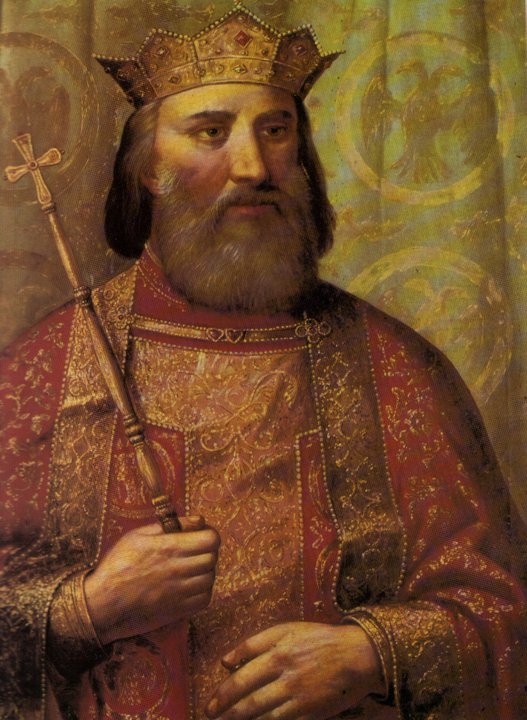
Lazar Hrebeljanović (Serbian Cyrillic: Лазар Хребељановић), born approximately 1329 and killed June 15, 1389, was a medieval Serbian ruler who established the largest and most formidable state within the fragmented territories of the former Serbian Empire. Lazar's realm, which historians designate as Moravian Serbia, encompassed the basins of the Great Morava, West Morava, and South Morava rivers. He governed Moravian Serbia from 1371 until his death in 1389, during which time he pursued the ambitious goal of resurrecting the Serbian Empire with himself at its head.
He proclaimed himself the direct successor of the Nemanjić dynasty, which had ruled Serbia for two centuries before its extinction in 1371. Lazar's political and dynastic program received unwavering support from the Serbian Orthodox Church, which provided crucial religious legitimacy to his claims. However, the Serbian nobility refused to acknowledge him as their supreme ruler, limiting his authority and preventing the full reunification of Serbian lands under a single sovereign.
Though he is frequently referenced as Tsar Lazar Hrebeljanović (Serbian: Цар Лазар Хребељановић / Car Lazar Hrebeljanović) in historical and cultural sources, he technically held only the title of prince (Serbian: кнез / knez) during his lifetime. The posthumous elevation to tsar in popular memory reflects his subsequent veneration and legendary status rather than his actual royal designation. Lazar met his death at the Battle of Kosovo in June 1389 while commanding a Christian coalition army assembled to confront the advancing Ottoman Empire under Sultan Murad I.
The battle concluded inconclusively, with neither side achieving a decisive victory and both forces sustaining devastating casualties. Sultan Murad I was also killed during or immediately after the battle, making Kosovo one of the rare medieval engagements where both commanding leaders perished. In the aftermath of this costly conflict, Lazar's widow, Milica, assumed the regency on behalf of their adolescent son Stefan Lazarević, who inherited his father's principality.
Faced with the dual threat of a weakened Serbian state and the looming danger of Hungarian invasion from the north, Milica made the pragmatic decision to accept Ottoman suzerainty in the summer of 1390. This arrangement, though representing a loss of full independence, secured a military alliance with the Ottomans that protected Serbia from immediate Hungarian aggression and allowed the Serbian state to survive, albeit as an Ottoman vassal, for several more decades. Lazar occupies a profound position in Serbian religious, historical, and cultural consciousness.
The Orthodox Christian Church venerates him as a martyr and saint, with his death at Kosovo interpreted as a Christ-like sacrifice for his people and faith. His feast day is celebrated annually, and he is regarded as a holy figure who chose heavenly glory over earthly survival. In Serbian history, he represents resistance against foreign domination and the struggle to preserve Serbian sovereignty during a period of existential crisis.
Serbian epic poetry, which has preserved and transmitted his memory across generations, consistently refers to him as Tsar Lazar (Serbian: Цар Лазар / Car Lazar), reflecting the elevation of his status in popular tradition. The Battle of Kosovo itself has become the central event in Serbian historical mythology, symbolizing both tragic defeat and noble sacrifice. Lazar's legacy extends far beyond his actual political achievements; he has been transformed into a timeless symbol of Serbian national identity, Orthodox Christian devotion, and martyrdom in defense of faith and homeland.
His story continues to resonate deeply in Serbian culture, appearing in literature, art, music, and national commemoration, making him one of the most significant figures in the Serbian national consciousness.