Lapulapu
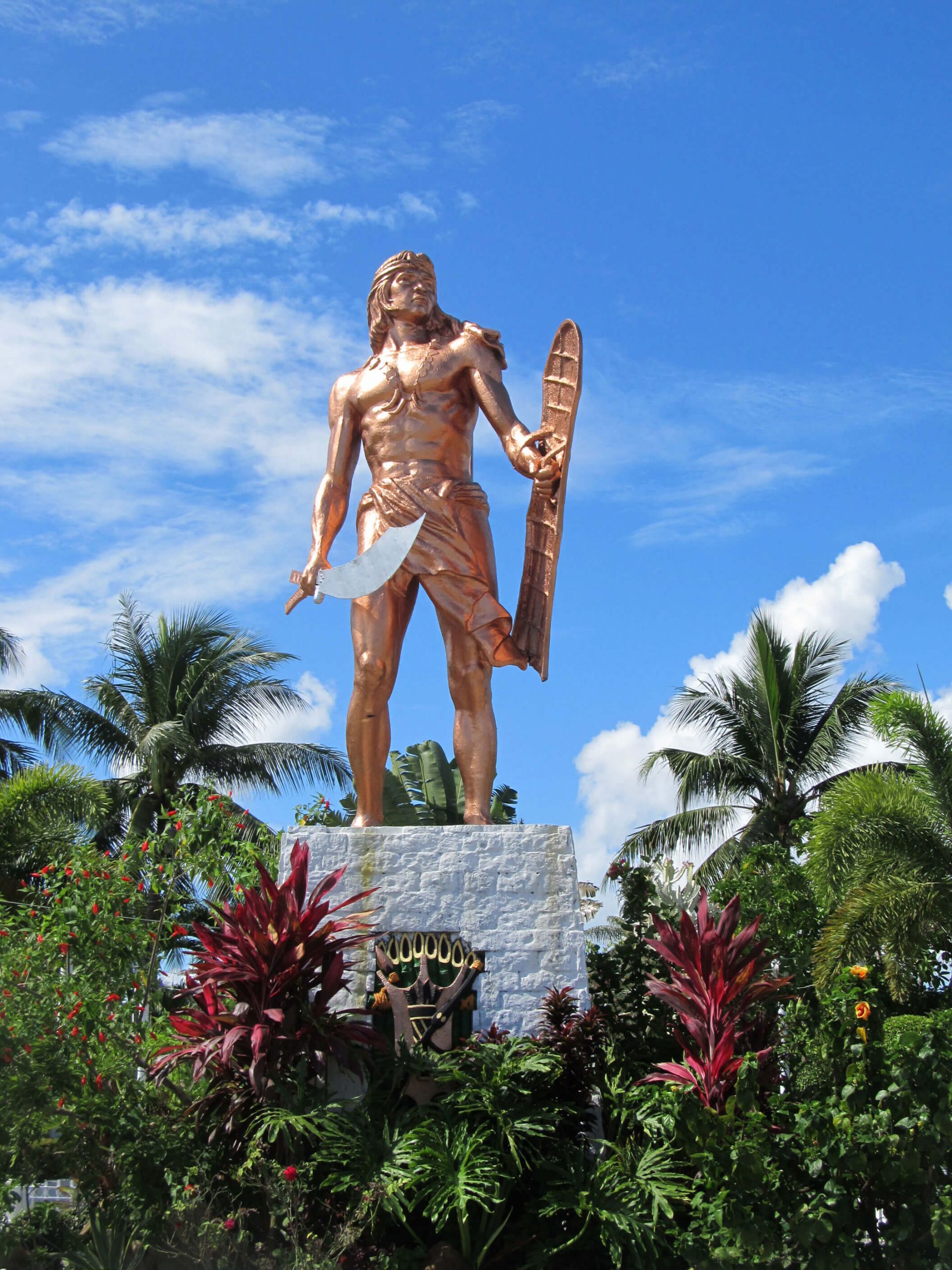
Lapulapu (born 1491, died 1542), also spelled Lapu-Lapu, whose name was first recorded in Spanish sources as Çilapulapu, was a Raja (Datu or chieftain) of Mactan, a small island that is now part of the modern Philippines. He occupies a unique and celebrated position in Philippine history as the indigenous leader who successfully resisted the first European attempt to establish authority in the archipelago. Lapulapu is renowned for the Battle of Mactan on April 27, 1521, where he and his warriors defeated Spanish forces led by the Portuguese explorer Ferdinand Magellan, who was sailing under the Spanish flag, along with Magellan's native allies including Rajah Humabon of Cebu and Datu Zula.
In this coastal engagement, Lapulapu's forces killed Magellan himself, striking down one of the most famous explorers of the Age of Discovery. Magellan's death in battle abruptly ended his ambitious voyage of circumnavigation—though his expedition's surviving ships and crew would eventually complete the journey without him—and critically delayed Spanish colonial occupation of the Philippine islands by more than forty years. Spain did not successfully establish permanent colonial presence in the archipelago until the expedition of Miguel López de Legazpi, which reached the Philippines in 1565 and initiated the Spanish colonial period that would last over three centuries.
Modern Philippine society regards Lapulapu as the first Filipino hero specifically because of his armed resistance to Spanish colonial incursion and his refusal to submit to foreign authority, making him a powerful symbol of indigenous dignity, courage, and independence. His victory at Mactan occurred before the concept of a unified "Filipino" identity existed—the archipelago consisting instead of numerous distinct ethnolinguistic groups and independent polities—yet his resistance to European conquest has been retrospectively claimed as the beginning of Filipino nationalism and anti-colonial struggle. Monuments and statues honoring Lapulapu have been erected throughout the Philippines, particularly prominently in Cebu and on Mactan Island itself, where a towering bronze statue commemorates his victory.
His iconic status extends into official Philippine government symbolism: both the Philippine National Police and the Bureau of Fire Protection incorporate his image as part of their official seals, associating these modern institutions with his legendary bravery and protective role. Despite his towering symbolic importance in Philippine national consciousness, remarkably little is reliably known about Lapulapu's actual life beyond his role in the Battle of Mactan. Historical sources reveal that besides being a rival of Rajah Humabon, the ruler of neighboring Cebu who had allied with the Spanish and converted to Christianity shortly before the battle, virtually nothing about Lapulapu's biography, personality, or political context can be established with certainty.
The only existing primary source that mentions Lapulapu by name is the detailed account written by Antonio Pigafetta, an Italian scholar who sailed with Magellan's expedition and kept a journal that became the most important eyewitness record of the voyage. According to the distinguished Filipino historian Resil B. Mojares, no European who left a primary record of Magellan's voyage or vessel "knew what he looked like, heard him speak (his recorded words of defiance and pride are all indirect), or mentioned that he was present in the battle of Mactan that made him famous." This remarkable statement reveals that the accounts do not even definitively confirm Lapulapu's personal presence at the battle that made him legendary—his role is inferred from his position as datu rather than from eyewitness descriptions of him participating in the fighting.
Consequently, virtually every aspect of Lapulapu's identity remains contested among historians and has generated substantial scholarly debate. His precise name and its etymology are uncertain, with various theories about whether "Lapulapu" was his actual name, a title, or a later attribution. His ethnic and geographic origins are disputed, with different theories claiming he was native to Mactan, a migrant from Borneo, or from elsewhere in the archipelago.
His religious beliefs remain unknown—whether he practiced indigenous animist religion, had converted to Islam (which was spreading through the southern Philippines during this period), or followed some syncretic combination. Even his ultimate fate after the Battle of Mactan is a matter of speculation, with various legends claiming he continued ruling Mactan, was killed in subsequent conflicts, or lived to old age, but no historical records documenting his later life or death. This profound gap between Lapulapu's historical obscurity—existing in primary sources as barely more than a name associated with the battle—and his enormous symbolic importance in modern Philippine nationalism illustrates how national heroes are often as much constructed as discovered.
The limited and ambiguous historical evidence has allowed successive generations of Filipinos to project onto Lapulapu the qualities and meanings most relevant to their contemporary concerns: resistance to colonialism, indigenous pride, martial courage, and refusal to submit to foreign domination. In this sense, Lapulapu functions less as a fully documented historical individual and more as a powerful national symbol whose very historical indeterminacy has enabled him to represent Filipino values and aspirations across different periods and political contexts, making him perhaps even more potent as a unifying national figure precisely because the sparse historical record allows diverse Filipinos to claim him as embodying their particular vision of heroism and resistance.