Lady Xian(冼夫人)
Lady Xian (Chinese: 冼夫人; pinyin: Xiǎn Fūrén; Jyutping: sin2 fu1 jan4; Vietnamese: Tiển phu nhân; 512–602), also known as Lady of Qiao Guo (Chinese: 譙國夫人) and born as Xian Zhen (冼珍), was a hereditary chieftain of the Li people in Southern China who wielded extraordinary political and military influence during the tumultuous period spanning the decline of the Liang dynasty, the brief Chen dynasty, and the establishment of the Sui dynasty. Born to the chieftain of the Xian tribe in what is now Guangdong Province, she demonstrated exceptional leadership abilities that enabled her to maintain regional stability, command military forces, and negotiate skillfully with successive Chinese dynasties while protecting the interests of her people and the broader Lingnan region. Her remarkable career as a female military and political leader in sixth-century China, combined with her success in preserving peace and facilitating the integration of southern peoples into the Chinese imperial system, earned her veneration as the "Saintly Mother of Lingnan" (岭南圣母), and she has been deified and worshipped in temples throughout southern China for over fourteen centuries.
Lady Xian's political acumen and military capabilities were particularly evident during periods of dynastic transition, when she maintained order in Lingnan even as central authority collapsed elsewhere. She skillfully navigated relationships with multiple Chinese dynasties, pledging loyalty when appropriate while retaining substantial autonomy for her region. Her ability to command troops—both her own tribal forces and Chinese imperial soldiers—made her an indispensable ally to successive emperors who relied on her to maintain stability in the strategically important but often rebellious southern territories.
She personally led military campaigns to suppress rebellions and defended the region against various threats, demonstrating both strategic insight and personal courage that transcended contemporary gender expectations. Lady Xian died in 602 during a tour of Hainan, having served three dynasties and maintained her influence into her nineties—an extraordinary achievement in any era, but particularly remarkable for a woman in early medieval China. Her legacy has been celebrated continuously since her death, with her story serving as an example of effective leadership, loyalty, and service to both local communities and the broader Chinese state.
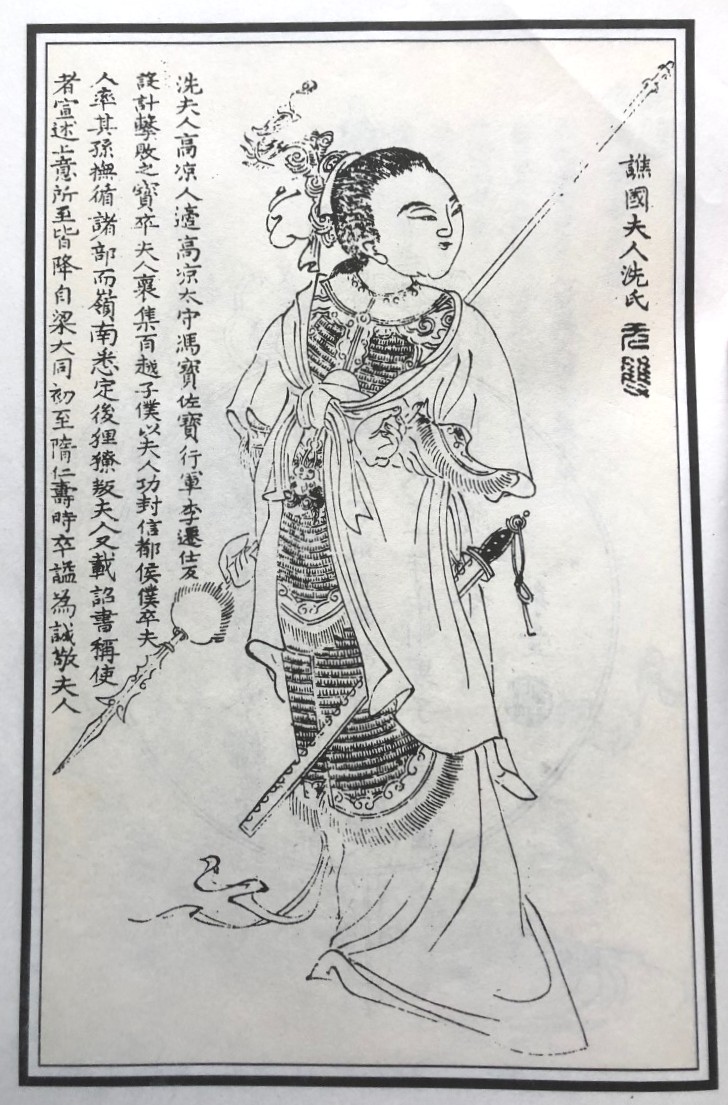
Former Chinese Premier Zhou Enlai called her "the First Heroine of China," recognizing her pioneering role as a female political and military leader whose achievements predated and arguably surpassed many better-known male figures in Chinese history. Chinese Communist Party General Secretary Jiang Zemin praised her as "the role model that the later generations should learn forever," indicating that her legacy retained political relevance and inspirational power even in contemporary China, where her example of leadership, ethnic harmony, and dedication to national unity continues to resonate. Lady Xian is also depicted in the Wu Shuang Pu (無雙譜, Table of Peerless Heroes), the collection compiled by Jin Guliang featuring China's most exemplary historical figures, cementing her place among the nation's greatest heroes regardless of gender.