Karkadann
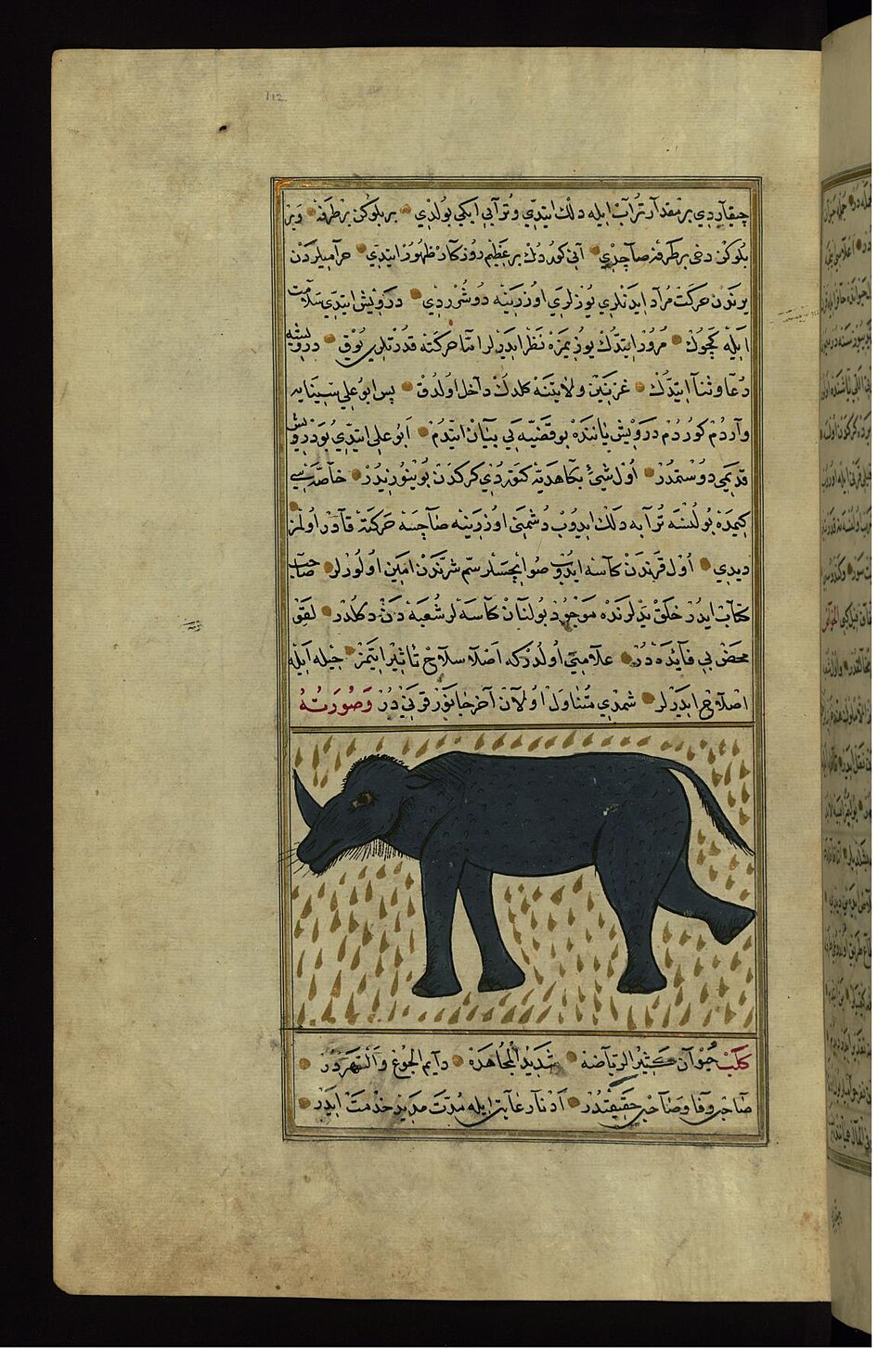
The Karkadann (Arabic: كركدن; Persian: كرگدن) is a legendary creature of India and Iran whose name is synonymous with the rhinoceros in Persian and Arabic. While originally based on the Indian rhinoceros (Rhinoceros unicornis), the creature evolved through centuries of literature and art into a mythical animal often referred to as the "Persian unicorn."
The earliest detailed description of the Karkadann was provided by the 10th-century scholar Al-Biruni. He described an animal with the build of a buffalo, black scaly skin, a dewlap, and three yellow hooves on each foot. He specifically noted a single, upward-curved horn on the top of the nose and a prehensile upper lip shaped like a finger. These anatomical markers confirm the Indian rhinoceros as the biological basis for the legend.
As firsthand knowledge of the rhinoceros became scarce, later Persian writers and artists began to embellish Al-Biruni’s account. The short, curved nasal horn was reimagined as a long, straight spike, and artistic representations gradually moved the horn from the nose to the brow. This shift led to the Karkadann's inclusion in medieval European bestiaries as a caption for standard unicorn illustrations.
In the 13th century, the physician Zakariya al-Qazwini attributed supernatural and medicinal qualities to the Karkadann’s horn in his work Aja'ib al-Makhluqat (The Wonders of Creation). He claimed that holding the horn could relieve constipation and cure epilepsy or lameness. Later traditions suggested the horn would perspire in the presence of poison, a characteristic shared with the Western "alicorn."
The Karkadann was also defined by its extreme ferocity. In the 14th century, the traveler Ibn Battuta described the rhinoceroses he saw in India as Karkadann, noting their ability to drive away animals as large as elephants. This rivalry is a central theme in the "Second Voyage of Sinbad the Sailor" from One Thousand and One Nights, where the Karkadann is depicted impaling an elephant upon its horn.
Despite its violent reputation, folklore suggests that, like the European unicorn, the Karkadann could be subdued by the presence of a virgin.