Kamaitachi
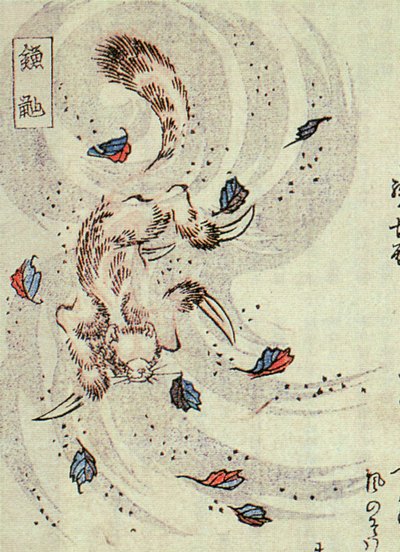
Kamaitachi (鎌鼬; Japanese pronunciation: [ka.ma.iꜜ.ta.tɕi]) is a yōkai (supernatural creature or spirit) from Japanese folklore, particularly prevalent in the oral traditions of the Kōshin'etsu region (the mountainous central area of Honshu including Nagano, Niigata, and Yamanashi prefectures). The term "kamaitachi" can refer both to the supernatural creature itself and to the strange, inexplicable cutting injuries and phenomena that this creature supposedly causes—mysterious wounds that appear suddenly on people's bodies without apparent cause or warning, attributed in folk belief to the kamaitachi's supernatural attacks. According to traditional descriptions, kamaitachi appear riding upon or traveling within tatsumaki (dust devils or small whirlwinds), using these spinning columns of air as vehicles or as cover for their approach.
They attack people by slashing them with their sickle-like front claws or talons, delivering cuts that are characteristically sharp, clean, and remarkably painless despite sometimes being quite deep—a distinctive feature that made these mysterious wounds particularly uncanny and contributed to supernatural explanations, as people would suddenly discover they had been cut without having felt the injury occur or seen what caused it. The name "kamaitachi" is a compound combining two Japanese words: kama (鎌), meaning "sickle," referring to the creature's blade-like claws and the clean, sickle-slash appearance of the wounds it causes; and itachi (鼬), meaning "weasel," describing the creature's general animal form as a type of supernatural weasel. The etymology and conceptual development of the kamaitachi reveals interesting evolution in Japanese folklore and yokai taxonomy.
The name "kamaitachi" was originally thought by some scholars to be a corruption or folk-etymological reinterpretation of the phrase "kamae tachi" (構え太刀), which could be translated as "stance sword" or "ready sword," possibly referring to the sudden, sword-like cuts that appeared on victims as if invisible swordsmen had struck them. However, through the process of yokai systematization and artistic depiction undertaken by Edo-period scholars and artists who collected, categorized, and illustrated Japan's folklore creatures, the kamaitachi underwent transformation from an abstract phenomenon or invisible force into a concrete creature with defined appearance and characteristics. The influential artist Toriyama Sekien (1712-1788), who created the foundational illustrated yokai encyclopedia "Gazu Hyakki Yagyō" (The Illustrated Night Parade of One Hundred Demons) and subsequent volumes that systematically cataloged and depicted hundreds of yokai from Japanese folklore, played a crucial role in this transformation.
Toriyama's work established visual conventions for many yokai that had previously existed only in oral tradition or vague textual descriptions, and his artistic choices often became canonical for how these creatures would be understood and depicted in subsequent centuries. Following patterns established in his work, the kamaitachi—which might have originally been conceived as an invisible cutting force or atmospheric phenomenon—was reinterpreted and depicted as a literal weasel yokai possessing supernatural powers and sickle-like claws, a concrete visualization that eventually became the standard and accepted understanding of what kamaitachi were. Additional textual evidence for kamaitachi appears in "Mimibukuro" (Ear Bag), an extensive collection of strange tales, rumors, and supernatural accounts compiled by Negishi Shizumori during the late Edo period (published 1814-1814).
In one account recorded in this work, children living in an estate called Kagaya in Edo (present-day Tokyo) were suddenly enveloped by a mysterious whirlwind. After the whirlwind passed, the children discovered that strange marks resembling beast footprints had appeared on the surfaces of their backs, though they had felt nothing during the incident and had no idea how the marks got there. The text identifies these mysterious marks as proof of a "kamae tachi" (構太刀) attack, using the alternative terminology and suggesting that the phenomenon involved some kind of supernatural cutting or striking force that could mark or injure people without their awareness while they were caught in whirlwinds.
Different accounts and regional variations describe the kamaitachi's physical appearance in somewhat varying terms, but common elements emerge across the folklore. The creature is typically characterized as a beast covered in fur resembling that of a hedgehog—meaning thick, spiky, bristling fur that stands up rather than lying smooth, giving the creature a wild, aggressive appearance. It is said to emit cries like those of a dog—yipping, barking, or howling sounds quite different from the squeaking or chittering noises that ordinary weasels make, emphasizing the creature's supernatural and threatening nature.
Some accounts describe the kamaitachi as possessing wings or the ability to fly through the air, explaining how it can ride whirlwinds, attack from above, and escape before victims realize what has happened. Most distinctively, kamaitachi are said to attack people using limbs that resemble sickles or razors—whether these are interpreted as actual sickle-shaped claws, blade-like talons, or limbs whose edges are sharp as razors, the emphasis remains on the creature's capacity to inflict precise, clean cuts that slice through clothing and skin effortlessly. The kamaitachi legend likely originated as a folk explanation for a puzzling real-world phenomenon: people working outdoors in windy, dusty conditions—particularly in cold, dry weather that can make skin brittle and prone to cracking—would sometimes discover mysterious cuts on exposed skin, particularly on their legs, arms, or faces, without having felt the injury occur or knowing what caused it.
These wounds typically were shallow but cleanly cut, relatively painless (possibly due to the cold numbing the skin or the sharpness of whatever caused the cut), and appeared suddenly without obvious cause. Modern explanations suggest these injuries might result from various natural causes: sharp particles of ice, frozen plant material, or debris carried by strong winds and striking exposed skin at high velocity; skin cracking from extreme cold and dryness in ways that produced clean splits resembling cuts; or thin, fast-growing grass blades or reed edges whose microscopic serrations can produce surprisingly clean cuts when skin brushes against them at speed, with victims not immediately noticing due to distraction, cold, or the sharpness of the cut. However, to people lacking these scientific explanations and working within a worldview that attributed unexplained phenomena to supernatural causes, the sudden appearance of painless cuts during or after encountering whirlwinds naturally suggested the work of malevolent yokai—invisible or barely glimpsed supernatural creatures that rode the winds and attacked humans with supernatural speed and razor-sharp weapons or claws.
The kamaitachi thus exemplifies how yokai legends often served as folk scientific theories explaining genuinely puzzling natural phenomena through supernatural agency, providing communities with conceptual frameworks for understanding and discussing experiences that seemed to defy normal explanation while also encoding practical warnings about environmental dangers (in this case, the risks of injury from working outdoors during windy, cold conditions) in memorable supernatural narratives that would be retold and transmitted across generations.