Julius Caesar
Julius Caesar is a legendary figure from Rome, Italy, dated to ~100 BC (Classical antiquity). It connects to 6 other myths and legends in the Mythosjourney atlas.
Gaius Julius Caesar, born July 12 or 13, 100 BC, and assassinated March 15, 44 BC, served as a Roman general and statesman. As a member of the First Triumvirate, Caesar commanded the Roman armies during the Gallic Wars before vanquishing his political adversary Pompey in civil conflict. He then ruled as dictator from 49 BC until his assassination in 44 BC.
Caesar played a pivotal role in the circumstances that culminated in the Roman Republic's collapse and the Roman Empire's emergence. In 60 BC, Caesar, Crassus, and Pompey established the First Triumvirate, an unofficial political coalition that controlled Roman politics for several years. Their pursuit of political power faced opposition from numerous senators, including Cato the Younger with Cicero's private backing.
Caesar ascended to become among the Roman Republic's most powerful politicians through successive military triumphs in the Gallic Wars, concluded by 51 BC, which substantially expanded Roman territory. During this period, he invaded Britain and constructed a bridge spanning the Rhine River. These accomplishments and his veteran army's loyalty threatened to overshadow Pompey's prominence.
The partnership between Caesar and Pompey gradually deteriorated, and by 50 BC, Pompey had realigned with the Senate. With his command nearing expiration and the Gallic Wars largely finished, the Senate commanded Caesar to relinquish his military authority and return to Rome. In early January 49 BC, Caesar openly defied the Senate by crossing the Rubicon and advancing toward Rome leading an army.
This initiated Caesar's civil war, which he won, positioning him with nearly unchallenged power and influence by 45 BC. After seizing governmental control and pardoning numerous adversaries, Caesar embarked upon an energetic reform and construction agenda. He introduced the Julian calendar to supplant the republican lunisolar calendar, decreased the grain dole's scope, established his veterans in new overseas colonies, substantially enlarged the Senate, and granted citizenship to communities in Spain and present-day northern Italy.
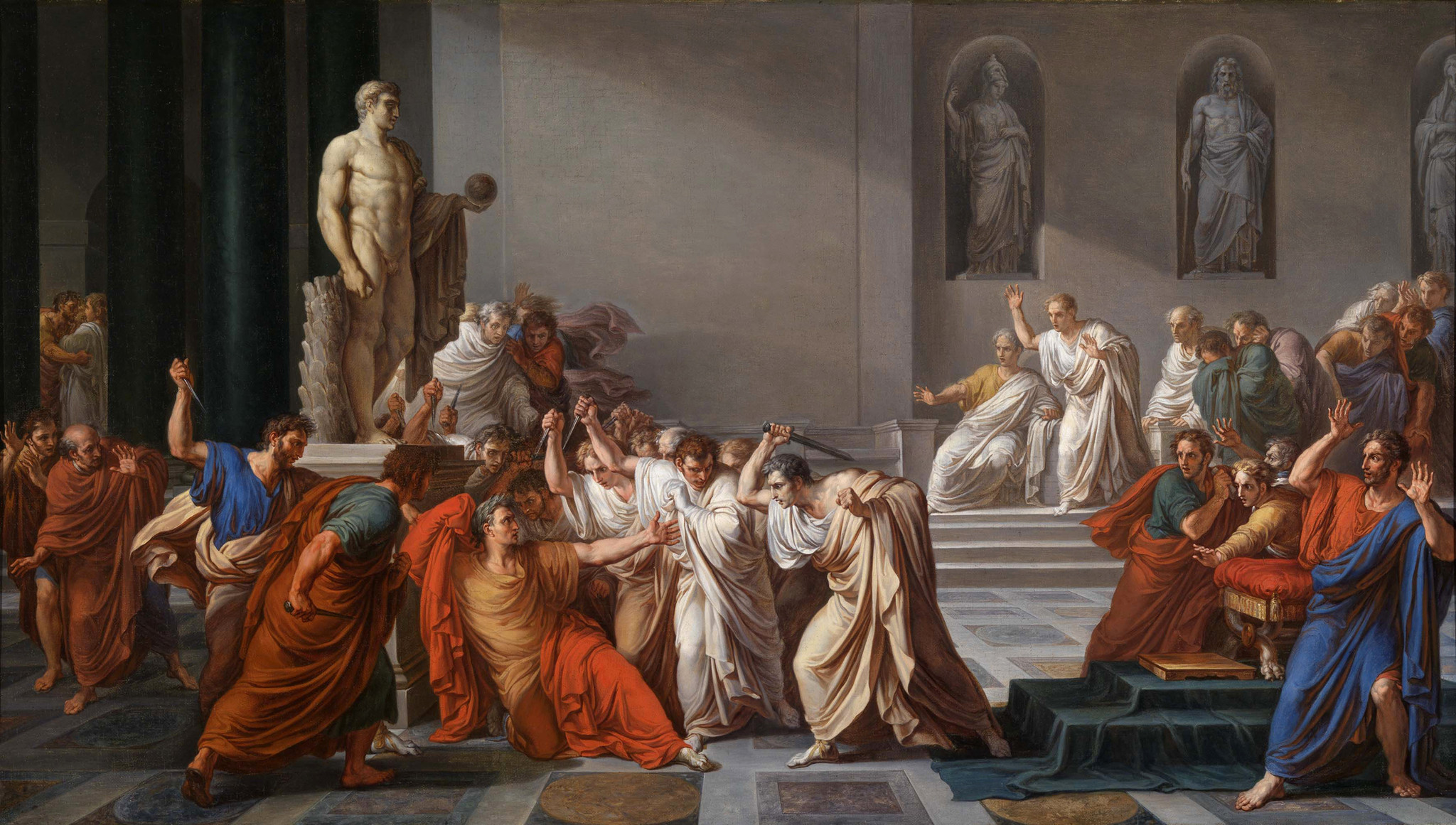
In early 44 BC, he received the proclamation "dictator for life" (dictator perpetuo). Apprehensive of his power, state domination, and the prospect that he might declare himself king, a senatorial faction led by Brutus and Cassius assassinated Caesar on the Ides of March (March 15) 44 BC. A fresh series of civil wars erupted, and the Republic's constitutional government was never completely restored.
Caesar's great-nephew and adoptive successor Octavian, later known as Augustus, achieved sole power after defeating his rivals thirteen years later. Octavian then consolidated his authority, transforming the Republic into the Roman Empire. Caesar was a distinguished author and historian; much of his life is documented through his own military campaign accounts.
Other contemporary sources include Cicero's letters and speeches and Sallust's historical writings. Later biographical works by Suetonius and Plutarch also constitute significant sources. Many historians regard Caesar as among history's greatest military commanders.
His cognomen was subsequently adopted as synonymous with "emperor"; the title "Caesar" was employed throughout the Roman Empire and generated modern derivatives such as Kaiser and Tsar. He has frequently appeared in literary and artistic works.