Jué yuán(玃猿)
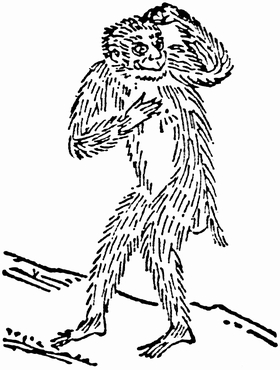
Jué yuán (Chinese and Japanese: 玃猿; pinyin: Jué yuán; rōmaji: Kakuen) is a legendary primate-like creature from Chinese mythology that was later incorporated into Japanese folklore. This cryptid is known by numerous variant names across different texts including simply Jué (玃) (pronounced "kaku" or "ōzaru" in Japanese), Jué fù (玃父), Jiā (猳), Jiā guó (猳國) (pronounced "kakoku" in Japanese), and mǎ huà (馬化) (pronounced "baka" in Japanese), reflecting the creature's appearance in various regional traditions and literary sources across centuries. The jué yuán resembles monkeys or apes but is substantially larger, more powerful, and possesses supernatural characteristics.
Most notoriously, these creatures are attributed with abducting human females and forcing them to become wives and bear hybrid offspring—a disturbing theme appearing repeatedly in East Asian folklore that reflects anxieties about boundaries between human and animal, female vulnerability in wilderness areas, and racial purity. According to the influential medical encyclopedia Bencao Gangmu (Compendium of Materia Medica, compiled by Li Shizhen, 1578), jué yuán are substantially bigger than ordinary monkeys. The Daoist text Baopuzi (The Master Who Embraces Simplicity, c.
317 CE) provides a transformational origin theory: a míhóu (rhesus monkey) that survives 800 years transforms into a yuán (ape), and if it lives another 500 years, it becomes a jué, which can then live 1,000 additional years. This progression represents spiritual evolution through extreme longevity, similar to how foxes and snakes in East Asian folklore gain supernatural powers after living for centuries. The Bencao Gangmu describes jué as monkeys grown extremely old with distinctive dark blue or blue-black coloration.
Despite their simian origins, they walk fully upright like humans rather than using quadrupedal locomotion. They frequently kidnap humans (particularly women) and steal objects, demonstrating purposeful intelligence. Critically, the text states there are only males—no female jué exist—which biologically necessitates abducting human women to reproduce, with captured women giving birth to hybrid children.
Two important early Chinese texts—the Sou Shen Ji (In Search of the Supernatural, c. 350 CE) and the Bo Wu Zhi (Records of Various Matters, c. 290 CE)—provide detailed accounts of jué yuán communities.
According to these sources, jué yuán inhabit mountains in southwest Shu (Sichuan region), resembling monkeys but standing approximately seven shaku (roughly 1.6 meters or 5'3") and walking upright like humans. They live in organized villages in remote mountain valleys, demonstrating social organization paralleling human society. When human travelers pass through their territory, jué yuán can distinguish males from females by scent alone and specifically abduct female travelers, taking them to mountain villages as wives.
Women unable to bear children are never permitted to leave and, after about ten years, undergo a disturbing transformation: their appearance and mental state become indistinguishable from jué yuán themselves, and they lose all desire to return to human society. Women who successfully bear hybrid children are eventually permitted to return to human villages with their offspring, but face a terrible consequence: if they don't raise these children, they invariably die shortly after returning. The hybrid children, when raised properly, appear sufficiently human to integrate into society and are indistinguishable from ordinary humans when grown.
An interesting naming problem arises: traditionally, Chinese children receive their surname from their father, but since the jué yuán father's name is unknown, hybrid children receive the provisional surname Yang (楊). According to these texts, many families with surname Yang in southwest Shu are actually descendants of jué yuán-human hybrids from past generations. Some scholars note that jué yuán descriptions—large, bipedal, intelligent ape-like creatures in remote Chinese mountains producing human hybrids—share striking similarities with modern cryptozoological reports of the yeren (野人; "wild man"), China's equivalent of Bigfoot or Yeti.
A later anecdote from the Song Dynasty collection Yijianzhi provides a more sinister characterization. A seemingly helpful man appeared nightly at a mountain stream offering to carry travelers across on his back, claiming pure altruistic motives. However, a suspicious man named Huang Dunli forcibly carried this stranger across the river, then threw a large rock at him.
The injured man let out an inhuman cry, and when illuminated by torch, revealed his true form as a jué yuán who had been masquerading as human. When killed and burned, the creature's corpse produced a terrible smell detectable from several li away, suggesting unnatural or demonic qualities. The jué yuán legend represents a complex nexus of Chinese folkloric themes including transformation through longevity, boundaries between human and animal, anxieties about miscegenation, vulnerability of women in wilderness, and ambiguity between helpful and dangerous supernatural beings.
The creature possibly reflects garbled accounts of actual large primates that may have inhabited Chinese forests historically, or represents cryptozoological sightings of unknown hominids interpreted through folkloric lenses, making the jué yuán simultaneously pure mythology and possibly culturally-filtered perception of genuinely anomalous primate encounters.