Jan Breydel
Jan Breydel (c. 1264–between 1328 and 1333) is traditionally credited with leading the Bruges Matins, a violent uprising against Philip the Fair of France, and playing a major role in the Franco-Flemish War. However, modern scholarship has raised serious questions about the historical accuracy of his legendary status.
Little is known with certainty about Breydel's personal life, including his exact dates of birth and death. He worked as a butcher in Bruges and is said to have come from a prosperous family. According to tradition, Breydel led the Bruges Matins alongside Pieter de Coninck, a weaver, on the night of 17 to 18 May 1302.
They allegedly stormed a French garrison and killed several prominent Leliaards, patricians who supported the French king. Approximately three weeks earlier, on 1 May, they had reportedly participated in an assault on Male Castle that annihilated its French garrison. Bruges city archives document that Jan Breydel was present in Kortrijk from 8 to 10 July 1302 as a meat supplier for the troops.
Based on this record, historians generally assume he fought at the Battle of the Golden Spurs on 11 July 1302, though no concrete evidence places him on the battlefield. In 1309, Breydel, along with Pieter de Coninck and Jan Heem, supposedly led another uprising in Bruges protesting the Treaty of Athis-sur-Orge that France had imposed on Flanders in 1305. Breydel and his ally Pieter de Coninck have been celebrated as patriotic heroes in Belgium for their devotion to Flemish identity.
Hendrik Conscience's novel "The Lion of Flanders, or the Battle of the Golden Spurs" magnified Breydel's role in the uprising, transforming him into one of Flemish folklore's most iconic figures. The Bruges Matins and the Battle of the Golden Spurs are frequently invoked as foundational moments of medieval Flemish identity, though they were part of a broader European pattern of urban revolts led by butchers and other tradesmen in late medieval cities. The nineteenth-century Flemish movement, with Conscience as a leading voice, framed the Battle of the Golden Spurs as a Flemish triumph over French occupation.
Contemporary Flemish nationalist parties, including Vlaams Belang, have adopted this narrative to illustrate oppressed Flemish infantry defeating a superior French force. Belgian historian Henri Pirenne, by contrast, emphasized the social dimensions of the conflict. Breydel is also credited with helping preserve the Dutch language in northern Belgium.
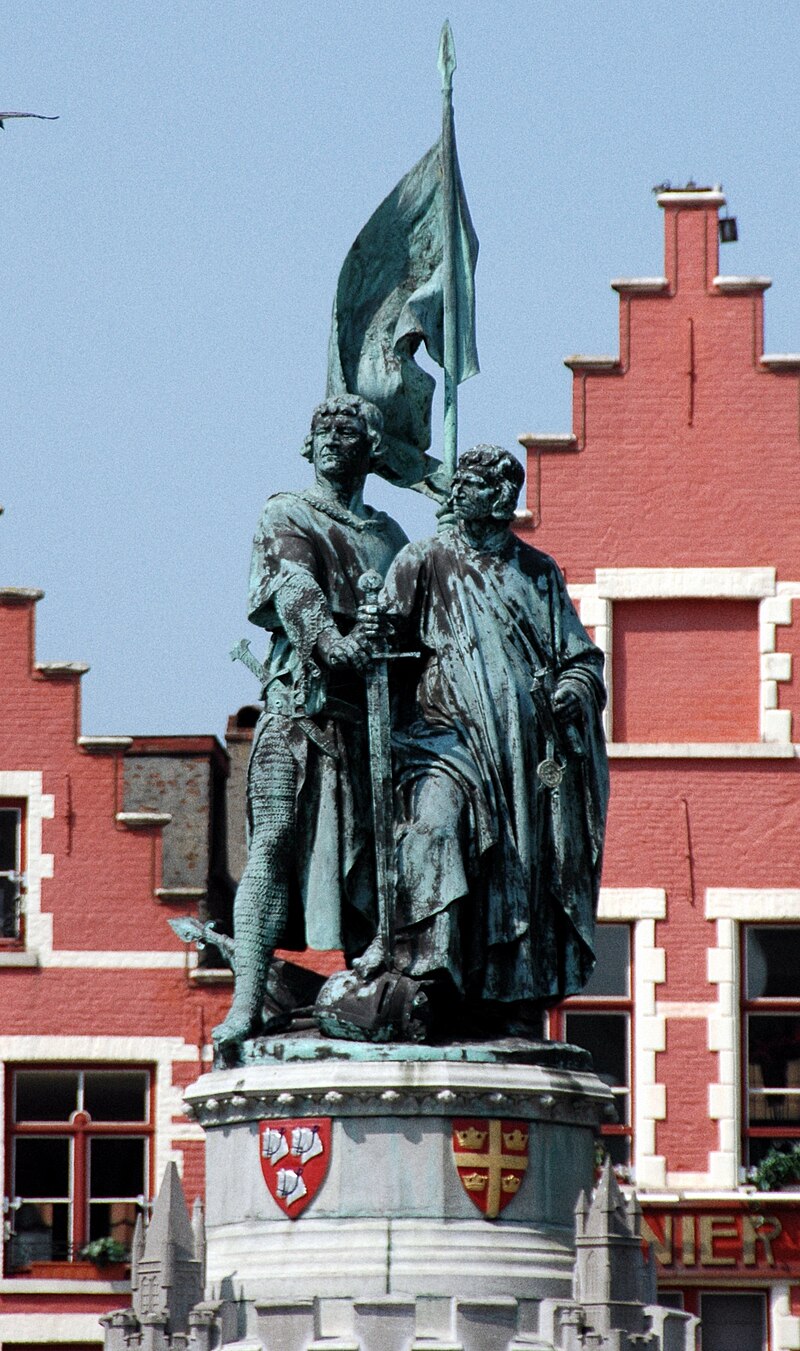
Since 1887, a statue of Breydel and Pieter de Coninck has stood in Bruges' Market Place. However, the heroic narrative surrounding Breydel has faced significant scholarly criticism. According to historian Lisa Demets, the historical perception of Jan Breydel as a leader of both the Bruges Matins and the Battle of the Golden Spurs is fundamentally flawed.
Demets states: "There isn't a single piece of evidence that Jan Breydel was the leader of the Bruges Matins or the Battle of the Golden Spurs. At that moment, there were three Jan Breydels. There were probably Breydels who fought in the army and they probably also delivered goods, given the fact they were originally butchers.
But the whole function as a leader was invented in the early 15th century." Demets argues that the contemporary heroic image of Breydel was fabricated by his family more than a century after the events. Sources mentioning a Jan Breydel after 1302 portrayed him negatively, describing him as an alcoholic and even a murderer. Around 1400, however, these characterizations suddenly shifted to depict him as a hero.
Demets suggests this transformation was likely an attempt by the Breydel family to enhance their political influence and consolidate their position in Bruges.