Ivan Susanin
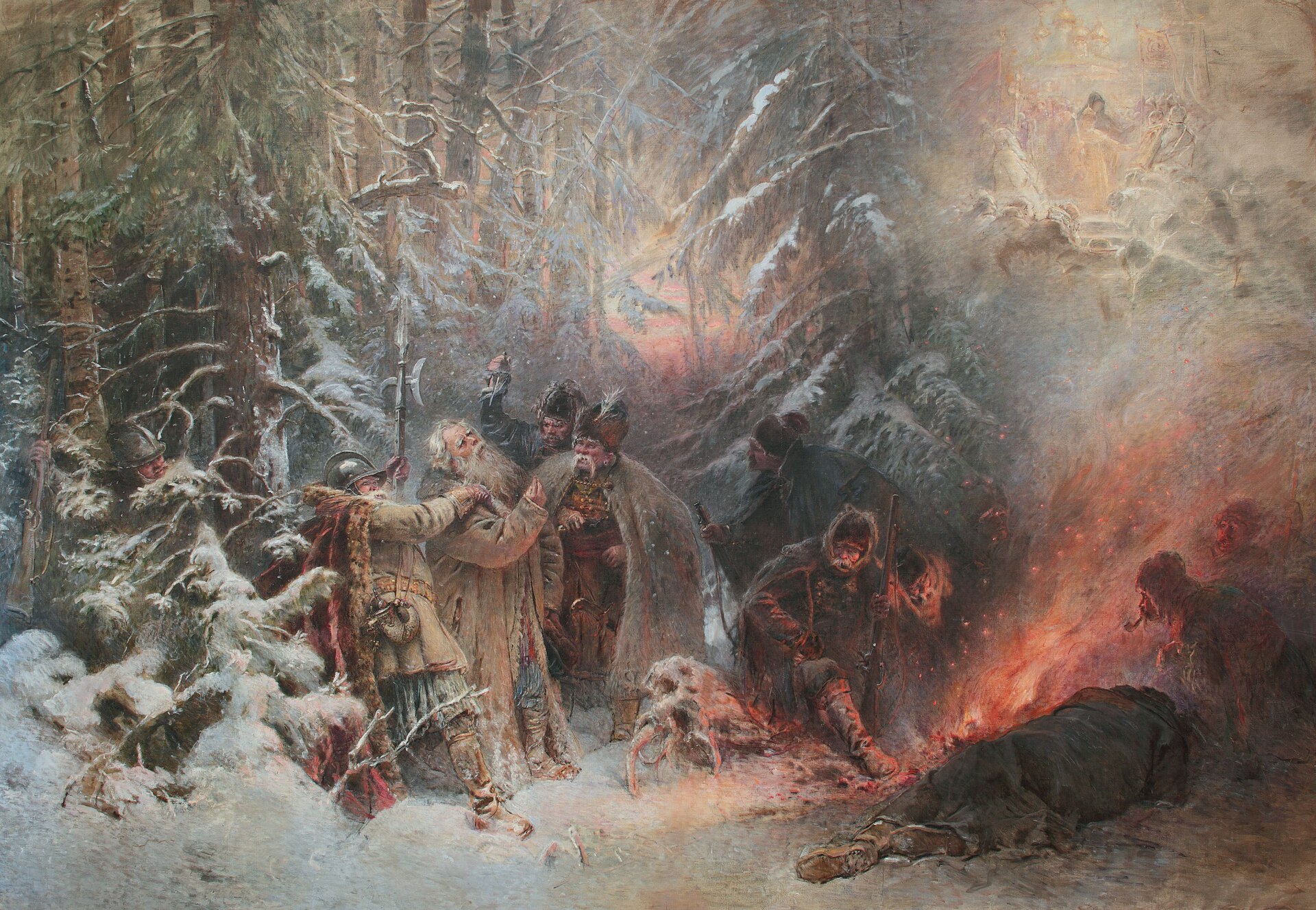
Ivan Susanin (Russian: Иван Сусанин, IPA: [ɪˈvan sʊˈsanʲɪn]; died 1613) was a Russian peasant who became a celebrated national hero and martyr in Russian historical consciousness and culture, particularly associated with the tumultuous early-seventeenth-century Time of Troubles (Smutnoye Vremya), the catastrophic period of political chaos, foreign invasion, social upheaval, dynastic extinction, famine, and civil war that brought Russia to the brink of complete collapse and disintegration before the election of Mikhail Romanov as Tsar in 1613 established the dynasty that would rule Russia until the 1917 Revolution. According to the popular legend that emerged after Susanin's death and was subsequently embellished, promoted by Russian nationalist writers and artists, and eventually elevated to quasi-official status in Russian imperial ideology, Polish-Lithuanian military forces seeking to capture or kill the newly elected Tsar Mikhail Romanov before he could consolidate his authority hired or coerced Susanin, a local peasant from the village of Domnino in Kostroma region, to serve as their guide through the unfamiliar Russian countryside and lead them to the monastery where the young tsar was sheltering. Susanin, demonstrating extraordinary loyalty to the nascent Romanov dynasty and sacrificial patriotism toward Russia, deliberately deceived the Polish soldiers by persuading them to follow what he claimed was a secret shortcut through the dense Russian forests that would bring them quickly to their target.
In reality, according to the legend, Susanin intentionally led the Polish detachment deep into the trackless wilderness, into impassable swamps and endless forest where they became hopelessly lost in the harsh Russian winter. After wandering for days in the freezing cold with their treacherous guide, the Polish soldiers eventually realized they had been deceived and betrayed. In their fury, they tortured and killed Susanin, who died without revealing the true location of the Tsar or the way out of the forest.
The Polish soldiers themselves subsequently perished in the wilderness from exposure, starvation, and the brutal Russian winter conditions, never emerging from the forests and swamps into which Susanin had deliberately led them. Thus, through his supreme sacrifice—knowingly accepting certain death through torture to save his sovereign and protect Russia from its enemies—Susanin prevented the assassination of Tsar Mikhail and helped secure the establishment of the Romanov dynasty that would rule Russia for over three centuries. This dramatic narrative of peasant loyalty, self-sacrifice, cunning resistance against foreign invaders, and martyrdom for Tsar and motherland proved extraordinarily powerful in Russian culture and was extensively promoted and celebrated through various media.
The story was immortalized in Russian literature, most famously in Mikhail Glinka's 1836 patriotic opera "A Life for the Tsar" (originally titled "Ivan Susanin"), which became one of the cornerstones of Russian national opera and was traditionally performed at important state occasions and imperial celebrations. The opera portrayed Susanin as the ideal Russian peasant—humble, deeply Orthodox Christian, instinctively loyal to legitimate authority, willing to sacrifice everything for Tsar and Holy Russia—embodying values that the Romanov autocracy wished to promote among the Russian population. However, the historical reality of Ivan Susanin and the actual events of 1613 remain significantly more uncertain and less heroically clear-cut than the legend suggests.
Contemporary documentation about Susanin is extremely limited, consisting primarily of land grants and privileges awarded by Tsar Mikhail to Susanin's descendants in recognition of their ancestor's service and sacrifice, which confirm that someone named Ivan Susanin did die in circumstances related to protecting the Tsar-elect but provide few specific details about exactly what occurred. Historians have questioned various aspects of the legendary narrative: whether Polish forces were actually seeking to kill Mikhail at that particular time; whether Susanin deliberately led them astray or was simply killed during a more conventional encounter; whether the entire story was substantially embellished or even largely invented by later generations seeking a founding myth for the Romanov dynasty that would emphasize the peasantry's supposedly innate loyalty to the Tsar; and whether what actually happened bears much resemblance to the dramatically satisfying tale of deliberate self-sacrifice that became canonical in Russian culture. Despite these historical uncertainties, Ivan Susanin's legend served powerful ideological functions in Russian imperial culture, providing a narrative that legitimized Romanov rule by portraying it as having been saved through the voluntary sacrifice of a humble Russian peasant, suggesting that the dynasty enjoyed the devoted loyalty of the common people rather than merely ruling through force and coercion.
The story also reinforced the paternalistic ideology of Russian autocracy, in which the Tsar was portrayed as the father of all Russians who deserved absolute loyalty and for whom any sacrifice, even life itself, was appropriate and praiseworthy. Additionally, the legend emphasized Russian resistance to foreign invasion and Russian cunning and resilience in defeating foreign enemies through intimate knowledge of the Russian land and willingness to endure suffering that foreign invaders could not match—themes that would be repeatedly invoked in Russian culture during subsequent conflicts including the Napoleonic invasion of 1812 and the Nazi invasion during World War II. The Susanin legend thus became a permanent fixture of Russian national mythology and historical consciousness, taught to schoolchildren, celebrated in art and literature, and invoked during patriotic commemorations, ensuring that Ivan Susanin—whether as historical figure or largely legendary creation—remains one of Russia's most recognized national heroes, representing the ideal of peasant loyalty, self-sacrificing patriotism, cunning resistance to foreign enemies, and devotion to Tsar and motherland that Russian state ideology has consistently promoted and celebrated across the centuries from the early Romanov period through the Russian Empire and even, with some modifications removing the pro-Tsarist elements, into Soviet-era patriotic narratives that retained Susanin as a symbol of Russian resistance to foreign invasion while reframing his sacrifice as being for the Russian people and motherland rather than for the Tsar personally.