Indrik
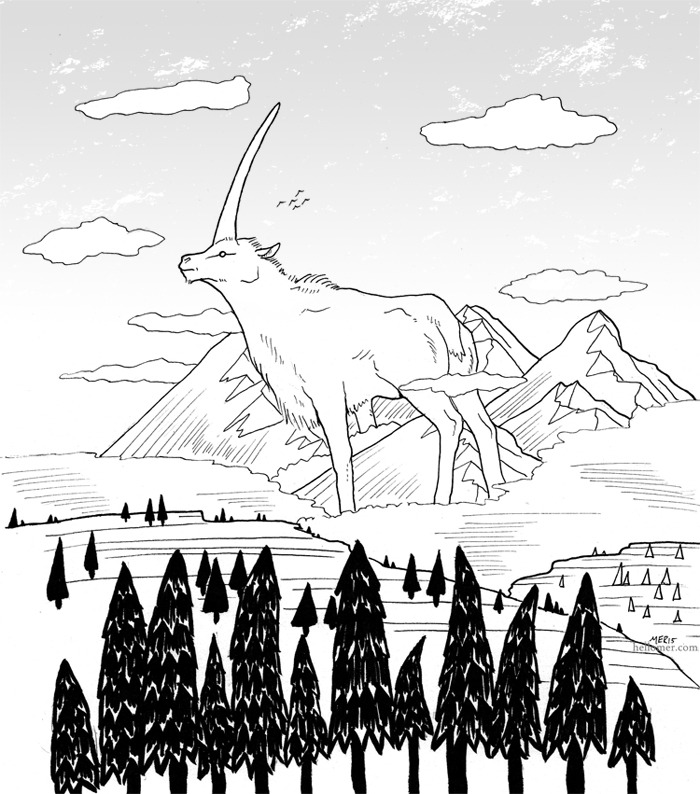
In the sacred traditions of the Dove Book (Golubinaya kniga) and Russian folklore, the Indrik (Russian: Индrik-зверь) was a formidable mythical creature revered as the "king of all animals." It was said to inhabit a forbidden realm known as the "Holy Mountain," a peak so secluded that no other living being was permitted to tread upon its slopes. The Indrik was viewed as a cosmic pillar of the natural world; according to legend, when the beast stirred or shifted its weight, the very foundations of the Earth would tremble, manifesting as earthquakes in the mortal realm.
The name "Indrik" is widely considered by linguists to be a phonetic distortion of the Russian word for unicorn, Yedinorog. Despite this etymological link, the creature's physical description deviates significantly from the slender equine unicorn of Western European tradition. Instead, the Indrik was envisioned as a massive, chimeric colossus.
It possessed the powerful body of a gigantic bull, the slender legs of a deer, and the head of a horse. Its most defining feature was an enormous horn situated on its snout, a characteristic that aligns it more closely with the rhinoceros or the Persian Karkadann than with a traditional horse-unicorn.
The myth of the Indrik eventually crossed from the realm of folklore into the world of paleontology. During the early 20th century, scientists named a genus of extinct, hornless rhinoceroses—the largest land mammals to ever walk the Earth—Indricotherium (now a synonym for Paraceratherium) in honor of the legendary Russian king of beasts. By linking the fossilized remains of these prehistoric giants to the Indrik, researchers acknowledged the creature's status as a symbol of immense physical power and primordial antiquity.
The legend remains a primary example of the "beast of burden" and "animal sovereign" motifs, personifying the raw, seismic energy of the natural world.