Hy-Brasil
Hy-Brasil is a legendary place from Rockall, Ireland, dated to ~1325 AD (Middle Ages). It connects to 1 other myth and legends in the Mythosjourney atlas.
Brasil (also known as Hy-Brasil or Uí Bhreasail) is a legendary phantom island traditionally believed to exist in the Atlantic Ocean, situated to the west of Ireland. In Irish mythology, the island is famously depicted as a hidden sanctuary perpetually cloaked in a dense shroud of mist, revealing itself to human eyes only once every seven years. Despite this periodic visibility, folk tradition maintains that the land remains physically unreachable to those who attempt to sail toward it.
The name is derived from the Irish Gaelic Uí Bhreasail, meaning "descendants of Breasal," reflecting its status as a primary fixture in the maritime folklore of the North Atlantic.
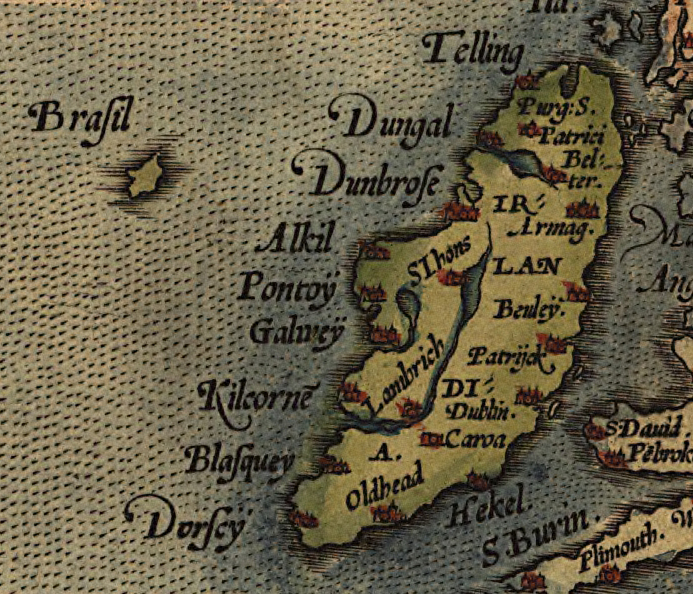
Historical cartography reflects a widespread and persistent belief in the island's existence, with Brasil appearing on nautical portolan charts under at least thirteen different spellings, including "Bracile," "Insula de Brasil," and "Illa de Brasil." Its first notable appearance was on a 1325 chart by Angelino Dulcert, and it was subsequently featured in prominent works like the 1375 Catalan Atlas and the 1436 Venetian map of Andrea Bianco. While some early maps placed the landmass as far south as the Antarctic or near the Arctic Circle, the majority of maritime records located it south-west of Galway Bay. Most cartographic depictions characterized Brasil as a perfectly circular landmass, frequently bisected by a central east-west river or strait that spanned its entire diameter.
In the 16th century, descriptions of the island became increasingly specific, with accounts citing dimensions of 12 leagues in length and 9 in width, located exactly 70 leagues from the Irish coast. As maritime exploration became more rigorous and failed to produce a physical landmass, the island's status on maps gradually diminished. By the 19th century, it was often relegated to a small maritime hazard known as "Brasil Rock" before being officially removed from nautical charts in 1865.
Modern geological research suggests that the legend of Brasil may have a basis in reality, potentially inspired by sightings of shallow-water geographical features such as the Porcupine Bank, the Yellow Ridge (Imaire Buidhe), or Rockall, which may have been exposed during prehistoric periods of lower sea levels.
Whether viewed as a persistent optical illusion caused by atmospheric refraction or a cultural memory of a sunken landmass, Brasil remains a central symbol of the "Otherworld" in Celtic tradition. It personifies the human fascination with the hidden and the unreachable, standing as a primary example of the "phantom island" motif that dominated European navigation for over five centuries. Its legacy persists not only in the annals of cartography but also in the name of the volcanic Monte Brasil in the Azores, serving as an enduring testament to the power of myth to shape our understanding of the physical world.