Hermocrates
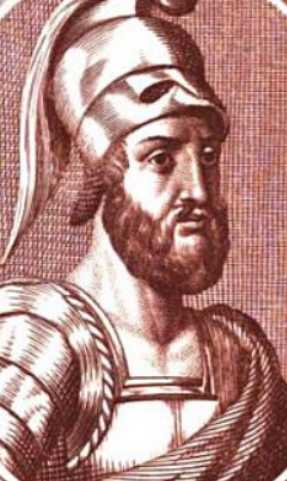
Hermocrates (Ancient Greek: Ἑρμοκράτης, Hermokrátēs, c. 5th century–407 BC) was a Syracusan general and statesman who played a pivotal role during the Athenian invasion of Sicily amid the Peloponnesian War. Beyond his military achievements, he appears as a character in Plato's philosophical dialogues Timaeus and Critias.
Hermocrates first enters the historical record through Thucydides' account of the Congress of Gela in 424 BC. There, he delivered a rousing speech urging the fractious Greek cities of Sicily to set aside their conflicts and present a united front against Athens, which had been launching attacks on Sicilian settlements for their support of Corinth. When Athens dispatched a massive expedition to conquer Sicily in 415 BC, Hermocrates immediately mobilized resistance.
He advocated for a broad anti-Athenian alliance and dispatched envoys to Sparta, Corinth, Carthage, and Italian cities seeking support. Despite his diplomatic efforts, the Athenians established a foothold at Catana and won an early victory against Syracuse at the Anapus River. Responding to the crisis, Hermocrates pushed for expanding Syracuse's fortifications and revolutionized the city's command structure, replacing the unwieldy traditional system of fifteen generals with a streamlined leadership of three.
He secured election as one of these three strategoi, serving alongside Heracleides and Sicanus. He also successfully persuaded the Athenian-aligned city of Camarina to adopt neutrality. However, battlefield setbacks led to his removal from the position of strategos.
His fortunes shifted when the Spartan general Gylippus arrived in Sicily. Hermocrates became one of Gylippus' most trusted advisers and commanded Syracusan forces in what proved to be a triumphant defense. Together, they orchestrated Athens' catastrophic defeat during the siege of Syracuse.
Following the victory, Hermocrates advocated for humane treatment of Athenian prisoners, though his counsel went unheeded. In 412 BC, Syracuse dispatched naval support to aid their Spartan allies against Athens in the eastern Aegean. Hermocrates commanded the Syracusan fleet as admiral, engaging in several minor clashes before suffering a crushing defeat at the Battle of Cyzicus.
The Spartan coalition was routed, and Hermocrates' political enemies in Syracuse seized the opportunity to exile him in absentia, holding him responsible for the disaster. While Hermocrates languished in exile, conflict erupted between the Sicilian city of Selinunte and its rival Segesta, which had Athenian sympathies. Unable to secure Athenian aid, Segesta turned to Carthage instead.
In 410 BC, the Carthaginian general Hannibal Mago invaded Sicily. Hermocrates assembled an army and mounted effective resistance against the Carthaginian forces. Back in Syracuse, however, political violence exploded between his supporters and opponents, the latter accusing him of harboring tyrannical ambitions.
Hermocrates was killed in street fighting in 407 BC. Hermocrates appears in Plato's dialogues Timaeus and Critias, and scholars believe Plato may have intended a third dialogue bearing Hermocrates' name, though it was never written. Classical scholar F.
M. Cornford observed the irony of Plato's choice: while the character Critias recounts how prehistoric Athens heroically repelled the invasion from Atlantis and saved Mediterranean peoples from subjugation, Hermocrates would be remembered by actual Athenians as the man who crushed their grandest imperial venture. Hermocrates is also referenced by Xenophon, Plutarch, and Polyaenus.
Additionally, he appears as a character in the ancient Greek novel Chaereas and Callirhoe by Chariton, where he is portrayed as the father of Callirhoe, one of the story's protagonists.