Goldhorn
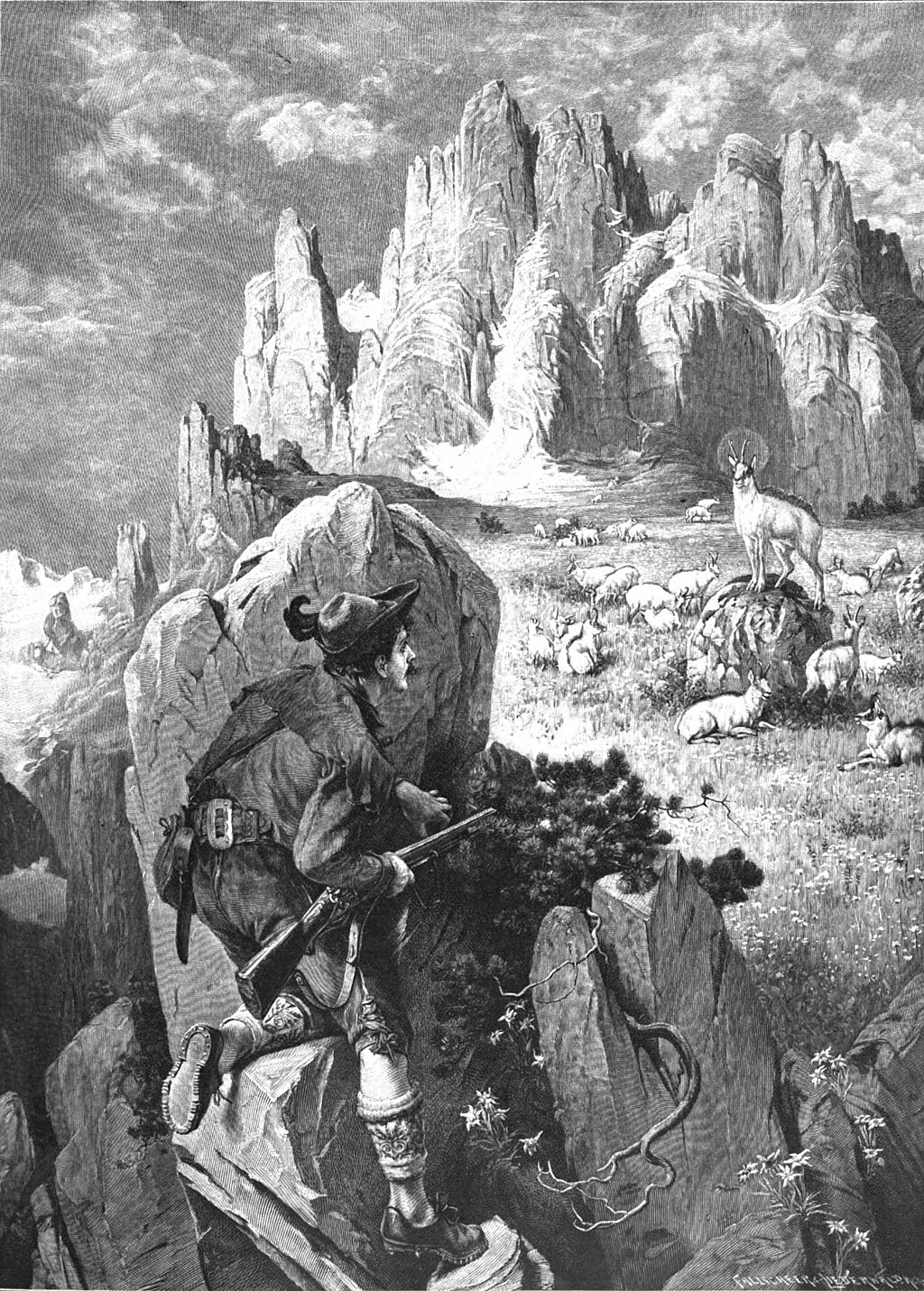
In Slovene folklore, Goldhorn or Goldenhorn (Slovene: Zlatorog) is a legendary white chamois buck, or alternatively an Alpine ibex, that ruled the heights of Mount Triglav, the highest mountain in Slovenia and the loftiest peak of the Julian Alps. This mythical creature, distinguished by its magnificent golden horns that gleamed in the mountain sunlight, has become one of the most iconic figures in Slovenian folklore and national symbolism. The legend is well known throughout Slovenia, particularly in Carinthia, as well as in Austrian Carinthia and Italian Friuli-Venezia Giulia, reflecting the shared Alpine culture of these border regions.
The story of Zlatorog was first recorded in written form by Karl Deschmann (Karel Dežman), who adapted the oral tradition to the late Romantic literary style prevalent in his era and published his version in the Laibacher Zeitung, no. 43, on February 21, 1868. This publication established the canonical version of the tale that would subsequently be retold in countless variations and became deeply embedded in Slovenian cultural consciousness.
According to the legend, Goldhorn's magnificent golden horns served as the key to a vast treasure hidden in the mountains surrounding Triglav. A young and brave hunter from the Trenta Valley fell deeply in love with a beautiful girl and successfully won her heart through simple but heartfelt gestures, bringing her beautiful wildflowers from the Alpine meadows. Their romance seemed idyllic until one day a wealthy merchant from Venice arrived in the valley and attempted to capture the girl's attention through ostentatious displays of wealth, giving her expensive golden jewelry and dancing with her at village celebrations.
When the hunter approached his beloved, expecting her loyalty, she cruelly mocked him, dazzled by the merchant's riches and sophisticated manners. The young hunter was devastated by this rejection and humiliation, and fled in despair. While the hunter wallowed in his misery and wounded pride, he encountered another hunter known as the Green Hunter—a sinister figure who, according to local warnings, had brought about the doom of several honest young men through his malicious counsel.
The Green Hunter persuaded the heartbroken youth that he could win back the girl's affection and prove his worth by hunting Goldhorn and claiming the legendary treasure guarded by the magical creature. Consumed by desperation and desire for revenge against his romantic rival, the young hunter agreed to this dangerous quest, and that very night the two set out into the treacherous high mountains. In the morning light, after hours of difficult climbing through perilous terrain, they finally located the magnificent white Goldhorn with its shimmering golden horns.
The young hunter shot the sacred animal, mortally wounding it, and the two hunters pursued the bleeding creature as it fled across the rocky heights. The dying Goldhorn dragged itself onto a narrow, treacherous rocky ledge where few humans dared to venture. As the young hunter carefully approached along this dangerous trail, he suddenly saw the most beautiful and magical healing flowers growing from the drops of Goldhorn's blood that had fallen onto the stone—the legendary Triglav flowers that possessed miraculous restorative powers.
The Green Hunter, recognizing the danger, urgently commanded the young man to move quickly and finish killing Goldhorn before the wounded animal could reach and consume these magic flowers. But the warning came too late. Goldhorn had already eaten one of the miraculous Triglav flowers, which instantly restored the creature to full vitality and granted it tremendous supernatural power.
Revitalized and enraged, Goldhorn turned and charged directly at the hunter who had wounded it. The young man, suddenly blinded by the overwhelming radiance and supernatural bliss emanating from the creature's golden horns, lost his balance on the narrow ledge and fell from the mountain, plummeting down the sheer rock face to his death. The river Soča far below carried his broken corpse down to the valley, where his body was discovered—a grim testament to the folly of greed, the dangers of forsaking one's honest nature for material gain, and the sacred inviolability of the mountain realm and its magical guardian.
The legend of Goldhorn has become deeply woven into Slovenian national identity, symbolizing the Alpine landscape, the dangers of greed and vanity, and the mystical power of Slovenia's mountains. The image of Goldhorn appears throughout Slovenian culture, from the name of Slovenia's highest literary award (the Golden Bird, a related symbol) to commercial brands, tourism marketing, and artistic representations, ensuring that this cautionary tale of a doomed hunter and a magical mountain guardian remains alive in contemporary Slovenian consciousness.