Gelert
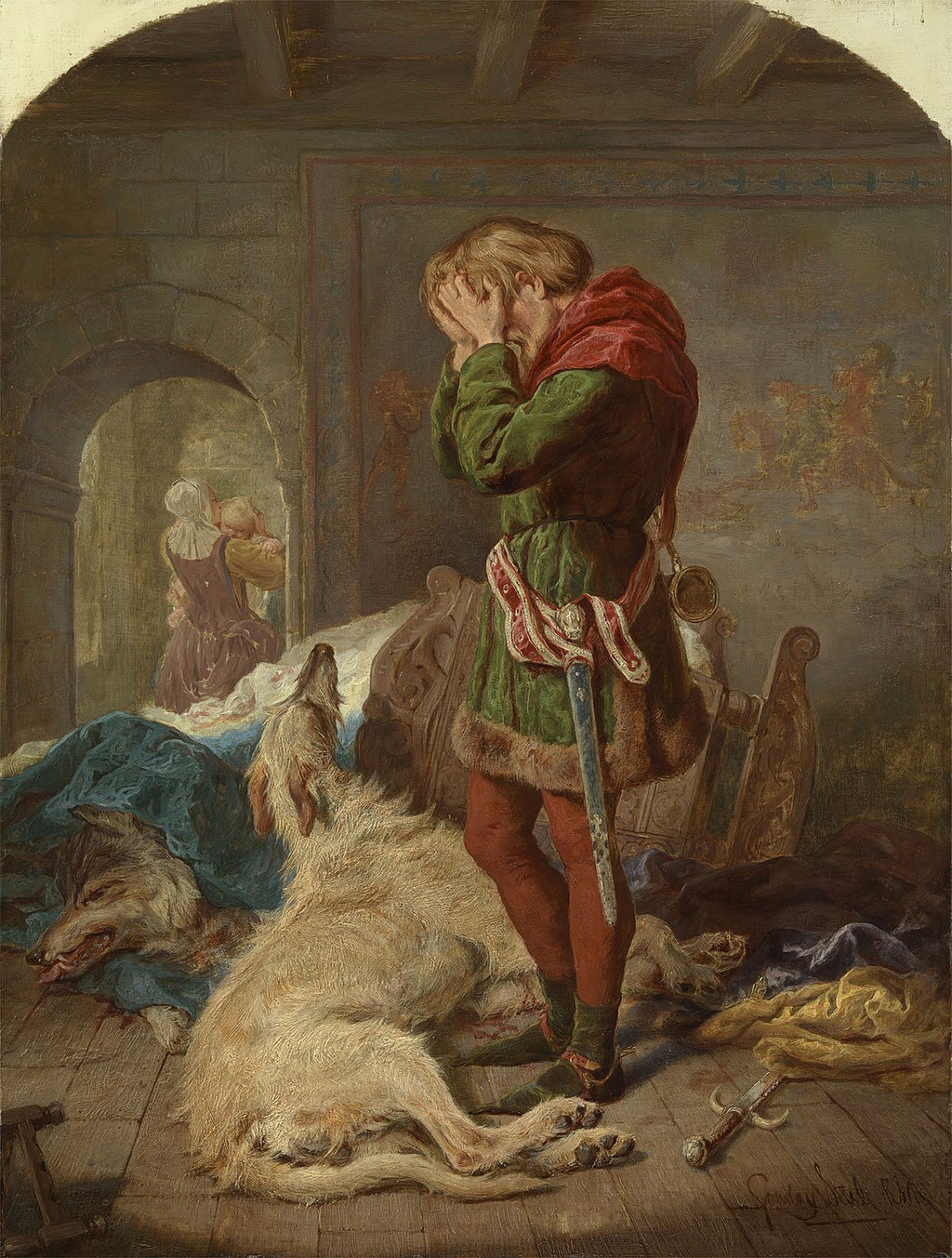
Gelert (Welsh pronunciation: [ˈɡɛlɛrt]) is a legendary hound from a Welsh folk tale, associated with the village of Beddgelert in Gwynedd, north-west Wales. The village name translates as “Gelert’s grave.” According to the legend, Llywelyn the Great returned from hunting to find his baby missing, the cradle overturned, and Gelert with blood around his mouth. Believing the dog had killed the child, Llywelyn struck Gelert down with his sword.
After the hound’s dying yelp, he heard the cries of his unharmed child and discovered a dead wolf nearby, killed by Gelert while defending the baby. Overcome with remorse, Llywelyn buried the dog with great ceremony, giving rise to the village’s name, and it is said that he never smiled again.
This poignant story inspired several English poems, including William Robert Spencer’s Beth Gêlert; or, the Grave of the Greyhound (c. 1800), Richard Henry Horne’s Beth Gelert, Francis Orray Ticknor’s Gelert, and Walter Richard Cassels’ dramatic poem Llewellyn. John Critchley Prince references Gelert in his poem North Wales, praising the hound’s bravery and loyalty. Despite these literary traditions and a raised mound in the village marking Gelert’s supposed grave, historians agree that the dog was likely fictional.
The legend was documented by George Borrow in Wild Wales (1862), included in Brewer’s Dictionary of Phrase and Fable, and referenced in The Nuttall Encyclopaedia under the Anglicised spellings “Gellert” and “Killhart.” John Fiske, in Myths and Myth-Makers, notes that Gelert’s story is deeply moving, comparing its emotional impact to other heroic legends. He observes that while the tale is widely told to visitors to Snowdon, similar stories appear in the folklore of nearly every Aryan culture.
Variants of the tale exist worldwide. In an Alpine Ligurian poem, a shepherd kills his dog after finding it covered in blood, only to later discover a dead wolf. In India, the roles are filled by a mongoose and a black snake. Egyptian versions involve a cook nearly killing a Wali over a smashed pot that contains a poisonous snake. In Malaysian folklore, a hunter kills his blood-covered tame bear, only to find it had slain a tiger threatening his daughter.
The story also appears in modern media. In Disney’s Lady and the Tramp (1955), Tramp is falsely accused of harming a child but is revealed to have saved the baby from a rat. Ballet adaptations of Gelert were produced by the London Children’s Ballet at the Peacock Theatre in 1996 and 2002. In 2002, The Return of Gelert, a short film by the Incredible Story Studios, depicted the ghost of Gelert haunting Beddgelert in the early 21st century.
It is now understood that the village name Beddgelert derives from a local saint, Kilart or Celert, rather than the legendary dog. The “grave” mound was created by David Prichard, landlord of the Goat Hotel in the late 18th century, who linked the story to the village to attract tourists. Two slate memorials mark the site, one in Welsh and one in English. The English inscription reads:
IN THE 13TH CENTURY, LLYWELYN, PRINCE OF NORTH WALES, HAD A PALACE AT BEDDGELERT. ONE DAY HE WENT HUNTING WITHOUT GELERT “THE FAITHFUL HOUND,” WHO WAS UNACCOUNTABLY ABSENT. ON LLYWELYN'S RETURN, THE TRUANT, STAINED AND SMEARED WITH BLOOD, JOYFULLY SPRANG TO MEET HIS MASTER.
THE PRINCE, ALARMED, HASTENED TO FIND HIS SON AND SAW THE INFANT'S COT EMPTY, THE BEDCLOTHES AND FLOOR COVERED WITH BLOOD. THE FRANTIC FATHER PLUNGED HIS SWORD INTO THE HOUND'S SIDE, THINKING IT HAD KILLED HIS HEIR. THE DOG'S DYING YELL WAS ANSWERED BY A CHILD'S CRY.
LLYWELYN SEARCHED AND DISCOVERED HIS BOY UNHARMED, BUT NEARBY LAY THE BODY OF A MIGHTY WOLF THAT GELERT HAD SLAIN. FILLED WITH REMORSE, THE PRINCE IS SAID NEVER TO HAVE SMILED AGAIN. HE BURIED GELERT HERE.
THE SPOT IS CALLED BEDDGELERT.