Eppelein von Gailingen
Eppelein von Gailingen, latinized as Apollonius von Gailingen (born c. 1315 in Illesheim, Middle Franconia; died 15 May 1381 in Neumarkt in der Oberpfalz), was a notorious German robber baron during the Middle Ages whose daring exploits transformed him into a legendary folk hero. Eppelein's exact birth date remains uncertain, with various sources placing it anywhere between 1300 and 1330.
Beginning in the 1360s, he preyed upon merchant caravans traveling to and from Nuremberg, one of the wealthiest trading cities in the Holy Roman Empire. In 1369, the Court of Nuremberg formally indicted him for his robberies and declared him under imperial ban, essentially outlawing him throughout the empire. When his castle was destroyed in 1372, Eppelein initially escaped but was soon betrayed and captured at Forchheim.
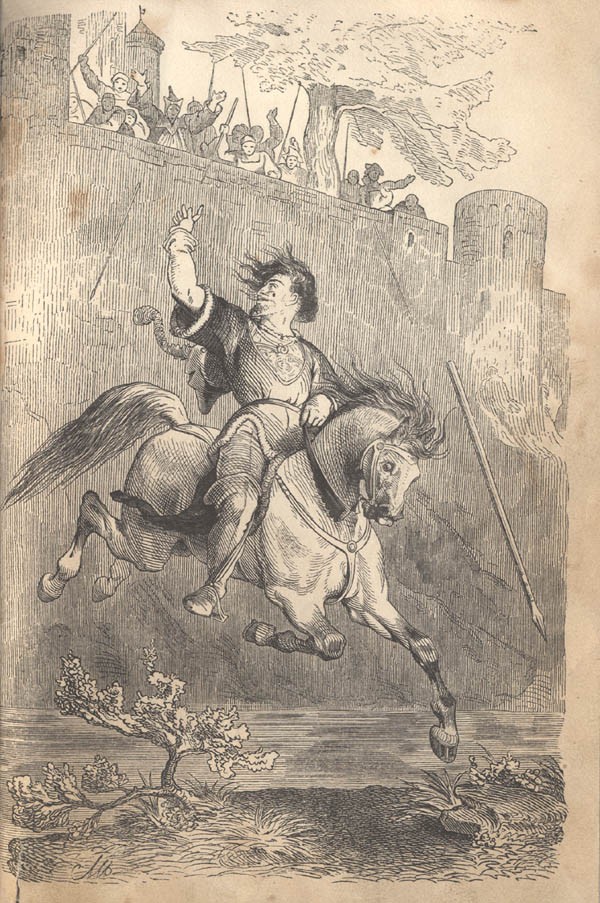
The Nuremberg authorities sentenced him to death by hanging. According to legend, when the day of execution arrived, Eppelein made a final request: to sit upon his horse one last time. Because the execution was scheduled to take place within Nuremberg Castle, the authorities granted this seemingly harmless wish.
Eppelein seized the opportunity brilliantly, spurring his mount into a gallop toward the castle wall and forcing the animal to leap over the ramparts into the moat below. During his flight from the city, he encountered a peasant traveling to witness the famous robber baron's execution, who asked whether he would arrive in time to see the hanging. Eppelein reportedly replied with memorable defiance: "The Nurembergians will hang nobody—if they hadn't him before!" ("Die Nürnberger hängen keinen – sie hätten ihn denn zuvor!"), suggesting that Nuremberg couldn't hang anyone they didn't already have in custody.
Eppelein's freedom proved temporary. In 1381, he and his men were apprehended during a drinking feast in Postbauer-Heng. This time there would be no escape.
He was executed by breaking wheel, a particularly brutal form of capital punishment. The dramatic leap from Nuremberg Castle's walls captured the public imagination. By the sixteenth century, folk songs celebrating Eppelein's exploits had emerged, gradually transforming the historical robber baron into a romanticized hero of popular culture.
This mythologization was reinforced by an architectural coincidence: approximately fifty years after Eppelein's legendary jump, the castle walls were demolished and rebuilt far more massively than before, making the purported feat seem even more spectacular in retrospect. Today, markings displayed on the castle wall are presented as evidence of the jump, though their authenticity is questionable given the subsequent reconstruction. Nevertheless, Eppelein von Gailingen endures in German folklore as the archetypal clever outlaw who outwitted authority through audacity and cunning, even if only temporarily.